


 Francais
 Deutsch
 Italiano
Refine Your Search
Greek-Civil-War stock footage and images
- Showing 5815 to 5820 of 27483 results more
more Hide
Hide
United States Army soldiers make artificial rocks that camouflage in rocky terrain during World War 2.
Camouflaged dummies and decoys in World War II. Realistic looking artificial rocks made by United States soldiers. Framework made of wire. Soldier lifts the framework from ground and places white paper on it. A group of soldiers paints the covered framework with natural mud color. The wired framework is removed from inside. Black paint sprayed on the imitation rock. Soldier removes cover from ditch on ground and emerges with a rifle in his hand. Soldier enters a camouflaged rocky area on ground. Tents covered with nets.
Montage of scenes during World War II on the Western front during January 1945
January, 1945, on the Western front during World War 2. Troops of the U.S. 8th Infantry Division test new white camouflage coveralls for use in snow. They patrol in snow covered forest areas on the Western Front. A sergeant makes outdoor field adjustments to the coveralls using a knife and captured German sewing machine. He helps a soldier who tries on his new coverall. The material used is from old mattress covers. Several soldiers are seen putting on the camouflage coveralls. Scene shifts to U.S. troops with a jeep towing a 20mm Italian dual purpose gun for use in Germany. On January 2, 1945, they set up and fire the gun at targets a half mile away. In Belgium, U.S. Army engineers of Company B, 238th Engineer Battalion, improvise remote controlled bazooka shells as road blocks. They set them up on fence posts and fire them by ordinary flashlight batteries. U.S. soldiers from a Signal Company of the 99th Infantry Division are seen using a Weasel vehicle (officially designated an M29C light cargo carrier) to lay communication cables through snow in the 1st Army Sector, Belgium. Views of the wire spool on back of the weasel, and soldiers pulling wire from it.
United States M-24 Chaffee tank compared to German tanks, during World War II.
United States M-24 Light Tank of the U.S. 9th Army fires at a target. Soldiers aboard tank. Narrator describes the M-24 to help distinguish it in appearance from German tanks, during World War 2. The torsion bar suspension of M-24 Light Tank and its 16 inch wide tracks. The 75 mm gun barrel of the tank. Side by side shot of M5A1 and the M-24 replacing it. Comparing ammunition placed on ground. Recognition features of M-24.
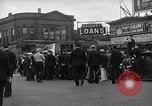
Leaders of an anti-war movement are put into a police patrol wagon in Chicago, Illinois.
An anti-war parade is dispersed in Chicago, Illinois. Police descend on an unauthorized demonstration by Whites and African Americans against conflict in Ethiopia. Leaders of the movement are put into a patrol wagon. One of the police officers is African American. A sign on a building in the background reads, 'Calumet Loans'
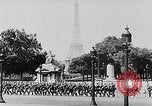
German troops occupy Paris in 1940, during World War II, and scenes from Bastille Day Parade in 1939
A contingent of German army troops marches loosely along road at Champ de Mars, during World War 2, as music of a fife and drum corps plays in the background. The Eiffel Tower looms in the mist. Some soldiers on bicycles bring up the rear. View shifts to the Champs Elysees, with Arc de Triomphe (Pl. Charles de Gaulle, 75008 Paris, France) dominating the empty street. German military cars move along one edge of the road. Camera moves closer to the Arch. Suddenly there is a flashback to the 1939 Bastille Day parade, in Paris, showing British Grenadier Guards in dress uniforms with bearskin hats, parading on the Champs Elysees, along with French colonial Tirailleurs Sénégalais (Senegalese Riflemen), French Sailors, and French infantry. Then, from a high point overlooking the parade, vehicles are seen pulling artillery along the Champs Elysees. Back at street level, French Renault UE Chenillette tankettes drive in the parade, followed by a formation of Panhard AMD armored cars. Film cuts back again to a year later (1940) with German occupation troops marching past the Arc de Triomphe. As the German troops pass, camera focuses briefly on German Field Marshal (Generalfeldmarschall) Fedor von Bock, Commander of Army Group B, reviewing the troops from the sidelines with another German general. View from Eiffel Tower of spectators and column of German troops below. Closeup of German officer on horseback, leading contingent of troops. Marshal von Bock, saluting. Closeups of parading troops. Aerial view looking down on the city of Paris, with Arc de Triomphe near center of the view. German artillerymen towing guns and caissons by means of horses. Ground views of the Arc de Triomphe, and Eiffel Tower. German troops riding on horse-drawn wagons, towing field artillery at the Place de la Concorde. The French Naval Ministry building (Hôtel de la Marine, 2 Pl. de la Concorde, 75008 Paris, France) seen behind them. More horses with troops, and artillery. Grim-faced Parisians watching from sidewalks. German sentries standing guard at the Hôtel des Invalides (Hôtel de la Marine, 2 Pl. de la Concorde, 75008 Paris, France), where the narrator notes, Napoleon is buried. French policemen talking with a German soldier, as they consult a map. German troops proceeding down the side of a commercial district street. Two French women smiling as they realize the camera is focused on them. Cheerful German soldiers marching informally, along a French countryside road, with a German marching chorus song heard singing in the background.
Allied forces attack German-occupied Ortona, and San Pietro in Italy during World War II
Opening scene shows British artillerymen bombarding the Italian town of Ortona, on the Adriatic coast of Italy, which is held by paratroops of the German 1st Parachute Division in World War 2. Closeups of British soldier operating 155mm gun. British officers planning the barrage. Battery of guns firing. View of shells striking Ortona, along the coastline. Heavy guns firing from under camouflage netting. Smoke rising from artillery strikes. Scene shifts to Allied occupied airfield in Foggia, on the coast, South of Ortona, where P-40 aircraft of the 99th Pursuit Squadron are preparing to fly in support of the Ortona offensive. (This U.S Army Air Forces unit is comprised entirely of African American pilots and support personnel including Tuskegee Airmen.) Closeups of airmen fueling and arming the aircraft, and of pilots gathered in a mission briefing. 99th Squadron aircraft taking off and departing overhead in formations. View from the British artillery position of numerous bombs bursting on Ortona. Film shifts to the Central Front in Italy where U.S. forces are engaged in the Battle of San Pietro. Views of American artillery bombarding German positions in San Pietro. Closeups of numerous U.S. guns being fired. An ejected shell flies through the air from a U.S. Sherman tank during the bombardment. Views of U.S. troops passing a Sherman tank as they enter San Pietro and begin searching for booby traps in the wreckage of the town. Closeup of a soldier dismantling a booby trap. German aircraft sweep overhead and bomb the town. American soldiers dig out a buddy who was buried by a bomb burst, but rescued unhurt. He smiles for the camera. Casualties of the fighting, including many civilians are carried on stretchers and assisted. Local residents are seen grieving over fallen relatives and friends. Groups of townspeople stand along a hillside and watch as Italian soldiers join with the Allies in the fighting. Jeeps are seen navigating the muddy mountain trails as far as possible. Then further movement requires the use of mules. Troops are seen with mule trains. Soldiers shoulder heavy ammunition crates and slog uphill with them over a muddy mountain trail.
CRITICALPAST.COM: About Us | Contact Us | FAQs - How to Order | License Agreement | My Account | My Lightboxes | Shopping Cart | Advanced Search | Featured Collections | Website Terms & Conditions | Privacy Policy ©2026 CriticalPast LLC.
License Agreement |
Terms & Conditions |
Privacy Policy
©2026 CriticalPast LLC.