


 Francais
 Deutsch
 Italiano
Refine Your Search
Guadalajara Mexico 1920 stock footage and images
- Showing 685 to 690 of 1233 results more
more Hide
Hide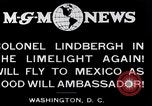
Aviator Charles Lindbergh with Speaker Longworth and Secretary of War for Aviation Trubee Davison in Washington DC.
Aviator Charles Lindbergh prepares to leave for Mexico. Lindbergh with Speaker Nicholas Longworth and other dignitaries after receiving the Congressional Medal of Honor. Lindbergh shakes hands with Longworth. He talks to Assistant Secretary of War for Aviation F Trubee Davison seated in the rear cockpit at Bolling Field. Lindbergh and an officer study the route to Mexico City.
U.S. Navy warships engaged in exercises and maneuvers to maintain readiness in 1940.
Film opens showing two U.S. Navy Colorado-class battleships leading two others in a line of U.S. Navy battleships underway in a harbor area. Glimpse of officers on bridge of a battleship. Prow of ship creating wake. Variety of U.S. warships engaged in tactical exercise maneuvers. Several views of Mahon-class destroyers leading the fleet seaward in battle order. At TC: 1:54, USS California (BB-44) is seen from port side while underway. Next, Curtiss SOC Seagull observation planes are launched from warships and fly over the fleet in flights of three each. New Mexico class battleship underway at TC: 02:20. The USS Tennessee (BB-43) is seen at TC: 2:25. Closeups of observation aircraft in flight with pilots visible. The USS Aylwin (DD-355) seen around 2:45, then the USS Farragut (DD-348), the USS Case (DD-370), and the USS Monaghan (DD-354). Sailors astern on a destroyer launch depth charges. Wickes-class 4-stack destroyers on the horizon dropping depth charges. Closeup of ashcan depth charges rolling off stern of destroyer. New Mexico class battleships maneuvering. (World War II period).
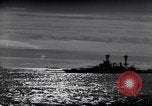
U.S. Navy Pacific Fleet maneuvers in Fleet Problem XIX, 1938
U.S. Pacific Fleet maneuvers including Colorado, New Mexico and Tennessee class battleships during Fleet Problem XIX. Several battleships underway in a line. Two battleships with various classes of heavy cruisers in the background. Lines of warships proceeding at sunset and in daylight. Four battleships and a heavy cruiser.The aircraft carriers, USS Lexington (CV-2) and USS Saratoga (CV-3), behind a line of U.S. warships. Several U.S. battleships headed by a Colorado class battleship. View of triple 14 inch guns on a New Mexico or Tennessee class battleship.
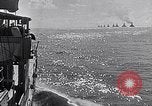
U.S. Navy fleet exercise and war game during 1925.
Line of U.S. battleships, including 1917 class (New Mexico class) such as the USS Idaho, USS Mississippi, USS New Mexico. Image of U.S. Capitol in Washington seen. U.S. Navy sailors parading in Washington, DC. Crowd gathered at Washington monument. Sailors on signal bridge of a U.S. warship, hoisting signals. Ships in distance. U.S. Navy sailors, aboard a destroyer, launching depth charges which explode and produce upsurge of water, behind the vessel. Sailors hurrying to their battle stations.
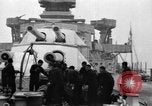
Montage of scenes involving U.S. Battleships in the World War I era
First scene shows foredeck and bridge of USS New York (BB-34) in World War 1. Second scene shows U.S. New Mexico-class Battleship underway. In the next scene, a sailor is signaling with a blinker from the bridge of a battleship ( Pennsylvania or New Mexico). Line of battleships in formation with the USS Texas (BB-35) leading. Quarterdeck view of U.S. Navy Pennsylvania-class battleship. View from deck of the battleship USS Texas or USS New York, looking forward. The final scene is a view from the quarterdeck of the battleship USS Pennsylvania (BB-38) looking out toward the SS George Washington (ID Number 3018) as they travel to France with President Woodrow Wilson on board in December 1918, for the Paris Peace Conference.
United States interests in South America and Latin America just before World War 2, and German presence in the Americas
Opening scene shows U.S. State Department officials of the Division of the American Republics in a meeting. They examine a map titled "Inter-American Highway" showing a proposed highway running from the border of the U.S. and Mexico at Laredo Texas, all the way through Mexico, Latin America, and into South America. View of South American farmers loading hay into a horse cart, then of cattle in a stockyard being herded by a cowboy on a horse. Aerial view of city of Rio de Janeiro Brazil circa 1938. Narrator discusses threat of dictatorships in countries of South America. Views of German ships and German contracted ships loading and unloading at Buenos Aires harbor. Narrator describes system of barter where Argentina sends goods to Germany in exchange for German-made goods. Swastika flag on one of the cargo ships. Dock crane with German sign "Deutsche Maschinenfabrik A.G. Duisburg". Letters on side of a ship reads 'Buenos Aires Maru'. Supplies unloaded from ship. Cargo stacked including wooden boxes with German writing labeled "Vorsicht - San Paulo Brasilien". In a Latin American or South American city, view of the storefront for luxury goods by Herm Stoltz & Co. A Nazi German flag hangs above the store entrance. Fine leather goods, cameras, figurines, steins, etc from Germany are shown in store window displays. View of Nazi German books on display in storefronts, including closeup of translated book "Mein Kampf" ("Mi Lucha") by Adolf Hitler, bearing an image of Hitler on front cover. A German passenger aircraft parked at an airfield, which narrator describes as being part of a German airline offering service to South America within two days of Berlin, Germany. More German airplanes are shown at an airport in South America. View of government offices in Rio de Janeiro Brazil. Large crest with a bird atop an entrance. Interior office view of President Getúlio Vargas of Brazil seated in discussion with American diplomats. Narrator indicates that Vargas learned of German colonists in Brazil planning his overthrow by assassination, and therefore outlawed all Nazi activity. Poster of Vargas communicating his policies. Scene switches to exterior view of the State, War, and Navy Building (later the Executive Office Building) in Washington DC, with the First Division Monument in the foreground. Interior view of office door bearing sign for Under Secretary of State. Inside, Sumner Welles is seen in discussion with officials. He is asked about the American attitude toward Latin America. Welles describes the importance of strengthening ties between the countries of the Americas. Under Secretary Welles states that the welfare of all of the countries in the region may depend on their continued solidarity.