


 Francais
 Deutsch
 Italiano
Refine Your Search
Guadalajara Mexico 1920 stock footage and images
- Showing 781 to 786 of 1233 results more
more Hide
Hide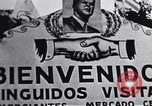
President John F Kennedy welcomed by people in Latin America.
To promote better relations with Latin America through his "Alliance For Progress," President and Mrs. Kennedy visited Puerto Rico, Mexico, Venezuela and Colombia. Starting at Puerto Rico,on December 15, 1961, a sign is seen bearing the President's image and reading 'Welcome" in Spanich. Next in a motorcade through a crowded street, a man stands in an open car throwing confetti, while President John F. Kennedy (JFK) follows in another open car, accompanied by Governor Munoz Marin of Puerto Rico. In change of scene (and country) on December 16th, JFK stands at a microphone in Venezuela, next to an interpreter making notes. He introduces his wife, as a Kennedy who doesn't need an interpreter, and asks her to say a few words. Mrs. Jacqueline Kennedy leaves her seat next to President Romulo Betancourt, and steps to the microphone, where she briefly addresses the gathering in Spanish. (Mrs. Betancourt occupies the seat next to JFK's empty one.) After Mrs. Kennedy's brief remarks, those in the gathering applaud, and President Kennedy appears delighted.
B-29 "Dave's Dream" returns to airfield in Marshall Islands after Test Able atomic bomb drop on Bikini Atoll
The B-29 "Dave's Dream" returns to airfield in Marshall Islands, after dropping atomic bomb on Bikini Atoll, in Test Able of Operation Crossroads, on July 1st, 1946, during U.S. nuclear testing. The B-29 lands and taxis to a parking place on the ramp. The area around the aircraft is cordoned off and the crew is confined therein as they deplane. Navy photographers take photos. An interviewer talks to crew members. The crew walks away from the aircraft along a cordoned pathway between numerous military personnel on hand to greet them on this historic occasion. The aircraft, number 44-27354, was actually participating in its second atomic mission. It also served as a photographic platform for the mission to Nagasaki on August 9, 1945, when it was named "Big Stink.". Pilot for the Bikini mission was Major Woodrow Swancutt of Wisconsin Rapids, WI. The aircraft was renamed "Dave's Dream" in honor of Captain David Semple, a bombardier killed during the crash of another B-29 on March 7, 1946, near Albuquerque, New Mexico. (World War II period).
Submarine tender with subs in Iceland. An Allied convoy underway in the Atlantic Ocean during World War II
Views of the Submarine tender USS Antaeus (AS-21) of Atlantic convoy, at anchor in Iceland, during World War 2, with about nine submarines tied up alongside. Scene shifts to a convoy underway in the Atlantic ocean. Various kinds of transport ships seen from time to time in the convoy. The U.S. New Mexico class battleship, USS Idaho (BB-42) passes to starboard of the camera ship. Scout planes are visible on her aft section. Scene shifts to camera ship, looking aft. A gun; a lifeboat on a davit; and a Curtiss SOC-1 scout-observation airplane are visible. A sailor watches as the USS Idaho passes to starboard. More transport ships are seen, low in the water. Camera pans aft, again, showing more of the camera ship, including covered guns in barbettes; two SOC-1 scout planes; the American flag; and behind that an anti-aircraft height finder. Scene shifts forward where officers are seen on upper deck with a gun barrel above their heads.Sailors on main deck prepare to deploy a float to recover a scout plane. Sailor stands on platform using semaphore flags to transmit a message. Barrel of a large gun in the foreground.View aft of a U.S. New Orleans class cruiser underway. Feet and legs of the semaphore signalman as he stands above the platform, on rungs of the circular railing at the signal station.
Plan for Peace, 1947. Public information film about U.S. Army Universal Military Training Project
Firing of a V-2 rocket from White Sands, New Mexico. An XP-84 jet aircraft on a test flight in California. Scenes of devastation in Hiroshima and Nagasaki. An atomic bomb test conducted in Bikini Atoll, Marshall Islands. Large smoke cloud rises. Americans expressing disgust with war and confidence in ability to protect against it in future. Newspaper headline about Armistice ending World War I on November 11, 1918. Victory parade in New York City. Close up view of Adolf Hitler as he speaks forcefully to a German audience. V2 rocket being launched in Germany. German Messerschmitt Me 163 Komet rocket plane in flight. Map depicting uranium deposits world wide. An XB-36 bomber in flight with landing gear extended. A huge formation of various warplanes in flight, high overhead. A wartime tank assembly plant. American army troops on parade. A United Nations meeting in session. Peaceful scenes of American soldiers in Hawaii before World War II in the Pacific. Hawaiian Hula dancers. Japanese carrier-based Aichi D3A1 dive bomber in flight during attack on Pearl Harbor, December 7, 1941. Bombed U.S. warships and facilities in Pearl Harbor. American Army officer and civilian discussing wisdom of maintaing large standing army. Army recruits are seen in the U.S. Army Universal Military Training Experimental Unit at Fort Knox, in 1947. They are seen in quarters, studying; taking part in sports (baseball); and attending religious services in a base chapel. Several trainees in a field tent, working with numerous tape decks in some kind of military communications activity.
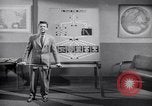
U.S. Army Public affairs film to explain idea of Universal Military Training (UMT) as a Plan for Peace, in 1947
The Universal Military Training Plan for Peace, 1947. A civilian spokesperson stands before a briefing chart entitled "Plan for Peace." He explains the concepts for the program, involving military training for young men immediately after they complete high school.He explains how young men would register and be screened, assigned, and trained under the program. Two college students discuss a requirement to join the Reserve Officer Training Corps (ROTC) under the program. Scene shifts to a U.S. Army officer talking with a civilian about the cost of World War 2. As scens of wartime military production are shown, Narrator interjects that "a full year of Universal Military Training will cost less than three days of war." Scene shifts to Separation Center, Fort Douglas, Utah. U.S. soldiers are seen mustering out. One holds his Honorable discharge certificate. View of marching German soldiers is inserted at this point. Contents of the U.S. Constitution are displayed in plain print, higlighting the part: "...provide for the common defense..." View of college students on a campus. Closeup of Dexter Gate at Harvard College, and three men walking through it into Harvard Yard. ROTC cadet talking with acquaintances about studying rockets. ROTC cadet talking with two middle aged men about unique sounds of airplanes. A B-17 bomber in flight. A C-119 (flying boxcar) aircraft in flight. A formation of B-17s viewed from above with clouds beneath. The XP-84 jet in flight. A V2 rocket being test fired at White Sands, New Mexico.
Bombardment at Satawan Atoll during invasion of Saipan, Mariana Islands in World War II.
View of sunrise during invasion of Saipan, Mariana Islands in World War 2.. Satawan Atoll under bombardment. Ships off the coast of Saipan including a New Mexico class battleship.