


 Francais
 Deutsch
 Italiano
Refine Your Search
Guadalajara Mexico 1920 stock footage and images
- Showing 805 to 810 of 1233 results more
more Hide
Hide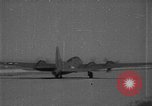
Test of a B-17 Flying Fortress drone, converted into BQ-7 missile, at Wendover Army Air Field, Utah
Test at Wendover Army Air Field, New Mexico, of a drone B-17 Flying Fortress converted into a remote-controlled bomb (designated BQ-7 missile). The B-17 drone sits with engines running. Interior of the aircraft shows technicians of the "Weary Willie Project" checking over radio controls. The B-17 drone takes off followed by a B-17 controller (mother ship). The two aircraft in flight. A ground tracking and control crew on the ground, follows the two B-17s in flight. Ten miles from the target, the drone BQ-7 missile is released from the mother ship B-17. Tracking and controlling the BQ-7 missile, using ascania camera. A hand controlled unit as an operator tracks it through the camera. A finger tip control box is used to control the B-17 (BQ-7 missile). It flies towards the target area along slope of a mountain. The target is approximately 30 feet square white area on the side of mountain slope. The BQ-7 missile crashes into the area, a large column of flame and smoke rises. (World War II period).
The launching and explosions of various test missiles in the United States.
A review of research and development in guided missiles by the United States Air Force from 1919 to 1948. Interior of a steel mill shows workers performing various duties around an open furnace. The exhaust section of a JB-2, flames erupting from the same. A JB-2 launching. It taxis in a wooded area. A large explosion. The exhaust section of V-2 during launching. Failed test as a V-2 rocket streaks down towards the earth after a launch and slams into a wooded area, with a huge explosion resulting. The first guided missile robot torpedo aircraft crashes at Arcadia, Florida. First successful launching of the U.S. aerial guided missile. Exhaust section of JB-2 starting operation attached to a wing of a B-17. The B-17 launching. JB-2 in flight. PQ-8 target aircraft dives towards the slope of a mountain and explodes. An atomic bomb explosion. Atomic cloud formation rises up in the air from the Trinity test, the first atomic explosion, in New Mexico.
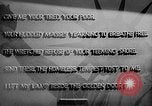
Montage of images chronicling the settlement and development of the United States of America over many years.
The last portion of Emma Lazarus’sonnet,"The New Colossus," is shown as engraved on a tablet inside the pedestal of the Statue of Liberty. Illustrations of immigrants arriving and felling trees to build dwellings in America. Reenactments of early English, Scottish, and Dutch settlers building houses and working at crafts in New England. Italian sulphur mine workers in Louisiana. Immigrants, from France and Switzerland, planting vineyards in California and New York State. Danes, Norwegians, and Swedes, sowing seed and cultivating crops in the Midwest. Polish and Welsh immigrants in American coal mines. African Americans harvesting cotton on farm fields in the United States south, including a woman picking cotton with her baby riding on her long collecting bag. A Spaniard on horseback in the Southwest. Mexicans working in Texas oil fields and on ranches of New Mexico. Greek and Portuguese fishermen with huge catches of fish. A German technician working with fine instruments. Hungarian and Russian immigrants working in steel mills. Irish, Slavs, and Chinese, building railroads. Closeup of lumberjack's axes and saws cutting trees. A forge and a blacksmith shoeing a horse with horseshoes. A woman at work with a spinning wheel. Railroad ties and rails being placed. An antique railroad workman's locomotive and car. Men installing telegraph wire on rough poles. A early historic railroad 0-4-0 steam locomotive (appears to be one of the few replicas of "The Atlantic" which had been built in the 1830s) pulling a single small passenger train car. Cowboys on horseback rounding up steers. Herds of cattle,sheep, and pigs, bound to market. Farmers tilling soil with horse-drawn cultivators, preparing tobacco leaves for drying, and loading cotton bales. Machines spinning thread in a textile mill or factory. Fabric weaving machines at work. An early steam boat underway in a river. Early model automobile driving on dirt road. Wright Brothers' Wright Flyer airplane in flight with several persons on board. Early tractors and harvester machinery working on a farm. Glimpses of American industrial plants and transportation in rapid succession (some of it showing building of Hoover Dam and building of the Chrysler Building in New York City). Oil well drilling and a "gusher" oil well spouting oil upward. Steel mills, locomotive trains, and then a scientist in a laboratory working with beakers and a solution. Dynamite charges blasting away sides of mountains and gorges, and scenes of dam construction and dams opening to allow water gushing. Large electrical control levers being thrown to run electricity, and scenes of electric transmission towers and facilities. Natural gas storage areas. Golden Gate bridge under construction and high rise skyscraper buildings being constructed, including the Chrysler Building circa 1930 while still under construction in New York City. Aerial view of New York City. Camera panning over the gravestones in Arlington National Cemetery.
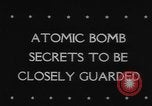
Y-12 atomic production facility; Trinity Shot atomic text explosion in the United States; Truman speaks about atomic secrets.
Atomic bomb production and its use in the United States. Doctor Ernest O. Lawrence experiments with the cyclotron at the University of California, Berkeley. View of the exterior and interior of the cyclotron. An animated diagram shows the results of the splitting of the uranium atom. Diagram shows a nucleus, electrons and protons. Atomic structures of Helium, Lithium and Uranium. A diagram of the creation of barium and krypton, and the release of atomic energy. Aerial and ground views of Y-12 atomic energy testing, uranium enrichment, and manufacturing plant at Oak Ridge, Tennessee created during Manhattan Project. Workers walking on the grounds of the the plant. The Trinity Shot first atomic explosion is shown near Los Alamos, New Mexico on July 16, 1945. Flash of explosion and a cloud of smoke rises as seen from U.S. Army cameras 6 miles away. Two other views of the explosion are seen from other camera positions while narrator explains the effects. U.S. President Harry S. Truman speaks of the need to keep the secrets of the atomic bomb among the U.S., the U.K, and Canada, alone, until they find successful techniques to control the bomb and protect the world from total destruction. He indicates that he will work the the U.S. Congress in the effort and make the power a force for world peace. Truman asks that God guide the U.S. in how to use the technology in His ways and for His purposes. (World War II period).
Protective measures taken by Americans in Hawaii, after the Japanese attack on Pearl Harbor.
Aftermath of Pearl Harbor attack. People in Oahu, Hawaii, prepare to deal with more air attacks by Japanese. Armed U.S. soldier in sandbagged position, in Hawaii. The territorial governor of Hawaii, Joseph Poindexter, signing a declaration of Martial Law. Four thousand members of Oahu's Civil Defense Committee, dressed in dark bottoms and white tops, wearing steel helmets with "W" on them, standing at attention in formation on grounds of a stadium. Windows in all downtown shops taped to prevent flying glass. Sand bags surrounding a power substation. Huge quantities of barbed wire in a storage yard and strung along the beaches, along highways, around schools, and public buildings of Oahu. A man pushing a lawn mower between sandbagged defense positions in a residential neighborhood. Construction machinery digging defensive trenches. Bomb shelters being constructed of precast concrete. Air raid sirens installed and school children leaving their building and sheltering in deep trenches during a test. Very small children taking shelter in zig-zag trenches and donning gas masks. Huge assemblies of children, and of grownups, all donning gas masks. Little children being dressed in capsule-like "bunny mask" protective gear.One of them crying inside the covering. Crowds of women and children lined up on a veranda waiting to receive these "bunny masks." Military personnel, civilians, and school children, all carrying personal gas masks with them at all times. Innumerable old rubber tires saved in an open yard. Japanese-Americans donating blood to the American Red Cross and lined up to buy war bonds. Soldiers arresting a Japanese resident known to be an enemy agent. Boarded up shops of Japanese-Americans, who had been interned. Japanese-Americans removing all Japanese language signs from their areas. Language school buildings with closed signs. An empty and boarded-up Shinto temple. One Japanese-American replacing his cafe sign with one reading: "Keep 'Em Flying Cafe." U.S. Army troops posted on roadways. The Aloha Tower in camouflage paint. A Lurline steamship leaving port, and being replaced by warships. Prewar view of people enjoying Waikakee beach, and current view of two boys playing in sand near barbed wire barriers. City streets deserted at twilight, as blackout procedures take effect at dusk. Views of darkened homes and palm trees silhouetted against sky at dusk. The "ghost" of a sailor killed in World War II, stands in front of Arlington cemetery, Washington, DC, and converses with the ghost of a soldier killed in World War I. They discuss idealistic notions about ending wars for good. Displays of flags is seen, including: Australia; Belgium; Brazil; Canada; China; Costa Rica; Cuba; Czechoslovakia; Dominican Republic; England; Ethopia; Greece; Guatemala; Haiti; Honduras; India; Yugoslavia; Luxembourg; Mexico; The Netherlands; New Zealand; Nicaragua; Norway; Panama; The Philippines; Poland; Russia; El Salvador; South Africa; and the U.S.A. "V" created in the sky by a skywriting airplane.
An oil pumping station which serves important fields and a map shows important oil pipe line systems in the United States.
Pumping and transportation of crude oil in the United States. A political map of the U.S. shows oil pipe line systems which are used to transport crude petroleum. The map shows main trunk pipe line systems including a new line under construction from Wyoming, connecting with the Great Lakes and the Gulf of Mexico. A pumping station which serves important fields in Texas, Oklahoma, Kansas and Wyoming with its chief terminals at East Chicago, Houston, Texas and Salt Creek, Wyoming. Internal combustion engines and machinery at the pumping station.