


 Francais
 Deutsch
 Italiano
Refine Your Search
Guadalajara Mexico 1920 stock footage and images
- Showing 991 to 996 of 1233 results more
more Hide
Hide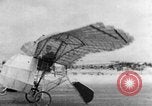
Ornithopter aircraft of various designs demonstrated including Gustav Lilienthal's large ornithopter.
Several attempts to fly ornithopters, intended to fly by flapping of wings. They manage to move their wings but fail in attempts to fly. The largest of them might be Gustav Lilienthal's large ornithopter, which was demonstrated in Germany and had a 3 horse power motor.
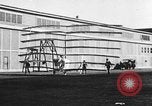
Men attempt to fly a 7-wing airplane contraption.
History of early flight and historic early attempts in aviation. Men run beside a seven-winged airplane as it begins to move in front of a hangar building. The aircraft collapses into pieces on the ground. before attaining speed.
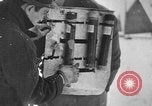
Attempted use of rockets to propel an ice skater
Three rockets are adjusted on a metal holder fastened to the back of an ice skater. View of rocket ignition control fastened on skater's belt. He presses button to close battery circuit and ignite rockets. He leans forward and starts to be propelled by the rockets. But the skater loses his balance in the humorous stunt and falls on the ice, with the rockets still firing.
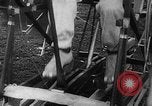
Attempts to fly a human-powered airplane or vintage flying machine
Early attempts of aviation. Views of a man using bicycle-type pedals to power an airplane. View of the machine atop a launching ramp. Two men assist as the operator pedals and the machine moves down the ramp. The would-be airplane simply falls off the end of the ramp onto the ground. The attempt is repeated with the same results.
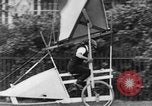
Early and historic flight: Attempts to fly ornithopters, including Gustav Lilienthal's large ornithopter.
Scenes of vintage, historic, early aviation flight attempts: Men at controls of several unsuccessful ornithopter aircraft, intended to fly by flapping wings. One man rides a bicycle equipped with wings that he flaps using sticks by his handle bars. Another sits in a tub-like machine with tricycle wheels, as it "flaps" its wings. In a third scene, men assist as operator moves very large wings on a machine. Although the wings move, the machine doesn't. This large machine might be Gustav Lilienthal's ornithopter. It had a 3 horse-power motor. Location might be Berlin's Tempelhof Airport, around 1927
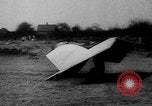
Man attaches wings to his body in unsuccessful attempt to fly
A man, "wearing" large fabricated wings and a tail, walks along the ground. He mounts a large rock and jumps off in an attempt to fly, but simply falls on the ground.