


 Francais
 Deutsch
 Italiano
Refine Your Search
Guadalajara Mexico 1920 stock footage and images
- Showing 49 to 54 of 1233 results more
more Hide
Hide
U.S. Labor strife - strikes and lockouts in the clothing industry in the 1920s
Post-World War 1 United States marked by labor-management strife and strikes, especially in the garment industry. Clothing workers are seen busy at their jobs in a factory in New York City. A man is seen symbolically closing and locking a steel door (narrative refers to a company "lockout.") Footage of police officers and crowd of laborers on New York City street. Police try to maintain order as crowds fill garment district streets in protest. Montage of persons awaiting a June 1921 decision by the Supreme Court of the State of New York, Kings County. Narrator announces that Justice James C. Van Siclen, has granted an injunction (against all picketing by the Amalgamated Clothing Workers of America). Narrator quotes Van Siclen's opening statement in the decision: "The court must stand at all times as the representative of capital, of the captains of industry..." View of Sidney Hillman, leader of the Amalgamated union (ACWA) sitting with other union members. View of a bustling New York City street lined with tenements and pushcarts in the lower east side of Manhattan. A man washing his face at a sink. A woman preparing a meal over a stove. Four children sharing a large bed. A gathering of idled clothing workers in a school room setting. Some in art classes. Dancers entertaining locked out workers. Young people presenting a puppet show. Narrator states that the lockout lasted 6 months, but the union prevailed. View of pleased union members.
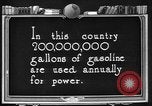
Busy city street with 1920's era automobiles; also Kerosene and by-products obtained from distillation of crude petroleum in US
Slate indicates that 200 million gallons of gasoline are used annually in the United States for power (in 1925). View of a busy city street, possibly New York City, circa 1925 with motor vehicle traffic, pedestrians and many tall buildings. Many early automobiles seen. A worker tests flash point of kerosene. Lighted candle in stuck block of paraffin (wax) showing wax or parrafin as a byproduct of petroleum. Slate indicates that petroleum provides motor fuel, common light, a lubricant for machinery and other important by-products.
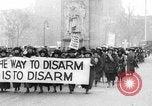
Women pacifists march in New York parade demanding complete disarmament, during anti-war movement of early 1920s
Scenes from a November 12, 1921 protest parade of anti-war women march to support disarmament and promote messages of peace and "No more war". The parade coincided with the start of the Washington Naval Conference, also called the Washington Disarmament Conference. Women march in New York City, under the Washington Square Arch, with a banner that reads "The way to disarm is to disarm." A banner for "Religious Society of Friends" (Quakers). People march holding placards demanding complete military disarmament. A placard reads "Thou shalt not kill" and another reads "War means death famine pestilence." Another sign reads, "Cooperation pays better than competition. Let's try it between nations." A banner reads "Mothers do you teach your sons to save life or to kill?". View changes to parade as it continues on 5th Avenue in Manhattan, New York City. Large banner includes "Immediate, Universal, complete disarmament". Scene changes to Washington DC, several months later, on July 29, 1922. A group of pacifist women in Washington DC in front of their "No more war' banner. Women hang "no more war" signs on a artillery piece that is on display in a public square. Group of women raise their banner for "No more war" in front of the Headquarters of the Council for Limitation of Armaments, located at the National League of Women Voters headquarters building, at 532 17th St., NW, Washington, DC. (The Friends Disarmament Council of the Society of Friends was involved in this group, which was predecessor of the National Council for Prevention of War in the United States.)

Montage of scenes, in random order, involving U. S President and Congress, and Navy aircraft carriers. Covers 1920s through 1930s prior to U.S. involvement in World War II
Opening slate reads: "U.S. Seeks Neutrality."Glimpse of the U.S. Capitol building. Speaker of the House of Representatives, William Bankhead, gavels the assembly to order. President Franklin D. Roosevelt in his office signs the Neutrality Act, or Senate Joint Resolution No. 173, on August 31, 1935. Afterwards he chats with Senators who attended his signing. Among those seen in closeup are James F Byrnes, John Nance Garner, and John H. Bankhead II. The Senators shake hands with the President as they leave. Scene changes to German aircraft in flight including Messersmitt Bf 109s and Dornier 17 bombers. A crowd, including civilians and military personnel, stand about the site of a crashed airplane, in Europe. View shifts to U.S. Navy warships at sea. View from one of the Aircraft Carrier, USS Lexington (CV-2) where a Boeing F2B bi-wing fighter airplane is landing on her deck. Closeup of the plane landing on Lexington's flight deck and sailors rushing to arrest and control it. Somewhat fuzzy view of a ship sinking in rough waters. Clear view of an injured sailor in a ship's infirmary. Rescued sailors eating on deck of the rescue ship. One of the sinking victims covered by an American flag, is buried at sea. View of a burning ship.
U.S. Air Service promotional activities during the 1920s.
1924: A crowd gathered at Boston Harbor to welcome the first 'Round the world flyers. Dignitaries seated. Air Service Douglas World Cruiser biwing float planes land in the harbor. United States Army Air Service flyers, led by Lieutenant Lowell Smith, arrive in boat at harbor. The six intrepid Lieutenants: Harding, Nelson, L.P. Arnold, Wade, Ogden and Smith, pose with General Patrick, Chief of the Air Service , along with several young women. View of the Barling Bomber at Wright Field in Ohio. Crew members: Lieutenants Harris and Muir Fairchild together with designer Walter Barling and engineer Culver, pose together and then climb aboard the airplane. The aircraft commander stands in open cockpit and orders flight engineer to start the 6 Liberty engines. The Barling Bomber taxis out and takes off. Commander waves from open front cockpit as aircraft climbs after takeoff. Views of the Barling Bomber in flight. President Calvin Coolidge stands, awaiting the arrival of the Pan American Goodwill flyers, at Bolling Field, Washington, DC. Crew of the Loening OA-1A amphibian, "New York": Major Herbert Dargue, and Lieutenant Ennis Whitehead, are greeted as they climb down from their aircraft. President Coolidge, presents all of the flyers with Distinguished Service Cross Certificates.
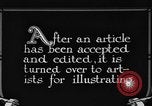
Making of a modern magazine in 1920s printing plant.
Making of a modern magazine Dearborn Independent. Accepted and edited articles are turned over to artists for illustrating. Artists paint illustrations. Workers operate keyboarding machines. Casting machinery in operation. Workers at machines. Workers arrange proofs. Women read proof. Worker places proof plate on printing press. He removes wax mold. Worker places mold into solution. Worker rinses mold, removes copper shell. Worker pours molten lead into back of copper shell.