


 Francais
 Deutsch
 Italiano
Refine Your Search
Helena Montana 1897 stock footage and images
- Showing 109 to 114 of 174 results more
more Hide
Hide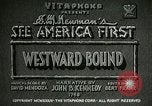
Scenes from 1934 film about westward expansion of United States in last quarter of 19th Century.
Scenes from a 1934 film documentary on the westward expansion of the United States in the 19th Century. The Marias River flows through the mountains in Montana. Goats and bears in the forest area of Camp Disappointment, the northernmost campsite of the Lewis and Clark Expedition. View of the Camp Disappointment monument erected by the Great Northern Railroad to commemorate Lewis and Clark. Engraved stone reads 'Farthest Point West on Captain Lewis trip up Marias River'. Car drives into portico of the Peace Arch situated near the westernmost point of the Canada–United States border between the communities of Blaine, Washington and Surrey, British Columbia. 'Children of a Common Mother' written on top of a monument. Engraved picture shows Lewis and Clark pointing towards land with boats next to them. View of the Columbia River flowing between mountains and a bridge. Aerial view of city of Portland. Steamer leaves harbor of Portland.

U.S. 65th Congress opening its First Session in Washington DC; women's suffrage leaders gather.
Glimpse of the U.S. Capitol dome. Members of Congress and associated staff and other persons are seen gathering in front of the U.S. Capitol in Washington, DC , on April 2, 1917, for the first session of the 65th U.S. Congress of the United States (following a special session in March). Many people sit on the steps and others gather in clusters. Scene shifts to Jeannette Rankin, Republican representative from Montana, and the first woman elected to Congress. She and a man are trying to unfold a large American flag before the camera. Soon two more men help and they hold the flag spread out as Representative Rankin poses in front of it. Next, James Beauchamp "Champ" Clark, Democratic representative from Missouri (who would be elected Speaker of the House) shakes hands with James Robert Mann, Republican representative from Illinois, who served as House Minority Leader from 1911-1919. Elsewhere in Washington, Jeannette Rankin stands with suffragist Carrie Catt (sometimes also called a suffragette), in the back of an open car in front of the Washington D.C. headquarters of the National Woman's Suffrage Association. Rankin holds a bouquet of flowers. An American flag is displayed nearby. Next the car is seen pulling away, causing Rankin to fall back and sit, from where she was standing, in the back seat. Two more cars full of women follow. A cordon of police officers begins to move a crowd back, and two mounted policemen direct people away from the Capitol buildings. (Note: In this first session of the 65th Congress, on April 2, 1917, President Woodrow Wilson asked Congress to declare war on Germany.)
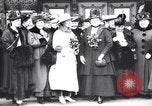
America's first elected woman member of Congress, Jeannette Rankin, in Chicago with women suffragists in 1917
Jeannette Rankin, Republican member of Congress from Montana, and first woman representative elected in the United States, is seen standing with women's suffrage movement activists in Chicago, Illinois, just before America's entry into World War 1. The leading slate mentions her forthcoming participation in a special session of Congress (referring to the Joint Session of Congress on April 2, when President Wilson will ask for a declaration of war against Germany). Rankin holds a bouquet of flowers and stands with another woman wearing a large corsage of flowers. A dozen women suffragists stand behind them (also sometimes called suffragettes). The building behind seems to be a hotel, containing several mirrored doors. Several men passersby walk past the camera while it photographing the group. Jeannette Rankin moves forward and another woman helps her to step into a vehicle (unseen).
Convicted crew of Italian freighter Colorado arrives New York.
Saboteur Captain Ettore Giugni and the crew of Italian tanker ship Colorado arrives at New York Harbor by ship. People gather to see the convicted Italian crew, after the ship's lengthy detainment in Puerto Rico, had been found guilty of intentionally damaging the ships' main engine, auxiliaries, and boilers to prevent its possibly use by American forces in World War 2. All were to be taken to prison camp in Montana. The crew are seen on a bus of the Flying Eagle bus lines.
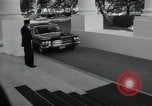
Political leaders arrive at the White House, including Senators Dirksen, Fulbright, Mansfield, and Humphrey
Limousine pulls up to White House, in Washington, DC, and Senate Minority leader, Everett Dirksen steps out. and enters the White House. U.S. Secretary of Labor, William Willard Wirtz, follows a companion out of a car and walks into the White House.They are greeted at the door by Senator J. William Fullbright, of Arkansas. Senate Majority leader, Mike Mansfield, of Montana arrives. U.S. Senate Democratic Whip Hubert Horatio Humphrey also enters the White House
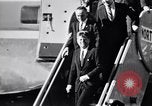
President John F Kennedy steps down from Air Force One plane at an American airport and greets people. Various crowd scenes with the President
United States President John F Kennedy steps down from Air Force One aircraft at airport in Billings, Montana and meets American citizens gathered there. He meets two Native American Indian men in ceremonial dress. He shakes hands with a group of Boy Scouts and with people gathered for his arrival. Scenes show several gatherings of crowds greeting the President, including at a college academic graduation ceremony.