


 Francais
 Deutsch
 Italiano
Refine Your Search
Helena Montana 1897 stock footage and images
- Showing 133 to 138 of 174 results more
more Hide
Hide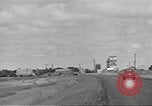
Students study in universities and farmers do weekly shopping in the Northwestern United States.
The Northwestern United States. Cars driven on a road. Trading centers in the United States. Grain elevators on farms near a road. Cattle and livestock shipping yards. 1930s and 1940s Automobile traffic on a main street in a small town of the western United States. Farmers do weekly shopping, going in various stores and shops. Sign "Barnard's" seen on one shop. Children in front of a school building. Students in a university. The clock tower with the "M" on it is Main Hall at the University of Montana in Missoula. Mount Sentinel is seen behind it. Fruits, vegetables and other articles on ships. Cattle and sheep in a field. Wheat fields. A harvester in operation on a field. Wheat is separated by a thresher.
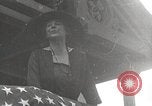
Jeannette Rankin, first woman elected to U.S. Congress, speaks in Union Square, New York City
Jeannette Rankin, of Montana, the first woman elected to U.S. House of Representatives (served April 1917 through December 1918). A pacifist, co-founder of the American Civil Liberties Union, and champion of humanitarian causes, she is seen addressing a group from a speakers pavilion in Union Square, Manhattan, New York City, in September, 1924. She accepts a glass of water from an associate (unseen). Closeups of Rankin leaning over the railing above an American flag, as she speaks to assembled group of men and women. From further away, several men and women associates can be seen at work behind her in the pavilion. Views from behind and to her right, with listeners below and cars parked in the square. Street scene in background. As before, Ms Rankin leans forward to be better heard. (There is no evidence of microphone in use.)

President John Kennedy attends first baseball game played at DC Stadium, between Washington Senators and Detroit Tigers, in 1962.
U.S. President John Kennedy attends the first ballgame played at the new $20 million District of Columbia Stadium, or DC Stadium, in April 1962. 45,000 spectators in stands for the opening of the stadium and the Major League Baseball season. Glimpse of the new DC Stadium in Washington, DC, filled with baseball fans. President John F. Kennedy enters the ballpark, accompanied by David Francis Powers, and proceeds toward seats bearing the Presidential seal. Spectators in nearby seats stand to greet the President, and several shake his hand. Scene shifts to players and newsmen on the field all focused on President Kennedy. News photographers are busy photographing him. Camera shifts to President Kennedy making a long throw followed by the ballplayers scrambling for it on the ballfield. View of the President smiling after his throw, with Illinois Republican Senator Everett Dirksen standing to his left, and slightly behind him, and David Powers to his right. Senator George Smathers of Florida is laughing behind them. The President bends down momentarily revealing Senator Mike Mansfield of Montana, directly behind him and Special Assistant to the President Lawrence “Larry” O’Brien, at Mansfield's right. Associate Press Secretary Andrew Hatcher, wearing sun glasses is behind and to left of Dirksen. Closeup of Home plate umpire Charlie Berry shouting "Play Ball!" after brief rain delay. Lights are on during daytime as game is played. Washington Senators player hits single to left field. Senators go on to beat the visiting Detroit Tigers 4-1. (Note: The stadium was later renamed Robert F. Kennedy Stadium, or RFK Stadium, in 1969).
Franklin Roosevelt and an official deliver speeches during the presidential campaign at the Democratic National Convention in Chicago.
The Democratic National Convention at the Chicago Stadium in Chicago, Illinois. A large crowd gathers for the national convention. People cheer. Banners reading 'Missouri' and 'North Carolina'. U.S. President Franklin Delano Roosevelt, nominee for the president, and other officials standing on a platform. Democratic Party Chairman, Senator Thomas J. Walsh (Montana) speaks to Roosevelt and congratulates him on his nomination to be the Democratic party candidate for President of the United States. The flag of the United States in the background. Another flag with 'California' written on it. Democratic Presidential candidate Franklin Delano Roosevelt speaks.
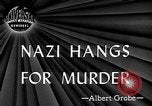
German civilian Matthias Gierens is hung until death for murdering a downed American flier in Germany in World War 2.
German civilian Matthias Gierens, a 37 year old railroad worker, is hanged in Rheinbach Germany for the August 15, 1944 murder of a downed American flyer, who was later identified as U.S. Army Air Forces 2nd Lieutenant Lester E. Reuss, from Forsythe, Montana. Reuss was the navigator on U.S. Army B-17 bomber #42-31183 which was downed by German aircraft after it attacked the Airdrome at Wiesbaden, Germany. Gierens and three other German civilian men, Peter Kohn, Peter Back, and Matthias Krein, were convicted on June 2, 1945 in Ahrweiler, Germany, for the murder of the American airman after his parachute landing near Priest, Germany. The trial was the first Allied trial in Germany of civilians charged with a war crime. Military police are seen escorting Gierens toward the gallows in a prison yard in Rheinbach. A German Catholic priest performs the rites. U.S military officer reads charges as Gierens is readied for execution (the officer is possibly Lt. Col J.V. Roddy, of San Francisco, who was in charge of the hanging). Trap door opens and Gierens is hung. The U.S. Army executioners were Master Sgt. John C. Woods, a former Texas State executioner, and Staff Sgt. Thomas Robinson, of Bronx, New York. Witnesses present included seven U.S. Lieutenant Colonels and one British officer, a number of Military Police, news correspondents, and photographers.
Men on horseback with pack horses move on mountain trail and Continental Divide from Pikes Peak, Colorado.
Landscapes in the United States. Animated map shows: tourist places in Montana,Idaho, Wyoming, Utah, Colorado,and New Mexico. Men on horseback as pack of horses move on a mountain trail. View of Continental Divide from Pikes Peak.