


 Francais
 Deutsch
 Italiano
Refine Your Search
Herne Germany 1945 stock footage and images
- Showing 73 to 78 of 10462 results more
more Hide
Hide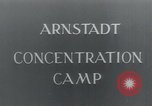
U.S. soldiers watch German civilians disinterring bodies at Arnstadt Concentration Camp in Germany (WW2)
Arnstadt Concentration Camp in Germany captured by American forces in April, 1945 near the end of World War II. Prisoners were mainly Poles and Russians. View from the camp gate to tents which were used to house prisoners. Dogs were used to guard the prisoners. Shown is A dog kennel for a watch dog. Local German citizens had exhumed he bodies of concentration camp victims from their original mass grave, and reburied them in a trench further away from the town because of the stench. Now they were disinterring them again under supervision of United States Army soldiers. A corpse with crushed head. Corpses lying outside the graves from which they have just been exhumed. Bodies laid out on the ground are viewed by several U.S. soldiers
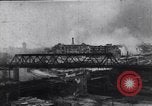
Soviet capture of Berlin and surrender of German Defense forces in Germany during World War II.
Combat footage filmed during the Soviet invasion and Battle of Berlin, Germany during World War 2. Smoke rises from damaged bridges and railroad lines. Ruined buildings of Berlin in aftermath of Soviet air and ground attacks. Piles of captured German weapons. German police officers and soldiers being taken as prisoners of war. Surrendering German troops march along a street. Grafitti on building wall says "Surrender - No." White surrender flags hang from windows and balconies of buildings. (These are contrasted by edited insert of German swastika flags covering the facades of buildings in the past.) German General Helmuth Weidling, commander of the Berlin Defense Area leads other Gernan officers from a bunker in the city, following their surrender to the Soviets on May 2, 1945. Large number of surrendering German soldiers marching, while General Weidling and other Berlin Defense Area officers quietly watch as their troops march past, as prisoners.

Prime Minister of UK Winston Churchill and U.S. President Harry S Truman attend the Potsdam Conference in Germany.
Prime Minister Winston Churchill gets a defeat in the 1945 United Kingdom General Elections. Past events show Prime Minister of UK Winston Churchill, U.S. President Harry S. Truman and other delegates attending the Potsdam Conference in Germany.
The end of WWII and U.S. President Harry Truman's role in immediate postwar actions
Opening scene shows some German infantry surrendering with hands raised. Next scene shows people thronging Times Square in Manhattan, New York City, celebrating VE Day, or Victory in Europe Day, on May 8, 1945, when Germany surrendered to end World War II, in Europe. Image of the first atomic explosion (Trinity) on July 16, 1945, in New Mexico, United States. Scene shifts to deck of the U.S. Battleship, USS Missouri, where Japanese foreign minister, Mamoru Shigemitsu, is seated and signing the instrument of surrender., on September 2, 1945. Closeup profile of General Douglas MacArthur. Another glimpse of Mamoru Shigemitsu signing. Next, MacArthur is seen signing the document. He turns and presents the pen to Lieutenant General Jonathan M. Wainwright , who is standing behind him alongside British Lieutenant-General Arthur Ernest Percival. Brief glimpse of the San Francisco War Memorial and Performing Arts Center with flag appearing to be at half staff and a long awning extending from its entrance to the sidewalk. View of representatives at the first United Nations meeting there . Views of audience in auditorium shows many notables. Closeups of Soviet Ambassador, Andrey Gromyko and Soviet Foreign Minister, Vyacheslav Molotov.. Next, President Harry S. Truman is seen broadcasting a greeting to the delegates, from the Capitol, Washington, DC, on April 25, 1945. The delegates are seen listening to the broadcast and then applauding.
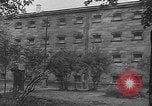
Post World War II trials of German and Japanese Leaders for war crimes
Film opens with exterior view of Nuremberg cell prison, just north of the Palace of Justice, holding war criminals for the Nuremberg Trials. Interior view showing cell bloick area and guards patrol the halls. Cell door with name Karl Doenitz on it. Views of German Admiral Doenitz and Admiral Erich Raeder, looking over war planning charts. Ships burning at sea in nighttime. Glimpse of German U Boat Captain observing through periscope. Back at Nuremberg Prison, an American soldier checks cell of Joachim von Ribbentrop. German Foreign Minister von Ribbentrop seen on steps of an airplane. Scene shifts to Nazi–sponsored so-called American Rally in Madison Square Garden, New York City, on February 20, 1939. A huge picture of George Washington dominates the stage where drummers play while flag-bearing marchers fill the stage. View of audience of 20 thousand persons, rendering Nazi salutes. Someone trying to interfere with the activity is quickly subdued on stage by men in military style uniforms. Scene shifts back to Nuremberg prison, where a soldier guard passes food through cell door to Julius Streicher (unseen). Closeup of Streicher speaking to crowd of people in Germany. Views of German Paramilitary Brown shirts (Storm troopers, or Sturmabteilung) during boycott preventing people from patronizing Jewish merchants. Next, victims liberated from Nazi concentration camp are seen being sprayed in delousing powder by American soldiers. Back at Nuremberg prison, a soldier stands outside the cell of Hermann Goering. Next, Goering is shwon in a scene eating at an outdoor table with other men, at a Nazi-sponsored public feeding event before World War 2. Brief view of German Chancellor, Heinrich Bruening, who fled Germany in 1934 as the Nazis were coming to power. A Graf Zeppelin airship, bearing Nazi Swastika insignia, is seen in flight over New York City. Crew member inside the Zeppelin, looking out a window as he plots a position on a chart. The Zeppelin casts a shadow over an ocean liner at sea, as it passes overhead. Back at Nuremberg cell prison, a guard opens a door with a key. Next seen shows several prisoners walking into a prison yard at an unidentified prison. A firing squad (unseen) is heard marching into position and firing their guns. Scene shifts to Japan, where a Japanese twin engine passenger plane is seen overhead, coming in for a landing. Official buildings are seen in Tokyo and jurists who will participate in war crimes trials. Scene shifts to war crimes trials authorized in Manila, by General Douglas MacArthur. Seen are Japanese General Tomoyuki Yamashita and another Japanese officer on trial at the High Commissioners Residence in Manila, in 1945. Views of ordinary Japanese soldiers. A court convening.
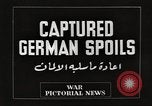
American occupation troops collect military uniforms and weapons from German population, at end of World War II. U.S. troops display Nazi plundered treasure in a salt mine.
German civilians in a city on the Elbe River, gather around a poster containing Law Number 5, issued by the Military Government-Germany (American Occupation forces). It announces the dissolution of the Nazi party. Next, a German Army medic talks to an American, near a huge pile of German military uniforms, military equipment, and accessories. Civilians including former German soldiers throng a town square, adding items to the pile. A woman pulls uniform items from her wash basket. An American soldier talks with a German woman as bystanders watch and listen. A man and boy look at a small rifle before the boy throws it on the pile. View from above of the square with people crowded around the pile of castoffs in its center. Women placing officers' swords on the pile. Complete change of scene shows a U.S. soldier from the 3rd Army, in a salt mine, in Merkers, Germany, on April 15, 1945. He is perusing Nazi seized and stolen jewelry, cutlery, and precious metal trinkets in a case. Another soldier looks at a bar of gold and displays it for the camera. Many wrapped gold bars are behind him. German currency bank notes are seen in the hands of a soldier. Numerous packages of currency sit in the background. American soldiers show some of the stolen art works also hidden in the salt mine. Among the seized paintings seen is "Wintergarden," by French impressionist painter Edouard Manet.
CRITICALPAST.COM: About Us | Contact Us | FAQs - How to Order | License Agreement | My Account | My Lightboxes | Shopping Cart | Advanced Search | Featured Collections | Website Terms & Conditions | Privacy Policy ©2026 CriticalPast LLC.
License Agreement |
Terms & Conditions |
Privacy Policy
©2026 CriticalPast LLC.