


 Francais
 Deutsch
 Italiano
Refine Your Search
Herne Germany 1945 stock footage and images
- Showing 5455 to 5460 of 10472 results more
more Hide
Hide
A crowd attends a trade fair in Poznan, Poland where American cars and German excavation machinery are displayed.
A trade fair in Poznan, Poland. Excavation machinery from Germany in operation. Heavy machinery from Russia is being operated by men. A sign reads 'Renault'. People attend the fair. American cars and truck are displayed.
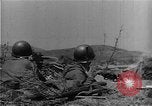
Information about unidentified airplanes is transmitted in the United States.
A public television program by the U.S. Army entitled 'The Big Picture.' U.S. troops are seen hunkered down and looking through binoculars in a defensive position in Korea, during the Korean War. American soldiers riding atop a Sherman tank on a city street in Germany, during World War II. Ski troops moving across snowy hill in Alaska. U.S. Army amphibious assault training on a beach in Puerto Rico. Army Master Sergeant Stuart Queen, narrator, speaks about America's defense against threat of atomic attack in these times of lukewarm peace. View of mountainous region in Alaska. A cluster of Cup'it Eskimo dwellings is seen on Nunivak Island, in the Bering Sea. Several of the local inhabitants are fishing through holes cut in the ice. Vapor trails are seen from Soviet aircraft flying at high altitude. A sign on a tarpaulin displaying logo of the Army Signal Corps, reads,"Alaska Communication System, Long Distance Commercial Telephone-Telegraph." A tracked vehicle carries a soldier to a facility posting a sign reading, "Alaska Communications System Receiver Station." Several tall antennas loom above the site. The soldier, dressed in arctic gear, steps from the tracked vehicle and walks past several snow shoes, standing upright in the snow, to enter a white wooden building. Inside, a man in civilian clothes works at a battery of telecomunications equipment. He transmits a message about the aircraft sighting, to the Alaska Communication System facility in Fairbanks Alaska (briefly shown) by means of a telegraph key. From there it is relayed to a Signal Corps facility, shown, in Washington, DC. A soldier is seen Inside that facility, in a room filled with computers and telecommunications equipment. A Sergeant handles paper tape messages being sent and received by teletype. Another soldier plugs connections into a communications switchboard. Next, the camera pans over the entrance to the Office of the Secretary of Defense, in the Pentagon. More views of soldiers attending banks of teletype machines. Animated map displays paths of orders being transmitted to U.S. Air Defense Centers in San Francisco, Chicago, Seattle, New York, and Atlanta. View from control room, of several U.S. Air Force F-94 Fighter Interceptor aircraft on an airfield ramp. A controller activates a Klaxon horn and pilots on alert, in the Fighter Interceptor Squadron ready room, jump up and scramble to their aircraft. A pair of F-94s taking off. One is number 51-5385. Next, a U.S. Navy F-9 fighter plane is seen taking off from an airfield. It displays tail code AE. It is followed by another F-9 aircraft.
Launching of Wright Brothers' glider and aircraft in different places in Europe.
The history of aviation. A glider being launched from a hillside in Germany. The glider is parked. Several men stand nearby. The glider in flight overhead. The first flight of the Wright Brothers at Kitty Hawk in North Carolina on December 17, 1903. A still photograph of Wright Brothers' aircraft in flight. The pilot in a prone position while piloting the aircraft. Launching of Wright Brothers' aircraft in France on August 8, 1908. A launching tower, weight dropping and the take off of the aircraft are shown. Spectators in stands watch the air show. Headlines of a New York newspaper proclaim Wright's flight in France.
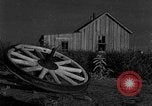
Farm machinery is used and postwar (WWI) decline of the wheat market results in overproduction in the Great Plains in the U.S.
A homestead on a farm in the U.S. Great Plains. Horse carts break the plains. A woman sweeps stairs. A man and a child stand on the plains near a plow. The homesteaders look towards the sky in hope of rain. An explosion on the land. News headlines: 'England declares war on Germany, Belgium invaded, French win at sea' and 'War news tumbles securities, Stock Exchange Closed, Wheat Prices Soar'. A man drives a tractor with a plow on a plain land and dust cloud rises. The plow breaks the plains. News headlines: 'Wilson proclaims war, Spy ring arrested, German ships seized' and 'War sends wheat soaring, Grain up 13 points, Pit in Pandemonium'. The postwar (WWI) decline of the wheat market results in overproduction and spurs dust bowl conditions: Farm machinery is used to sow the land. Wheat grains are poured into a thresher. A steamer at a sea. Tractors are driven and plows break the plains. A dust storm in the foreground. Overproduction of wheat shown. Farmers celebrate the production of wheat. Tractors driven in the Great Plains.
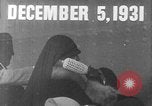
Flashbacks show USS Wakefield being christened as SS Manhattan, and famous passengers aboard in the early 1930s
Famous passengers aboard ocean liner SS Manhattan (later USS Wakefield during World War II) in the United States. Flashbacks show the USS Manhattan being christened by Mrs. Theodore Roosevelt on 5th December 1931. It is seen being launched from New York Shipbuilding Corporation in Camden New Jersey. View of maiden voyage on 10th August 1932, with passengers boarding the ship. It leaves a port for her first trip to Ireland, England, Germany and France. Couples dance aboard the deck of the SS Manhattan. Passengers including Babe Ruth, Jimmy Walker, Glenn Cunningham, and aviator Douglas Corrigan ("Wrong Way Corrigan") seen aboard the ship.
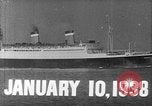
Scenes aboard ocean liner SS Manhattan: Ambassador William Dodd interviewed in 1938 and passengers fleeing war in Europe in 1939.
A large number of passengers aboard the ocean liner SS Manhattan (later USS Wakefield) in the United States. Scene from January 10,1938 as the USS Manhattan returns from her Europe trip. A large number of passengers aboard the ship. U.S. Ambassador to Nazi Germany, William E. Dodd, is interviewed by media persons about his Europe trip. He declares that living in Europe at the time is discouraging and there is crisis in Europe as German Nazism and Fascism are gaining ground everywhere. In next shot, from 1939, the ship is underway and arriving at New York Harbor on September 30, 1939, carrying 1837 persons, its largest passenger count ever. The passengers include many Americans from overseas fleeing war-torn Europe early in World War 2. A sign on the ship: 'Manhattan United States Lines'. The passengers in mass numbers at a harbor. The Statue of Liberty in the background.
CRITICALPAST.COM: About Us | Contact Us | FAQs - How to Order | License Agreement | My Account | My Lightboxes | Shopping Cart | Advanced Search | Featured Collections | Website Terms & Conditions | Privacy Policy ©2026 CriticalPast LLC.
License Agreement |
Terms & Conditions |
Privacy Policy
©2026 CriticalPast LLC.