


 Francais
 Deutsch
 Italiano
Refine Your Search
Hoboken New Jersey 1918 stock footage and images
- Showing 6181 to 6186 of 9472 results more
more Hide
Hide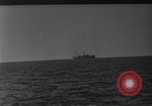
America enters World War I against Germany
A ship blows up at sea (presumably torpedoed by a German submarine). Newspaper of April 2, 1917 announces the United States and Germany at War. U.S. Secretary of War, Newton D. Baker, speaking on a public platform, outdoors.. General John J. Pershing, Commander of American Expeditionary Forces in World War 1, is seen seated behind Secretary Newton. Scene shifts to U.S. President Woodrow Wilson signing papers his his desk at the White House, Washington, DC. Next, Red Cross women are seen serving coffee into the mess of American soldiers about to embark for Europe. Another Red Cross woman carries a basket of baked goods. The soldiers are checked off by officers at the pier, and then embark on a troop ship. View of the troop ship in camouflage paint, moving away from the pier Scene shifts to glimpse of a town in France, where an American officer and some soldiers are seen walking past French inhabitants on a street corner Other American soldiers stand near a large canvas covered army truck. They salute as the American officer passes them.
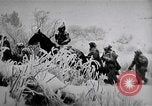
White Russian refugees in Siberia, escorted by White Russian Guards. Bolshevik prisoners. Also a ANT-20 airplane scene.
White Russian refugees making their way through heavy snows in Siberia during Russian Civil War period. They are escorted by several White Russian Guards on horseback. Change of scene shows some Bolshevik prisoners walking through snow, on a snowy day. Wooden sleds and gear towed by horses accompany the prisoners. Anachronistic brief glimpse of the giant Soviet Tupolev ANT-20 airplane in flight overhead, circa 1934. The name Maxim Gorky is written (in Russian) on the wings of the plane. (Russian Civil War and World War I time frame.)
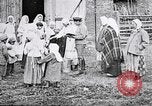
Bolshevik Soviet worker oversees distribution of milk to children in rural area of Russia
Women gather children together as a man from the local Soviet oversees distribution of milk to them in a rural area of Russia, following Russian Revolution and overthrow of the Russian Provisional Government, in World War 1. The man holds a book and annotates it during the process. Closeup of the children receiving milk in their cups.
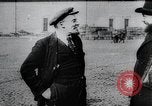
Vladimir Lenin talks to Lev Kamenev in Kremlin and sits with his wife Nadezha Krupskaya in his wagon in Moscow, Russia.
Bolshevik leader Vladimir Lenin comes to power in Russia after the Russian Revolution. Lenin talks to Lev Kamenev in the courtyard of Kremlin in Moscow. The two communist leaders talk while walking. Large cannon and the cannon balls. Lenin with his wife Nadezha Krupskaya sitting in his wagon.
Soon after Russian Revolution, Imperial Russian troops seen moving to engage Bolshevik revolutionary forces in Russian Civil War
Conflict between Imperial Russian forces and Bolsheviks in time frame of Russian Civil War and World War 1. Map shows area around Samara (Camapa) Russia, on the East bank of the Volga River. Imperial Russian soldiers run ashore from a Russian Navy boat on the river bank. An Imperial Navy Jack (flag) is seen on a docked long boat manned by Russian sailors. Next scene shows Imperial Russian soldiers aboard two open rail cars, pushed by a locomotive. They have armed the cars with a 76.2 mm divisional gun model 1902 field artillery piece and other smaller arms. They have a shelter built on one of the cars.
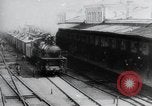
Refugees flee in railroad cars and civilians who died in the Civil War between White Guards and Bolsheviks in Russia.
Russia during the Civil War fought between the White Russian Guards and the Bolsheviks, on the heels of the Russian Revolution. A train arrives at a railroad station fully loaded with passengers. Refugees loaded on the roof of railroad cars to its maximum capacity. Brief view of Russian Revolution leader Vladimir Lenin speaking. A hungry child stooped over hunting for bits of food on the ground near a fence. A starving boy lying on a wooden surface and picking up tiny bits of food to eat. Lenin speaking again. View of a snow covered rural village and dead bodies of men, women, and children on ground in cold. A pile of dead bodies of civilians in the frozen cold. Vladimir Lenin in a winter hat giving speech to a large crowd outdoors.
CRITICALPAST.COM: About Us | Contact Us | FAQs - How to Order | License Agreement | My Account | My Lightboxes | Shopping Cart | Advanced Search | Featured Collections | Website Terms & Conditions | Privacy Policy ©2026 CriticalPast LLC.
License Agreement |
Terms & Conditions |
Privacy Policy
©2026 CriticalPast LLC.