


 Francais
 Deutsch
 Italiano
Refine Your Search
Hoboken New Jersey 1918 stock footage and images
- Showing 625 to 630 of 9472 results more
more Hide
Hide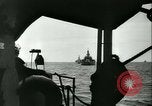
U.S. Signal Corps officers and soldiers use mine detectors, modern radars, and meteorological equipment during World War II.
The role and contribution of the U.S. Army Signal Corps in combat and war. U.S. shuttle ships loaded with signal communication supplies for U.S. and Allied troops in the European Theater make their way in the Atlantic ocean. The Squier Laboratory at Camp Alfred Vail in Fort Monmouth, New Jersey. A technician works on signal communication equipment in the laboratory. U.S. soldiers use mine detectors in the European Theater during World War II. The mine detectors detect metallic, non-metallic mines, wooden box mines, and mines in glass containers. Artillery soldiers bury large microphones into the ground in advance zones. The microphones relay back information on enemy artillery. Soldiers receive the information on radio sets. U.S. aircraft on a training flight simulating real combat situation: The aircraft lost in heavy rain and rough weather, looking for the location of Boston. The pilot switches on a modern advanced radar. The radar waves pierce thick clouds, are reflected by Earth's surface and display an image on the scope. The image shows the clear location of Boston harbor directly under the aircraft. U.S. bombers attack over the Channel coast on D-Day (6 June, 1944). U.S. soldiers employ meteorological equipment for long range weather forecast in the European Theater during World War II. Soldiers release a hydrogen balloon into the sky. Another soldier uses an apparatus to take readings of atmospheric conditions behind enemy lines. An aircraft drops an automatic weather station called SCM-18-TI by parachute into enemy territory. The timed mechanism sends out weather data in codes. The interior of the automatic weather station lying open in a field.
United States sends crop duster aircraft to combat a locust plague in Iran.
The United States sends aircraft to enable Iran to spray against a locust plague, in 1951. Iranian farmers are seen trying to cope with a plague of locusts, seen covering everytning in sight. The farmers chase them with cloths and use watering cans to dispense chemicals. A DC-4 transport aircraft taxis in after landing in Iran. The aircraft carries several small Piper Super Cub 135 airplanes and a croip duster, all equipped for aerial spraying. View of Piper Cub being removed from the DC-4. A bi-wing crop duster airplane being assembled. Several Super Cub aircraft flying low and spraying against locusts. (Note: The DC-4 aircraft is owned by United States Overseas Airlines, a non-scheduled air carrier based in Cape May New Jersey, that was contracted to combat the locust plague. The project was undertaken as part of President Truman's Point Four Program. approved by the United States Congress on June 5, 1950 in the Foreign Economic Assistance Act. )
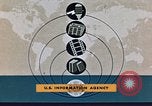
Efforts by United States Information Agency to provide information to populations behind the "Iron Curtain."
Chart shows USIA information endeavors to send information behind the "Iron Curtain," including libraries, films, newspapers, and broadcasts involved in anti-Communist propaganda during the Cold War. Other charts cite cooperation with private enterprise, including 750 groups, such as businesses, schools, etc. Illustration shows letters written by Americans to family and friends abroad that can inform them of the truth. Town and city affiliation program is shown, with the example of Montclair, New Jersey, in the United States, and its relationship with Graz, Austria. The Mayor of Graz is seen being honored at a dinner in Montclair. Chart illustrates program of salvaging and sending American magazines abroad.
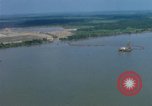
U.S. Army Corps of Engineers dredging the Mekong river during construction of the Dong Tam Base Camp in South Vietnam in the Vietnam war.
Aerial view from helicopter flying over delta region ot the Mekong River in South Vietnam during the Vietnam war. The Dredge, "New Jersey" is seen operating in the river where it is increasing depth for a harbor turning basin that can accommodate larger ships, and pumping spoils, as land fill, to the shore. The chopper moves inland showing where dredging spoils have been deposited, near quonset huts of the base. Aerial views continue over such areas and then over the main base, itself. showing buildings, motor pool, and other features. (Note: Silent except for some wild sound of helicopter, at times.)
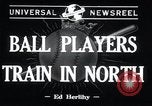
Baseball players train in northern U.S. states during World War II, 1943
Newsreel clip entitled "Ball Players Train in North" shows major league baseball teams holding spring training in 1943. Teams were not allowed to travel south to Florida because of World War 2 travel restrictions. First part of clip shows men (presumably baseball players) riding in a horse and buggy along a tree-lined road. Giants seen running on field and meeting with manager and Hall of Fame outfielder Mel Ott. Players pose for camera, all wearing long sleeves. Closeup of Giants Hall of Fame pitcher Carl Hubbell. Giants players seen throwing at posters of Benito Mussolini, Adolf Hitler and Hideki Tojo -- Leaders of the Axis powers during the war. Players look at the posters after throwing; note patriotic war patch on Giant player's sleeve. Clip shifts to Washington Senators training camp the same year. Coach and renowned baseball clown Nick Altrock leads players in warmup drills. Players warm up in outfield, near what looks like a heating plant. Closeup of Senators pitcher Dutch Leonard throwing. Closeup of Senators owner Clark Griffith (in overcoat) talking with manager Ossie Bluege. Closeup of Bluege. Players marvel over of 7-foot player Richard Ahrens, who was signed by the Senators that spring as a possible publicity stunt; he never appeared in a minor or major league game. Washington players pretend to warm themselves up by small campfire on the field. Another shot of Altrock. (Note: There is no indication where these clips were taken but the Giants trained in Lakewood, New Jersey that spring and the Senators trained in College Park, Maryland. )
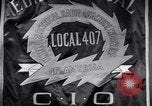
Pairs of American and British workers on exchange visits meet workers at American cities across the country
Logo of United Electrical, Radio, and Machine Workers Union Local 407 in New Jersey is shown. Narrator says it it one of the places a group of 4 English and 4 American Working men were to see on their exchange visit to America. View of their luggage The group is seen examining a map of the United States as they plan to make their visits in pairs to save time. They decide that each British worker would visit the hometown of an American counterpart. One pair leaves to visit Bethlehem, Pennsylvania. The pick up their luggage. Another pair are going to Detroit, Michigan. They pick up their luggage. The third pair is going to St. Louis, Illinois. They pick up their luggage. The final pair are going to Los Angeles, California. They pick up the last remaining pieces of luggage. One pair of workers is seen entering the Chrysler plant in Detroit. The American was welcomed home to America from his trip to England. View inside the plant of an African American woman working beside an older man, where they were making tank and marine engines. The visitors examine the gang drill presses containing multiple drills operated by a single operator. They stop to say hello to the American's daughter who also works at the plant, checking to assure parts met tolerances. It was noted that she was paid the same as any man doing the job. The pair of visitors are met at the American's home by some company union workers. They sit together on the step outside the house and get acquainted. An infant inside the house looks out the window at them. Scene shifts to Los Angeles where another English-American visiting pair is seated outdoors and the wife of the American brings out some bottles of beer for them to all share. Change of scene shows the pair visiting the offices of the Screen Actors Guild in Hollywood, where they meet celebrities Edward Arnold, George Murphy, Dick Powell, Alan Hale, Jane Wyman, Helen Hayes and Lena Horne. Edward Arnold, President of the Guild's Board, speaks with the pair, alone explaining how every actor in Hollywood belongs to the Guild which is affiliated with the America Federation of Labor (AFL). Arnold shows the pair his union card. Closeup of the card.
CRITICALPAST.COM: About Us | Contact Us | FAQs - How to Order | License Agreement | My Account | My Lightboxes | Shopping Cart | Advanced Search | Featured Collections | Website Terms & Conditions | Privacy Policy ©2026 CriticalPast LLC.
License Agreement |
Terms & Conditions |
Privacy Policy
©2026 CriticalPast LLC.