


 Francais
 Deutsch
 Italiano
Refine Your Search
Hoboken New Jersey 1918 stock footage and images
- Showing 649 to 654 of 9472 results more
more Hide
Hide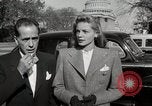
Hollywood stars visit Washington, DC, to voice their objections about proceedings of the House Unamerican Activities Committee (HUAC)
Hollywood stars (members of the newly formed, Committee for the First Amendment) visit Washington D.C. to express their objections to the actions of the House Unamerican Activities Committee (HUAC). Opening scene shows movie stars Humphrey Bogart and Lauren Bacall on a sidewalk at Indendence Avenue in Washington, DC, Southeast of the Capitol building which is seen behind them. A police car is parked at the curb and an officer is standing in the street. Next, they are seen posing with Hollywood personalities, including Danny Kaye and June Havoc, among others. Views of the group from different angles, and from behind a group of photographers taking pictures. Then they begin to walk towards the location of the HUAC hearings, with Bogart and Bacall in the lead. They proceed up the steps of the building. Scene shifts to the hearing room inside, where Screen writer, John Howard Lawson, is being sworn in. He begins to testify. During his testimony, the Chairman, Representative John Parnell Thomas, of New Jersey, finds it neccessary to gavel for order and appears to berate the witness. Lawson leaves the witness chair and departs. Another view of the hearing room.
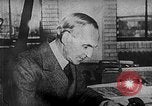
Henry Ford's work in the area of historic preservation. Construction of Ford Museum and Historical Greenfield Village
Henry Ford works on historical preservation project. McGuffey readers are seen. Sketch of Ford family farm in Springwells, Michigan. View of homestead at the farm, that Ford restores. He examines the farm's steam engine. The historic Wayside Inn, in Sudbury, Massachusetts, which Ford purchased to construct a community of historic buildings. View of the restored Botsford Inn,Detroit, Michigan, that Ford bought in 1924.View of Eagle Tavern, in Clinton, Michigan,before,and,after its purchase and restoration by Henry Ford. Concerned about need for additional buildings to house artifacts, Henry Ford consulting with Detroit architect,Robert O. Derrick (with mustache) and two other men. Derrick's plan for the Henry Ford museum is unrolled. It borrows from Independence Hall, Congress Hall, and the old City Hall in Philadelphia.Views of the Clock Tower and museum, as completed in 1929. A pictorial map of the Edison Institute Museum and Historical Greenfield Village, in Dearborn, Michigan. View of construction begun in 1927. Thomas A. Edison laboratory in Menlo Park, New Jersey, that Ford acquired for Greenfield Village. On a windy September 17, 1928, Thomas A. Edison steps from a car, and pauses before entering the doorway of his restored laboratory, in Greenfield Village. Henry and Mrs.Ford step from their car to quickly join him in the building.Edsel Ford and his wife, also follow. Inside the building, Edison officially open the site by starting a steam engine in the laboratory. Ford and Edison converse (Ford speaking close to Edison's ear, because he is hard of hearing). Later, Edison, in a cornerstone ceremony, imbeds, a shovel contributed by Luther Burbank, and then writes in cement of the cornerstone.Newspapers show coverage of the formal dedication of the museum and Greenfield village, October 21, 1929. Workers rushing the Village toward completion for that event. The Smithcreek Railroad depot is moved to the Village. Workers preparing installation of the depot.
A man takes measurement of Private John's big feet to make Army shoes in San Francisco, California.
A U.S. Army soldier having big feet in San Francisco, California. The soldiers march in a squad. Private John from New Jersey wearing sandals while marching. A drill instructor speaks to him. The long feet of the soldier. The soldier gets a desk duty. John seated at a desk. 'US Army' written on his uniform. A close up of the soldier having big feet. A man takes measurement of his feet for making Army shoes.
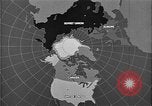
Cold War scenes: Soviet military on parade in Red Square; U.S. Army placing gun batteries in U.S. residential areas
Opening scene shows animated map of northern part of the earth, centered on the North Pole. It depicts the shortened flight paths between various parts of the Soviet Union, and the United States via polar routing, representing bombing threats. The Soviet Red flag flying on a flag pole. A large number of Soviet Tupolev Tu-2 bomber aircraft parked at an airfield. (They are equipped with four-bladed AV-9VF-21K variable pitch propellers.) Aerial view of several Russian Tu-2 aircraft in flight. Closeup of aircraft's twin tail showing dihedral angle between them, as viewed from tail of the aircraft. View of military parade in Red Square, Moscow. Numerous open army trucks, filled with Soviet troops, drive in formation. In a closeup, the Soviet State Museum building dominates the background. Closeup of Georgi Malenkov (who was named premier and first secretary of the Communist Party of the Soviet Union, upon the death of Joseph Stalin, in March 1953). He reviews the parade from the Kremlin. Soviet Secret Police Chief, Lavrentiy Beria, stands beside him. Army motorcycle troops pass in formation. Lenin Mausoleum and Kremlin Walls in background. Closeup of Soviet military veterans in civilian clothes, with medals, watching the parade. More troops in open trucks. They pass large posters of Lenin and Stalin. Closeups of Soviet civilians including women and children. A group of Asian persons watching the parade. View from a high point overlooking Red Square showing lines of army trucks snaking around both sides of St. Basil's Cathedral, as they leave the square, past Lenin's Tomb. Closeup of Soviet soldiers saluting with rifles as they pass reviewing stand. Their truck is towing a field howitzer equipped with two tires on each axle. Closeups of several towed howitzers. Scene shifts to Elizabeth, New Jersey, United States, where army jeeps and artillery pieces maneuver on the city streets, in preparedness exercises during the Cold War. A woman hanging laundry out to dry on a line. Artillery being placed in a vacant lot near a residential neighborhood. A woman looks out her apartment window at the gun being placed in the lot. Soldiers uncover it, revealing a 120 mm M1 anti-aircraft gun. Young boys watch the activity from a backyard, where clothes are on a line to dry. The soldiers erect a radar antenna on a fire control trailer. Two women watch the activity from their apartment window. Closeup of the gun installed and ready. A radar antenna rotating in the field. A battery of several antiaircraft guns installed in the field. Cars and pedestrians on busy streets and sidewalks in the city. Children playing on monkey bars in a park. Distant view of military temporary buildings and guns installed near apartment buildings. An alarm clock. A rotating radar antenna. A civilian asleep in his bed. A soldier steps from his unit's orderly room and blows a whistle. The disturbed civilian in bed looks at his clock reading 5:30 AM and expresses disgust. He is next seen with friends, registering a complaint with an Army Captain in his office, who agrees to resolve the matter. An Army Officer is seen standing at a large chalk board explaining how and why anti aircraft guns are being installed across the area, as civilians watch and listen to his explanation
Luis Martinetti, Gymnast and contortionist, photographed at Edison studio, as he performs on flying rings.
A performance on the flying rings, by Gymnast and contortionist, Luis Martinetti of the Martinetti Brothers. Filmed on October 11, 1894, in Edison's Black Maria studio, West Orange, New Jersey, United States.
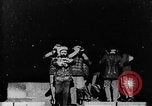
Musicians from Broadway Musical Farce, "A milk white flag," perform a Band Drill
Bandmaster, Frank Baldwin, and musicians from cast of the show, "A Milk White Flag,"perform. The musicians are: A.D.. Dorsch, E.P. Brown, J.F. Boardman, George Goddard, E.F. Balch, Paul Pfarr. Fred W. Boardman, and William Cushing, Filmed at Edison studio in New Jersey.
CRITICALPAST.COM: About Us | Contact Us | FAQs - How to Order | License Agreement | My Account | My Lightboxes | Shopping Cart | Advanced Search | Featured Collections | Website Terms & Conditions | Privacy Policy ©2026 CriticalPast LLC.
License Agreement |
Terms & Conditions |
Privacy Policy
©2026 CriticalPast LLC.