


 Francais
 Deutsch
 Italiano

Refine Your Search
Hoboken New Jersey 1918 stock footage and images
- Showing 667 to 672 of 9492 results more
 Hide
Color Sound
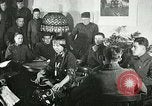
U.S. soldiers watching the performance of Tsianina Redfeather (a.k.a. Tsianina Blackstone), during World War I .
Tsianina Redfeather (also known as Tsianina Blackstone), a famous Creek-Cherokee Native American Indian mezzo-soprano, plays the Hawaiian guitar and sings for U.S. soldiers in YMCA- sponsored entertainment for the troops in a canteen, 1917-1918, during World War 1. (Historic note: While sailing to Europe in 1918 as a member of the American Expeditionary Forces, her vessel, the HMS Carmania, was struck by a torpedo. She continued the journey, entertained thousands of troops, and received a commendation for her service. Her interest in entertaining the troops, according to her autobiography, rested in the fact that so many American Indian soldiers were fighting overseas-- around 17,000. After her return to the U.S. her career continued to escalate. This clip perhaps represents the only surviving footage of this truly remarkable individual.)
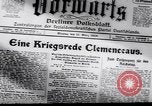
View from Berlin Germany, of events leading up to, and subsequent to, the Armistice in World War I.
Succession of Berlin, Germany, newspapers shown, from 1918 through 1919, chronicling progress of war towards the World War 1 Armistice, and subsequent problems and conditions in postwar Germany. Newspaper of November 12, 1918 addresses concerns about the conditions and the price of the truce. Crowd stands on a road covered with snow around statue of the Kaiser, with scaffold around it. Crowd in a square in War Bond rally. One of crowd carries a Communist red flag. Newspaper refers to gunfire in Berlin from Unter den Linden to Friedrichstrasse. Newspaper announces the Kaiser's abdication, which is then illustrated by reversed footage showing the Kaiser walking backwards and being lifted into his automobile, which then drives away backwards. Returning German soldiers are happy to see the war end, and sing in their returning trucks. An officer inspects war trenches that are now empty. Newspaper announce increasing domestic problems . Newspapers raise issue of German prisoners of War held in foreign countries. Troops are seen moving in streets and at checkpoints in Germany.
Civil war breaks out in Russia after Brest-Litovsk Peace Treaty, in year after Russian Revolution
After Lenin makes peace with Germany, civil war breaks out in Russia. White Russian troops are seen fighting against Bolshevik troops in the snow. American soldiers, supporting the White Russians, are seen in Archangel (Arkhangelsk). Cossacks on horseback carry the Tsarist flag. The Romanovs, Tsar Nicholas II and his family are photographed outdoors seated on a wooden bench by barricade fence at Ipatiev House in Ekaterinburg. Bolsheviks arresting other revolutionaries who were opposed to them, and executing them by firing squad. Vladimir Lenin with cat in his lap. View of Fanny Yefimovna Kaplan (AKA "Dora") who attempted to assassinate Lenin on August 30, 1918. View of Lenin speaking to Soviet workers. Newspaper of September 1, 1918 reports on the assassination attempt, with dateline London, August 31st: "Lenin wounded twice by assassin. Attempt on Red Premier's life at Moscow. Commissary Uritzky murdered at Petrograd." Crowd in turmoil in Moscow. Newspaper reports capture of would-be assassin, noting that "official Bolshevist paper says, "She is girl of intellectual class." Narrator states that some 500 anti-Bolsheviks are executed in Moscow.
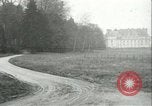
Railroad train carrying Marshal Ferdinand Foch to Compiegne, France for signing of Armistice ending World War I.
Views of the Chateau of Franc-port located close to the forest at Rethondes, near the town of Compiègne, where the German delegation was lodged during the World War 1armistice negotiations. On November 8, 1918, a steam locomotive pulls Marshal Foch's train through the railroad station in Compiègne, on the way to the armistice negotiations. Later, on November 11, 1918, after the Armistice is signed, the train is seen as it returns and slows to a stop at the station, in Compiègne. The train bears the name: " Compagnie Internationale Des Wagon-Lits Et Des Grands Express Europeens." Several cars of the train are seen close up, including the voiture-restaurant and dining car number 2419 D, in which the armistice was actually signed. Several French soldiers are seen inside the train, and looking out its windows. A large group of French troops pose and celebrate in front of the train, parked in the station.
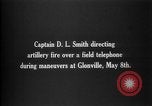
American Expeditionary Forces (A.E.F.), 42nd Infantry Division, on maneuvers in France during World War I
American Expeditionary Forces, 42nd Infantry Division (Rainbow Division) in France during World War 1. At Glonville, on May 8, 1918, Captain D. L. Smith talks over a field phone while directing artillery fire. Another soldier stands behind him. Captain D. L. Smith and Major Curtis G. Reddon converse over the field telephone. An officer smokes standing under a tree. Troops walk along a road in the background. On May 9, 1918, In Baccarat, France, U.S. Army Major General Charles T. Menoher, Brigadier General M. J. Lenihan, U.S. Army Colonel Douglas MacArthur and staff officers confer in a field.
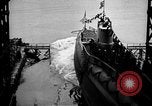
A mix of submarines from World War I to 1925
Sequence 1; The launching of the USS V-1 (later Barracuda SS-163) on July 17, 1924 from the Portsmouth Naval Shipyard in Kittery, Maine. Sequence 2; Two surrendered German U-Boats, most likely the U-117 (L) and the UB-148 (R) circa 1918/19. Sequence 3; The USS S-19 circa 1925 either looking to moor or pulling away to sea. Sequence 4; U.S. "L" class submarines ay Bantry Bay, Queenstown, Ireland circa 1918 World War 1, American submarines had to place an "A" before there name to avoid confusion with the British "L" class submarines. L to R are L-11 (bow), L-1, L-10, L-4 and L-9.
CRITICALPAST.COM: About Us | Contact Us | FAQs - How to Order | License Agreement | My Account | My Lightboxes | Shopping Cart | Advanced Search | Featured Collections | Website Terms & Conditions | Privacy Policy ©2026 CriticalPast LLC.
License Agreement |
Terms & Conditions |
Privacy Policy
©2026 CriticalPast LLC.