


 Francais
 Deutsch
 Italiano
Refine Your Search
Hoboken New Jersey 1918 stock footage and images
- Showing 6817 to 6822 of 9472 results more
more Hide
Hide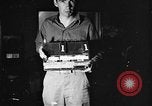
Re-enacted Radio Tokyo broadcast featuring Iva Ikuko Toguri as 'Orphan Ann'
Re-enacted broadcast of the 'Zero Hour' by Iva Ikuko Toguri as 'Orphan Ann' from Radio Tokyo. Iva Ikuko Toguri begins the broadcast, saying, 'Greetings everybody! This is your Number One Enemy, your favorite playmate, Orphan Ann on Radio Tokyo...the little sunbeam whose throat you'd like to cut! Get ready again for a vicious assault on your morale, 75 minutes of music and news for our friends...I mean, our enemies!' A male announcer, possibly her husband, Felipe d' Aquino, reads propaganda news about Pacific battles and American casualties. Toguri was wrongly tried and sentenced for being 'Tokyo Rose' a supposed Radio Tokyo character that was never identified. (World War II period).
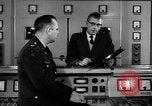
Lieutenant Colonel Robert Cranston at AFN (American Forces Network) radio station talks about its network coverage area.
Lieutenant Colonel Robert Cranston at AFN (American Forces Network) radio station. Animated map shows AFN transmitters and studios in Germany, France. Lieutenant Colonel Robert Cranston talks about the broadcast of AFN radio. Man walks through gate with 'American AFN Services in Europe' written on wall. View of a radio tower. AFN Munich Headquarters building. Sergeant Lloyd Eyre writes on a piece of paper. News readers operate controls and broadcast news from AFN Radio station. Includes various shots of radio studio equipment in control room and microphones in studio.

Montage of scenes during World War II on the Western front during January 1945
January, 1945, on the Western front during World War 2. Troops of the U.S. 8th Infantry Division test new white camouflage coveralls for use in snow. They patrol in snow covered forest areas on the Western Front. A sergeant makes outdoor field adjustments to the coveralls using a knife and captured German sewing machine. He helps a soldier who tries on his new coverall. The material used is from old mattress covers. Several soldiers are seen putting on the camouflage coveralls. Scene shifts to U.S. troops with a jeep towing a 20mm Italian dual purpose gun for use in Germany. On January 2, 1945, they set up and fire the gun at targets a half mile away. In Belgium, U.S. Army engineers of Company B, 238th Engineer Battalion, improvise remote controlled bazooka shells as road blocks. They set them up on fence posts and fire them by ordinary flashlight batteries. U.S. soldiers from a Signal Company of the 99th Infantry Division are seen using a Weasel vehicle (officially designated an M29C light cargo carrier) to lay communication cables through snow in the 1st Army Sector, Belgium. Views of the wire spool on back of the weasel, and soldiers pulling wire from it.

United States Army soldiers use sound deception to deceive the German in Film 'Sonic Deception'.
Film 'Sonic Deception' shows the use of sounds to deceive the enemy (sometimes described as the "Ghost Army" in World War 2). Dramatization shows United States troops crossing river in small boats and arriving on beach. They establish beachhead on river bank and defeat German troops located there, having arrived by suprise. Film recounts through actors how a German spy at a German army corps headquarters informs about the presence of United States tanks and trucks. Film demonstrates how sound recordings were used by U.S. soldiers to create false impression of troop activities including bridge building and tank and vehicle movements, in order to serve as a decoy and mislead Germany enemy forces about U.S. Army activities. Dramatization shows German officials consulting and looking at maps. German soldier looks through binoculars and informs officials through phone. Tanks cross a bridge and artillery on field. Actual scenes of front gate of Army Experimental Center station headquarters at Pine Camp in Great Bend, New York (upper New York State). U.S. Army soldiers are shown recording via microphone the sounds of actual bridge construction at the center. The microphone routes to a recording truck where a turntable for pressing recordings is running, creating a phonograph recording of the bridge building decoy sounds. Recording of other sounds is shown, including sound of a bulldozer at work, sounds of men unloading trucks, and sounds of tanks crossing a bridge. Soldier is seen selecting a phonograph record from the Army Experimental Station Library.
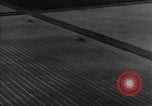
Views of the United States. Farms, cities, highways, and beaches. Destruction in Japan by atomic bomb. U.S. infantry in combat
Farmers harvesting grain and corn with machinery on American farms with a narrow tractor harvester. Steel mills and heavy industry and cargo railroads in the United States. Industrial views with smokestacks releasing much smoke and smog (also pollution scenes). Scenes of New York City with busy streets filled with cars, buses, and truck traffic, together with pedestrians. Many varied 1940s and 1950s cars on the roads. Elevated and also aerial views of U.S. highway networks busy with 1940s and 1950s cars. Views of Jones Beach, on Long Island, New York. Scenes of destruction in Japan from the atomic bomb, with sweeping views of destroyed city in Hiroshima or Nagasaki circa 1945 or 1946. U.S. Army infantrymen engaged in house-to-house fighting in Europe during World War II, firing rifles and moving between points of cover in a city filled with rubble.
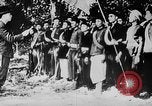
Cadres of Viet Minh holding flags. Ho Chi Minh, in declaration of independence,establishes Democratic Republic of Vietnam
Views of several cadres of Viet Minh holding flags. Image of Ho Chi Minh. Crowds gathered in celebration as Ho Chi Minh declares the independence of the new Democratic Republic of Vietnam. The Viet Minh flag with single star appears in many places as the flag of the new nation.
CRITICALPAST.COM: About Us | Contact Us | FAQs - How to Order | License Agreement | My Account | My Lightboxes | Shopping Cart | Advanced Search | Featured Collections | Website Terms & Conditions | Privacy Policy ©2026 CriticalPast LLC.
License Agreement |
Terms & Conditions |
Privacy Policy
©2026 CriticalPast LLC.