


 Francais
 Deutsch
 Italiano
Refine Your Search
Hoboken New Jersey 1918 stock footage and images
- Showing 7105 to 7110 of 9472 results more
more Hide
Hide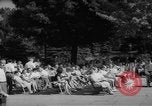
Social Director, Lou Goldstein, leading guest activity at Grossinger's Catskill Resort Hotel
Many summer guests are seated on chairs, outdoors at Grossinger's Catskill Resort Hotel (Grossinger Golf Course Liberty, New York, 12754 United States). Lou Goldstein, the resort Social Director, begins to lead a group activity involving a series of motions, such as raising their hands, stretching, and similar as they warm up for an activity. The action is repeated in another take and then continues. Closeups of the guests stretching in response to Goldstein's prodding. Next the guests form a large circle where some pass a medicine ball to each other. Closeup of Goldstein leading the group in clapping. He then directs a man holding the medicine ball to begin passing it to the person on his right. Closeup of others continuing to pass the ball around the circle. Goldstein participates in the circle and prods the others to keep passing the ball. Next, someone tosses the ball to Goldstein, who tosses it to another person, to conclude that activity. The group then reassembles in a casual way as Goldstein, standing above them, attempts to lead them in a game of "Simon Says."
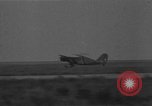
Italian aviator Francesco De Pinedo dies in fiery crash during takeoff in his Bellanca aircraft, the Santa Lucia
Italian aviator, General Francesco de Pinedo, attempts takeoff in his Bellanca airplane, named the Santa Lucia. The Italian flag is painted on the aircraft rudder. The ship is heavily laden with fuel for a solo long-distance flight from Floyd Bennett Field in Brooklyn, New York, to Baghdad, Iraq. The aircraft is seen to wander during the takeoff roll and with loss of control, crashes near a fence alongside the runway. The aircraft breaks into pieces, and with one wing sticking straight up in the air, begins to burn. It is immediately consumed in fire. Vehicles rush to the scene. Hangar number 6, at Floyd Bennett field, can be seen in background, with "Erickson and Remmert, Inc." painted on it. De Pinedo died in the accident.
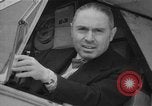
Italian aviator, Francesco de Pinedo, in cockpit of his Bellanca airplane, the Santa Lucia, before his ill fated last flight
Italian aviator, Francesco de Pinedo, sitting in the cockpit of his Bellanca aircraft, the Santa Lucia, on the ramp at Floyd Bennett Airfield, Brooklyn New York. The cockpit contains pillows and other items to help him endure a planned solo long-distance flight to Bagdad, Iraq.
Women work as the members of a community in the United States.
The role of women as active community members in the United States. An aerial view of the suburban town. View of the houses, buildings, snow covered area and roads. A railroad train arrives at a railroad station. Close views of the locomotive with sign "Erie" on the front. Men discuss a town zoning map on a wall. A garbage man throws garbage into a garbage truck. A post man delivers postal mail. He walks outside a house. He delivers a mail to a woman. The woman standing outside the house and takes the mail. Interior of the house. The woman sits with her family. A man reads a newspaper. Children have their breakfast. The woman opens the mail and views a sample ballot sheet listing the candidates of local elections. Little girl spills glass of milk on table. Her mother cleans up the spill. A woman shops in a grocery shop. View of small town grocery counter and shelves. The post man delivers mail to a woman in the grocery store. A woman sitting with her children gets mail from the postman. A man takes out a mail from a letter box. A woman stands with him. She reads the mail. Exterior of a school building. Interior of a class room. HIgh school or college age students studying. A young woman views a sample through a microscope. A post man walks on a road and vehicles move past, including a bus with sign "Lake Region Bus Co." Women come out of the bus after it comes to a stop. Destination sign on side of bus reads, "Monroe" (most likely Monroe New York). People stand in a line outside firemans hall to vote in local election.
Dimas Earthstopper, a dachshund is awarded as the best dog at the Westchester Kennel Club Fixture.
Crowd gathers for the Westchester Kennel Club Fixture in Rye, New York. People arrive with their dogs for the event. Dimas Earthstopper, a dachshund is awarded as the best dog.
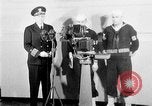
The Norden bomb sight is revealed to the U.S. public for the first time during World War II
The making of a public information film about the Norden bomb sight, during World War 2. Opening scene shows a Norden bomb sight on a pedestal, at the Museum of Science and Industry, in Radio City, Manhattan, New York City. It is flanked by U.S. Navy Captain, Irving Entwhistle and Shore Patrolman, Boatswain's Mate 2nd Class. Orville T. Payne. Another shore patrolman stands behind the bomb sight. The trio waits to begin. Then Captain Entwhistle begins to speak about the significance of the bomb sight to the war effort. The filming is interrupted and takes up again, focusing solely on Captain Entwhistle, as he continues to talk about the bomb sight, but is quickly interrupted, again, by the film director (heard, but not seen). The captain begins, repeating his scripted talk again. Scene shifts to Captain Entwhistle, now standing with hands on the bomb sight. He describes its operation as he maneuvers the sight. He notes the bomb sight's ability to take over control of the bomber's course to the precise drop point. Entwhistle, then looks up and comments: "Is that enough?" He then continues with his talk, but is interrupted, again. Next, Entwhistle picks up again, repeating part of his talk, while the camera pans over the bomb sight. Captain Entwhistle, states that, the instrument "is an automatic pilot, as well as a sight." He rotates the sight various ways for the camera, and asks: "'Want some more?" Scene changes, now showing Harold Barth, President of the Norden company, standing with Captain Entwhistle, who rotates the sight around on its pedestal, while chatting with him. (Microphones do not pick up the conversation.) Mr. Barth leans forward and peers through the sight. Next, in a closeup, the Captain manipulates the sight, while talking to Barth (sound not recorded). Mr. Barth and Captain Entwhistle, take turns looking through the sight. Closeup of the Captain looking through the sight, and manipulating its controls.
CRITICALPAST.COM: About Us | Contact Us | FAQs - How to Order | License Agreement | My Account | My Lightboxes | Shopping Cart | Advanced Search | Featured Collections | Website Terms & Conditions | Privacy Policy ©2026 CriticalPast LLC.
License Agreement |
Terms & Conditions |
Privacy Policy
©2026 CriticalPast LLC.