


 Francais
 Deutsch
 Italiano
Refine Your Search
Hoboken New Jersey 1918 stock footage and images
- Showing 733 to 738 of 9472 results more
more Hide
Hide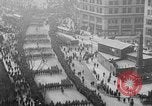
U.S. troops march along streets and officials and people wave to them in the U.S.
The United States of America in 1918. U.S. troops march along the streets. A crowd gathered to watch the troops. Aerial views of the troops marching. The people in a city, lined on both sides of the road, watch the troops. A number of Civil War Union veterans in uniform, watch from sidelines. Buildings on both sides of the road. The U.S. flags displayed on the buildings. Officials on the side of the road wave to the troops. The troops moving along a street. People in the balconies of the buildings wave to the soldiers. (World War i; World War 1; WWI; WW1)

U.S. Naval officers in Europe and the United States at the end of World War I
A glimpse of two U.S. Navy Captains exiting a dark alley, somewhere in France right after World War 1. Scene shifts to U.S. Admiral William S. Benson, the first Chief of Naval Operations, posing with Vice Admiral William S.Sims, Commander of all U.S. Naval forces in Europe. Several French men watch from inside an alley in the background. The two admirals turn to enter the building in the background. Next, a U.S. Navy Captain is seen standing on deck of a ship alongside another officer. Two American Naval officers smile and converse at a waterfront, in the United States. One is dressed in work overalls.A workman sits behind them in a shack that has a hand-scrawled message on the door reading:""No Smoking Allowed in here." Complete change of scene shows a line of young U.S. Naval officers replete with swords, entering a large brick Georgian revival building by way of a stairway at a side door. It appears they are entering an auditorium. What looks like a 1918 Phaeton car is parked at the curb outside. The officers number in the dozens. Another change of scene shows closeup of a an unidentified, relatively young, clean shaven, U.S. Naval Rear Admiral, posing in front of a stone wall behind which the tops of several widely separated buildings are seen. He removes his hat.
Bolshevik leader Lenin, Commander of the Red Army Leon Trotsky and Russian soldiers during the Civil War in Russia.
Scenes from the Russian Revolution and years immediately after in Russia, roughly 1918-1921. Troops moving in the snow. Vladimir Ilyich Lenin, the Bolshevik leader, makes peace with the Germans. The Civil War breaks out in Russia. White Russians continue war with World War 1 allies, against Germany. Czarist Cossacks seek to restore the monarchy of Nicholas II. Photograph of the Russian Czar and family sitting outdoors on the ledge of a wooden building. Secret police seen arresting people. Bolshevik firing squad executes three prisoners, who fall dead into a mass grave behind them. Lenin, holding a kitten in his hand, seated at a table. March 7, 1921: Workers and sailors gathered on the streets, in Kronstadt, demanding peace, freedom, and bread. Red Army Troops disperse the crowd, shooting many of them. Leon Trotsky, Commander of the Red Army, states that the slaughter was necessary. Trotsky seen walking with other officers. People on the sides of a path watching Trotsky. Families looking over dead workers and sailors in a field.
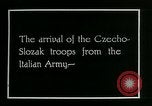
Crowd cheer as troops arrive and men cover statue of Joseph Radetzky in Prague, Czechoslovakia after independence.
A film on 1918 celebrations of independence as the Habsburg reign ends in Prague, Czechoslovakia. Czecho-Slovak troops look out from a railroad train window as they arrive in Prague. Troops stand holding their flag. The troops arrive from Austria. People cheer as troops march. People cover the statue of Joseph Radetzky von Radetz in front of the Radetzky Memorial at the Malostranské náměstí, the main square of Malá Strana (Lesser Town) at the foot of Prague Castle. Cartoons and caricatures of Kaiser and Crown Prince. Pictures of the cabinet members of Czechoslovakia. Troops depart from Slovakia to hold the Hungarian border on horse carts and horses. Battisti, the brother of the executed Italian deputy in a car. (World War I; World War 1; WWI; WW1)
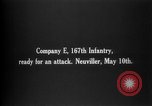
Company E of the U.S.167th Infantry Regiment (A.E.F.) at their base in France during World War I
Soldiers of Company E, U.S. 167th Infantry Regiment, American Expeditionary Forces (A.E.F.), 42nd Infantry Division (Rainbow Division) at their base in Neuviller-la-Roche, France,on May 10, 1918, during World War 1.They demonstrate readiness to defend against attack, entrenched behind barbed wire defenses set up in a grove of birch trees. Sentries, of Company E, walk their posts and occupy lookouts at an established outpost constructed of logs and masonry.
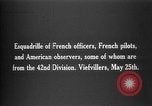
American A.E.F. observers pose with French fliers at airfield in World War I. A French Letord twin engine reconnaissance plane.
A French airfield, in World War 1. Escadrille of French Officers, pilots, and American observers (some from the A.E.F. 42nd Infantry, Rainbow Division) pose in front of a Spad biplane on May 25, 1918, in Viefvillers, France. An American flag has been affixed to one of the wing struts of the plane. Front View of a large French Letord twin engine biplane used for armed reconnaissance and photography, parked on a grass field in France. A soldier turns one of its curved propellers.Fliers occupy pilot and gunner positions. Tents seen in background.
CRITICALPAST.COM: About Us | Contact Us | FAQs - How to Order | License Agreement | My Account | My Lightboxes | Shopping Cart | Advanced Search | Featured Collections | Website Terms & Conditions | Privacy Policy ©2026 CriticalPast LLC.
License Agreement |
Terms & Conditions |
Privacy Policy
©2026 CriticalPast LLC.