


 Francais
 Deutsch
 Italiano
Refine Your Search
Hoboken New Jersey 1918 stock footage and images
- Showing 7465 to 7470 of 9472 results more
more Hide
Hide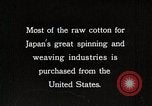
Cotton industry and urbanization in Japan
Cotton production, transport, and urbanization in Japan. Shipment of raw cotton from the United States are unloaded from a freighter on a Japanese port. Dock worker pulls lever. The package is offloaded from the ship. Various machines process United States cotton in Japanese factories. OSK Line ship Naruto Maru sailing in New York City. The captain of the Naruto Maru stands beside the Japanese flag. The urbanization of Japanese cities. Overcrowded houses and slum areas because of industrialization in Japan. Vehicles move on the road in a Japanese city.
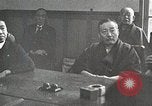
China builds Burma Road to carry war materiel and supplies and creates flood of Yellow River to thwart Westward expansion of Japanese occupied territory
Japanese officials meeting in strategy session. Japanese infantry on mission to cut Chinese supply lines during 2nd Sino-Japanese war. Black smoke rises as they move along a river bank. Chinese prisoner-workers are forced to rebuild railroads destroyed by the Chinese people during their great Westward trek. Japanese soldier closely guards workers. A Japanese army armored train underway on the rebuilt railroad, as Japanese soldiers cheer. Animated map shows China's supply lines by sea, to Tsingtao, Hangchow, and Amoy, cut off by Japanese naval blockade. Japanese Navy launch with officers and crew moving near commercial ships as they take over Chinese river ports. War materiel and other supplies destined for China, including trucks, sit idle, unable to be transported to their destinations. Large oil tanks and drums of gasoline are shown, as well as gun barrels and a flightline filled with parked Curtiss P-36 Hawk aircraft. The Imperial Japanese Navy destroyer Asakaze (DD-3) and another, next to it, in a Chinese river port. A Japanese freighter with anchored weighed, secured by long lines to a wharf. Small boats flying Japanese Naval ensigns are next to it. View of map showing china, Burma, Indo-China, and Chungking, with Japanese blockading fleet stationed in the South China Sea. It traces path of narrow gauge rail line from Indo-china to Kumming,China, where it connected to an overland road to Chungking. Next it traced the old Camel Caravan route, across China, from Russia. Narrator notes these were to small to be useful and too close to Japanese-occupied territory. Next, the map traces a railroad that from the port of Rangoon to Lashio, Burma. It is separated from the road to Chungking, by mountains and gorges. Views of the actual mountainous terrain. Animal pack trains moving through the area. Construction engineers in a large drafting room designing a road to transit the area. View of modern road-building caterpillar tractor equipment of the type needed to accomplish this. View of Chinese laborers using manpower instead. They push large rollers and employ pickaxes and other hand-held tools to carve away and dig road beds. Masses of Chinese laborers at work, carving a road along the edge of a mountain. Two-men teams using manual tampers to pound down the roadbed. Children are employed along with adults. A woman with a baby on her back, pounding large rocks into gravel, surrounded by other children doing the same. View from above of the "Burma Road," the product of their labors, winding its way through the mountains and gorges. Many scenes of trucks moving along portions of the Burma Road. P-40 airplanes flying past white cumulus clouds, overhead. Animated map shows continued expansion of Japanese occupied areas to encompass two thirds of the rail lines in China with goal of controlling the remainder, starting at Chengchow, in Summer, 1938. View of Chengchow region, on banks of the Yellow River. Map illustrates flow pattern of the Yellow River. View from past of the Yellow River's Spring floods toward the Sea, with Chinese people throwing rocks onto dikes that keep the river flowing in a more Northerly direction than its former course. Illustration shows how with Japanese encrouching on Chengchow, the Chinese decided to destroy those dikes and allow the river to flood over its former more Southerly course. Japanese soldiers being inundated by the flooding river. Japanese infantry and tanks regrouping on their occupied side of the new (old) path of the Yellow River. Local Chinese residents of Chengchow, wade with belongings as they leave their flooded homes.
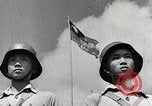
Battle of Changsha in China during the Second Sino-Japanese War (WW2)
Closeup of two Nationalist Chinese soldiers with their flag flying on tall flagpole in background. Next, countless numbers of Chinese soldiers are seen marching along the Great Wall during the Second Sino-Japanese War (World War II). Newspaper article reads: "52,000 Japanese fall at Changsha." Animated map depicts China and environs, with major cities. Areas of Japanese occupation are shown in black. The city of Changsha is highlighted by a circle. Japanese force is shown massing at Yueyang (Yochow), near Dongting Lake (Ting Tung Hu Lake), and advancing on 24 December 1941, toward Changsha. The map shows Chinses forces putting up token resistance and retreating to the East (rather than toward Changsha) and Japanese forces beginning assault on Changsha, New Year’s Day, 1942. Map shows the Chinese forces from the East attacking and cutting the Japanese supply lines. Japanese forces besieging Changsha are forced to retreat under counterattack by the Chinese. A field artillery piece being fired by Chinese forces and explosion and smoke from its shell striking. More field artillery being fired. Japanese forces carrying their Rising Sun flag as they retreat under fire. Chinese infantry firing from a berm A Japanese soldier falls to gunfire. Japanese soldiers retreating across a narrow-improvised bridge across a swamp. Chinese soldier next to a building, firing a Czech ZB vz. 26 light machine gun. Japanese running with horses through a village. Chinese gunner firing Japanese Type 92 machine gun down on Japanese troops retreating across a bridge below. Another Chinese soldier firing a Czech 26 light machine gun, from hill overlooking retreating Japanese troops, below. Victorious Nationalist Chinese troops parading in celebration along a road high above buildings of a town below in background. Men in Khaki pants and white shirts parading. Girls in white dresses, carrying Chinese flags. Soldiers marching (without weapons) celebrating.
CARE 'Self Help' orders and farming equipment aid for Greece
CARE 'Self Help' orders for Greece typed and put in envelope in New York office. Two Americans attach a CARE clipper plow to a donkey in Greece. Greek farmers with two Americans from the CARE program in a field. Greek farmer plows field with CARE clipper plow donated from America. Wife of Greek farmer holds and admires a high quality shovel donated to help the Greek farmers. Greek farmer speaks to other farmers on field.
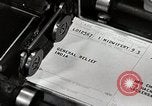
CARE 'Self Help' order for General Relief Midwifery in India
CARE 'Self Help' order for General Relief Midwifery in India is typed in New York office. CARE Midwife kit includes antiseptic soap, bowl and surgical instruments. American woman trains Indian midwives on the use of CARE midwifery kit at WHO Training center in Najafgarh Indian midwife is called upon to help deliver a baby. Indian midwife washes hand with soap. Midwife uses CARE midwifery kit to help mother deliver a baby.1950.
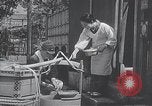
Children learn to write Chinese characters (Kanji), play baseball, and practice kendo in Japan.
A Japanese maid buys soft tofu (soybean curd) from a street vendor. Street vendor cuts a block of tofu. A Japanese woman practices Ikebana flower arrangement. Japanese woman places the finished flower arrangement on the Butsudan, a small household Buddhist shrine for family ancestors. An old Japanese woman sews on a new kimono while a little boy plays with his toys. Japanese woman bows in front of the Butsudan. At the railway station the Tokyo Express steam train arrives on time and official in-charge writes the train report. Engineer inspects steam train. Children learn to write Japanese characters inside a classroom. Schoolchildren use bamboo calligraphy brushes to write basic Chinese characters or Kanji. Japanese boy writes Chinese characters that read “Great Japan”. Children play baseball during school recess. Older children practice kendo, a modern Japanese martial art.
CRITICALPAST.COM: About Us | Contact Us | FAQs - How to Order | License Agreement | My Account | My Lightboxes | Shopping Cart | Advanced Search | Featured Collections | Website Terms & Conditions | Privacy Policy ©2026 CriticalPast LLC.
License Agreement |
Terms & Conditions |
Privacy Policy
©2026 CriticalPast LLC.