


 Francais
 Deutsch
 Italiano
Refine Your Search
Hoboken New Jersey 1918 stock footage and images
- Showing 7639 to 7644 of 9472 results more
more Hide
Hide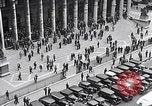
A large crowd at the Paris Bourse and people on the streets in Paris.
A large crowd emerges from the Paris Bourse (Paris Stock Exchange). Rows of motorcars parked outside. The dealing room inside the Stock Exchange. A man with sign boards fixed onto his back. Men and women in the crowd. A Catholic Nun. Men near a news stand or book stall. A man pulls a cart on the road. A traffic policeman minds the traffic. A park.

Invention of an 'Amphirol', British Army six wheel carrier and a jalopy race in Europe.
A Dutch invention called the 'Amphitron' or the 'Amphirol'. Men seated on it. The vehicle driven on land and in quicksand. Tracks in wet mud. The driver at the controls. The amphitron taken into water. The British Armys new six wheel gun and personnel carrier zips uphill and downhill on steep slopes. A jalopy race underway at the Brands Hatch Track in England. British and American drivers participate. The cars flip, bump and bash into oil barrels on the tracks. A large crowd witnesses the event.
Men and women sailors join and serve in the U.S. Coast Guard, and citations for those who gave up their lives in battle.
'Battle Stations' depicts life as a United States Coast Guard. Medals lie on citations for gallantry in action during the landing on Tulagi Island. Images of U.S. Coast Guard cutters at sea and soldiers in battle as the citations are read out. U.S. CG troops during a parade. Sailors with rifles. They march with the U.S. flag. CG cutters in heavy seas. Sailor watches through binoculars. A sailor at the deck gun, another sends a semaphore signal. The Congressional Medal of Honor lies on a citation for heroism and gallantry in action during the evacuation of a battalion on Guadalcanal. Bodies of U.S. Coast Guard sailors wrapped in U.S. flags. Sailors salute as bodies are loaded. Women take the oath as they join the U.S. Coast Guard as U.S. Coast Guard SPARS (US CG Women's Reserve). Training Station: New SPARS recruits arrive as graduates leave the station. Recruits on bunk beds, during training, getting uniforms, on bicycles, and attending classes. Class of SPARS graduates receiving diplomas. Narration by Ginger Rogers and James Cagney.
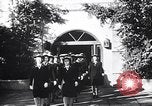
U.S. Coast Guard sailors and SPARS report to various Battle Station across the United States.
U.S. Coast Guard SPARS (US CG Women's Reserve) march at the Training Station. CG men and women recruits take their places at various Battle Stations across the U.S. U.S. CG men and women personnel report for duty on shore and at sea. SPARS arrive in Washington and New York. A sailor watches through binoculars, a SPARS with documents, sailor on cutter, SPARS drives a car, sailor by a plane. A radioman and woman operate the radio. Men and women gunner mates on cutters. A U.S. CG pilot in the cockpit, SPARS parachute riggers at work. A deck gun on a cutter. A crew of 8 sailors observe the gun. SPARS take their places at a shore station. The captain and his crew come aboard a cutter. U.S. CG cutters at sea. Includes narration by Ginger Rogers and James Cagney.
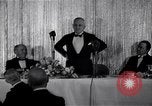
Official of the Boys Clubs of America awards a Medal to J Edgar Hoover at a ceremony in the United States.
First Director of the Federal Bureau of Investigation (FBI) of United States, John Edgar Hoover awarded a Medal in the United States. An official of the Boys Clubs of America addresses the attendees. He states that Hoover is only the second person to receive the Medal after John Hays Hammond in 1934. He talks about a poll at the New York Boys' Club that depicts Hoover as an inspiration to the youth. He reads out the citation and presents the medal to Hoover. Hoover accepts. The official displays the Medal.
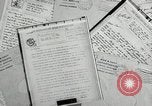
Views of Lexington Main Street and University of Kentucky on 'By Request' program for American soldiers.
Women's Army Corps (WAC) Sergeant in broadcasting studio for the Army Navy Screen Magazine feature called: "By Request." She holds a letter received from 43 American soldiers ("foxhole buddies") in New Guinea. They ask "By Request" to show them scenes from the University of Kentucky, where they trained, and some shots of Lexington, Kentucky. The program continues with motion pictures of the requested scenes, beginning with the Phoenix Hotel and a theater on the Lexington Main Street. Pedestrians on the side walk and cars parked by the roadside. Keith's Bar and Chop House. Bartenders and waitresses serve beer. A roller coaster, known as the Wildcat (after UK's mascot) at the Joyland amusement park, located on Paris Pike north of town. The University of Kentucky campus. GIs and women soldiers on campus. A sign for the University. Soldiers take pictures by the statue of James Patterson on campus. (Given the lack of foliage on the trees, this film was obviously taken sometime between November and March. ) (World War II period).
CRITICALPAST.COM: About Us | Contact Us | FAQs - How to Order | License Agreement | My Account | My Lightboxes | Shopping Cart | Advanced Search | Featured Collections | Website Terms & Conditions | Privacy Policy ©2026 CriticalPast LLC.
License Agreement |
Terms & Conditions |
Privacy Policy
©2026 CriticalPast LLC.