


 Francais
 Deutsch
 Italiano
Refine Your Search
Hoboken New Jersey 1918 stock footage and images
- Showing 8173 to 8178 of 9472 results more
more Hide
Hide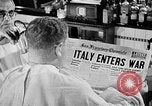
President Franklin Roosevelt denounces Italy's entry into the war as Germany invades France; German operations in South America
June 10, 1940, American man, in San Francisco barbershop, reads newspaper report that Italy enters World War 2 as part of Axis and against France and Britain. Barber cuts the mans hair. They both look over at a portable radio on a counter and listen as President Roosevelt denounces Italy's action. American family with a husband, wife, and boy sit in a living room and listen to the radio while William L. Shirer broadcasts from Compiègne as France signs an armistice with Hitler. Views of railroad carriage in clearing surrounded by German troops in formation. Hitler strides with Hermann Goering, Admiral Erich Raeder, and others. Statue of Marshal Foch. French General Huntzinger, and his delegation escorted by German officers. Hitler and his delegation rise as the French delegation enters the rail car. Germans drape Nazi flag over the Glade of the Armistice monument (French: Clairière de l'Armistice). View of the Eiffel Tower. German troops marching through the Arc de Triomphe on the Champs Elysee in Paris. Hitler's railroad train entering Paris station. Hitler taking an early morning tour of Paris in an open car. Hitler and party admiring the Eiffel Tower during German invasion of France and occupation of France. View from Eiffel Tower of German troops marching along street. German rail guns in new positions on coast of France, pointed toward the English Channel and England. The German rail guns moving on tracks and firing. Animated map showing Allies overseas possessions. German residents in Brazil in largely German communities, with German schools, German school children, Nazi textbooks, and Nazi German newspapers in a town in Brazil. A Hermann Goering glider club operating in Brazil, as a glider is prepared for flight. View of Japanese residents in Brazil on behalf of Imperial Japan. SEDTA German airline planes with bomb racks operating in Ecuador, South America. Germans exercising at exclusive German clubs in Argentina, modeled after Hitler Youth. Narrator indicates these operations represented a "Fifth Column" ready to take over.
A large crowd gathers at the funeral of U.S. President Franklin Roosevelt (WW2)
United States President Franklin Roosevelt passes away. A large crowd gathers to attend the funeral. Officer carries the dog of the President. President Roosevelt's body is placed on a special train at Warm Springs, Georgia. People gather all along the way to pay tribute to President Roosevelt in World War II. The train is met at Washington DC by Vice President Truman and Henry Wallace. Cars parked on the street. People gather in large numbers to attend the funeral. The body is carried by caisson to the White House. War planes in formation. Soldiers march in honor of the President. Vehicles passing on the street. People weeping. Funeral ceremonies are held in the rose garden at the Home of Franklin D. Roosevelt (4097 Albany Post Rd, Hyde Park, NY 12538, United States) in Hyde Park, New York. People bowing and soldiers saluting in front of the casket. Eleanor Roosevelt standing near the casket.
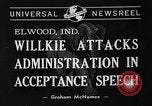
Wendell Willkie arrives in his home town and formally accepts the Republican Presidential nomination before the crowd.
Wendell Willkie arrives in his home town after being nominated as the Presidential candidate. Wendell Willkie in a car. A large crowd gathers to greet him. Crowd cheering and applauding. He stands on the podium and addresses the crowd. He formally accepts the Republican Presidential nomination before the crowd. Addressing the crowd, he states that the domestic and foreign policies of the New Deal is leading the nation into war. He endorses the draft for U.S. defense and dares President Roosevelt to meet him for a public debate on questions vital to all Americans.

President Franklin Roosevelt signs the Selective Training and Service Act of 1940. U.S. soldiers march and drill in a camp.
America prepares for World War II. U.S. President Franklin D. Roosevelt signs the Selective Training and Service Act of 1940 (codified as 54 Stat. 885). He signs and dates September 16, 1940. A blindfolded man reaches into a large glass container and draws out the number of the first young man to be drafted under the new law. He gives the selected number to President Roosevelt. American soldiers march past a line of tents at an Army Camp. They drill on the parade field.
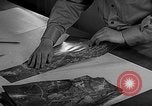
The film mosaic of T-3A camera is assembled together and interpreted in United States.
A U.S. Army training film about interpreting a camera film with aerial views. A print of T-3A camera film is developed. The mosaic prints are mounted by adhesive or staples. Completed mosaic is matched for contrast control networking. It is contrasted with U.S. geographical survey sheets and road maps. These are used to mark known places. Then these prints are pasted together. These pictures are send to an interpreter officer who translates the desired information. He uses stereoscope to find new enemy gun position, camouflage or other informations. (World War II period).
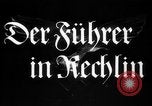
Adolf Hitler, Hermann Goering and officers watch test flights of German aircraft at Rechlin airfield in Germany.
Adolf Hitler and German officers attend inspect and review test flights of new Luftwaffe aircraft in Rechlin, Germany. Hitler and Commander of the Luftwaffe, Hermann Goering, and other officers exit a railroad train at station. Officers at the platform greet Hitler and give a Nazi salute. They all move towards cars. The cars are driven off. Hitler waves at the crowd and greets a young girl who gives him flowers. At the airfield, Hitler and Goering view various aircraft with their entourage at Rechlin Airport. Goering points out a separate cockpit and engine displayed beside a bomber aircraft. A crew member assembling parts of an aircraft. Hitler watches the test flights of German aircraft. DFS 230 glider being towed on the ground for takeoff and then taking flight. Pilot and crew member crank start a fighter aircraft. Wide view of a Messerschmitt Bf 109 shortly after takeoff and gaining altitude. Next, a Blohm & Voss BV 141 tactical reconnaissance aircraft (BV 141A with complete tail) starts engine, taxis and takes off. Three Heinkel He 111 bomber aircraft are seen taking off. The last He 111 appears to employ rocket-assisted takeoff (RATO). The entourage of officers crosses the airfield by open automobile and then exits the cars to view more aircraft. Views of early model Dornier Do 217 aircraft in flight overhead. A Junkers Ju 88 aircraft flies by low and then climbs steeply. Brief view of a low flying attack aircraft that appears to be a Henschel Hs 129 (or possibly a Focke Wulf Fw 187) flying just above the airfield. Next is seen a twin boom aircraft, presumably a Focke-Wulf Fw 189, but with a shorter central crew gondola than later variants. The next scene shows good views of the Blohm & Voss BV 141 low in flight and then performing a rapid ascent and descent. It is followed by a low flying Blohm & Voss BV 138 Seedrache (Sea Dragon).
CRITICALPAST.COM: About Us | Contact Us | FAQs - How to Order | License Agreement | My Account | My Lightboxes | Shopping Cart | Advanced Search | Featured Collections | Website Terms & Conditions | Privacy Policy ©2026 CriticalPast LLC.
License Agreement |
Terms & Conditions |
Privacy Policy
©2026 CriticalPast LLC.