


 Francais
 Deutsch
 Italiano
Refine Your Search
Hoboken New Jersey 1918 stock footage and images
- Showing 9157 to 9162 of 9472 results more
more Hide
Hide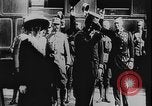
Emperor Karl I and Empress Zita after coronation, Italian POWs, SMS Szent István, WWI
Austro-Hungarian Emperor Karl I and wife, Empress Zita of Bourbon-Parma, meets military officials and commoners in Vienna shortly after their coronation. Empress Zita receives flowers, shakes hands with children. Austro-Hungarian citizens welcome the new emperor and his wife. Empress Zita and Emperor Karl receive more flowers from adoring children. Emperor Karl I meets Austro-Hungarian generals and infantry. Emperor Karl I speak to soldiers fighting for Austria-Hungary during World War 1, giving them reassuring pat on the back. Emperor Karl I rides a horse with retinue. View of Italian prisoners-of-war in Austria. Emperor Karl I onboard SMS Szent István, also known as His Majesty's Ship Saint Stephen (the last of four Tegetthoff-class dreadnought battleships built for the Austro-Hungarian Navy).
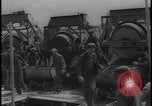
German laborers construct the Siegfried Line on the western border of Nazi Germany
German laborers pour concrete from cement mixers during work on the Siegfried Line defense fortification in western Nazi Germany. Two men talk beside a high-speed cement mixer. Concrete pours into bucket that are then hoisted to pour into forms. Mixers rotate, process cement. Mixer pours cement down shoot into forms. Water being sprayed on newly created Dragon's teeth tank barriers to cure concrete via hydration. Shirtless laborers dig soil with shovels amongst surveyor's stakes indicating placement of new barriers. Men walk in trench. Man arranges grasses outside finished bunker to ward off soil erosion. Men tamp down soil with shovels. A man waters newly planted pine tree saplings.
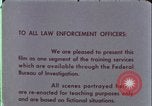
City scenes, pedestrians shopping, cook, secretaries, machinist, printing press, United airplane
A written introduction by Federal Bureau of Investigation (FBI) Aerial view of the 8200 block of Georgia Ave., Silver Spring MD. (Little Tavern at 8230 Georgia Avenue seen left side of street) Pedestrians with shopping bags walking outside the J.C. Penney Co. department store at 8650 Colesville Rd. Silver Spring, MD 20910. Two women typing documents at the offices of Capital Film Laboratories 470 E Street SW Washington, D.C. 20024 A short order cook at a restaurant kitchen window, rings bell after placing food on counter for the server. Waitress places a new order to line cook by placing check on rotating check-minder. A machinist shapes metal using a lathe at D. Ballauf Manufacturing Company ( 619 H Street, N.W. Washington D.C.) View of receipts next to lathe operator. Man picks up newspaper printed from printing machine. Newspaper printing press running, likely at the Washington Post or Washington Star. Mechanic working under the hood of a car. A receipt next mechanic reads, "replace fuel pump." Front end loader scoops soil in construction site. Surveyor looks through transit scope and takes notes at a construction site. A forklift operator moves a Gibson refrigerator, still in box, from a loading dock truck. Man signs a receipt at an appliance wholesaler. A United Airlines Douglas DC-8-11 passenger airlplane taxiing on a runway, likely Washington National Airport, before takeoff. A United Airlines officer checks his watch, takes down notes. A Metropolitan police officer stands behind a counter while listening to a woman as he fills out a missing person report .
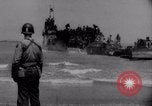
Reinforcements arrive in Normandy after its capture by Allied forces on D-Day during WW2
British, Canadian and United States soldiers clear up beachheads, receive reinforcements in Normandy after D-Day in World War 2. Soldiers sit on the beach, a sign says “Navy Beach C.P.”. Infantrymen dig in on the beach for protection. Sitting behind sandbags, a soldier fixes his belongings. Reinforcements and new supplies arrive in Normandy. Reinforcement troops and equipment land on beach. Soldiers in moving US Army truck. M4 Sherman-dozer, a tank with a bulldozer blade and outfitted with snorkel exhaust to make it a wading tank, also known as a tank dozer, clears the beach. This M4 dozer was named "Double Trouble" and operated by the 70th Tank Battalion. A body is seen in the foreground. Soldiers land on beach from LCM (Landing Craft Mechanized). Reinforcements carry supplies on their backs. Heavy machinery and vehicles land on beach from ships. GMC CCKW cargo trucks on beachhead in Normandy. Armored tanks (M4 Sherman tanks) move into a French town. Soldiers walk in meadow. A light tank enters a road towards Ver-sur-Mer. The location might be La Platine, just outside Courseulles-Sur-Mer. A sign reading “Dump Mae West” indicates to soldiers where to drop their life preservers. An M10 tank destroyer crosses a bridge. Infantrymen move into beach and grassy field. A Mk IV Centaur tank crosses a bridge. United States soldiers march along wall, one carrying a metal detector. A soldier carries carries a heavy machine gun, possibly a Browning M1917, and ammunition belt on his shoulders. United States Infantrymen wade through muddy water, passing by the corpse of a German soldier.
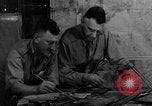
US General Joseph Stilwell with Major General Frank Dow Merrill; Allied soldiers in China Burma India Theater training in India during WW2
United States General Joseph Stilwell discusses plan with Major General Frank Dow Merrill during World War 2. Insignia of the China Burma India Theater (CBI). Nationalist Chinese soldiers march toward a United States Army Air Force transport plane to India. USA Army Air Force plane takes off, heading for India. At the U.S. Army Chinese Training and Combat Command at Ramgarh, India, Chinese soldiers train under the United States Army leadership. Aerial view of tents and buildings at Ramgarh. General Stilwell personally instructs Chinese soldiers as they shoot at targets while in prone position. Chinese troops charge out of a trench, crawl with guns under barbed wire, and avoid gun fire and explosions. India Command Formation insignia. British General Archibald Wavell inspects soldiers in formation. General Archibald Wavell shares a map with Field Marshal Claude Auchinleck, who was made Commander in Chief, India, for the British. British Indian soldiers seen in training, as they lift logs, jump over obstacles, climb ropes, and practice jumping from a parked airplane fuselage during parachute training. Next, soldiers are seen jumping out of an aircraft in flight with parachutes. British Indian soldiers descending with parachutes. United States soldiers unload supplies. Allied soldiers marching. Indian infantry marching in farmland. Gurkha soldiers from Nepal march with donkeys. Naga headhunters from Assam and northwestern Burma. East and West African soldiers. British colonial regiment, the Burma Rifles marching. Soldiers from the Kachin people of Burma and Southwestern China. Allied soldiers in India coming from various races- Scots, Irish, English, Welsh, Australian, New Zealander, Indian, Gurkha, Burman, African, Chinese and American. Multinational army from Allied countries.

United States President John F. Kennedy addresses the United States Congress for defense and space program budget increase
United States President John F. Kennedy addresses the United States Congress, appealing to increase the budget for defense and support for the space program. Congressmen clap upon the arrival of President Kennedy in the United States Capitol. Cameramen capturing videos of President Kennedy’s address using very long lenses. “These are extraordinary times. And we face an extraordinary challenge. Our strength as well as our convictions have imposed upon this nation the role of leader in freedom's cause.”, President Kennedy begins his speech. “I have not asked for a single program which did not cause one or all Americans some inconvenience, or some hardship, or some sacrifice. But they have responded and you in the Congress have responded to your duty--and I feel confident in asking today for a similar response to these new and larger demands. It is heartening to know, as I journey abroad, that our country is united in its commitment to freedom and is ready to do its duty” said President Kennedy, concluding his speech to the United States Congress.
CRITICALPAST.COM: About Us | Contact Us | FAQs - How to Order | License Agreement | My Account | My Lightboxes | Shopping Cart | Advanced Search | Featured Collections | Website Terms & Conditions | Privacy Policy ©2026 CriticalPast LLC.
License Agreement |
Terms & Conditions |
Privacy Policy
©2026 CriticalPast LLC.