


 Francais
 Deutsch
 Italiano

Refine Your Search
Hoboken New Jersey 1918 stock footage and images
- Showing 1621 to 1626 of 9492 results more
 Hide
Color Sound
American soldiers and Australian soldiers arrive in Buna, New Guinea during the Battle of Buna-Gona.
A film on the Battle of Buna-Gona in New Guinea during World War II. A map showing distance of Buna from Australia and Port Moresby. Thick jungles in Buna-Gona. American soldiers arriving in aircraft. The troops in trucks. An aircraft in flight. The soldiers inside the aircraft. Men trained in Australia. The aircraft arrives at a field. Australian soldiers get out of the aircraft. The soldiers and Papuan natives in the field. The natives carrying supplies move across a marshy area in the jungle. The soldiers holding guns crossing a water body. The soldiers moving across a bridge. The soldiers among the trees. The soldiers and the natives working to build a log bridge in the jungle. An M-3 tank moving on the bridge with a soldier atop the tank. Other soldiers watching the tank. Engineers building another bridge in the jungle. The Papuan natives carrying the supplies move on a path in the jungle. The natives wading through a water body. The 114th Engineers building a native-type hut. Wounded soldiers are carried on stretchers on the bridges by the natives and are evacuated. The soldiers and the natives beside the hut drinking from cups. The natives watch the soldiers. Several soldiers seated on the ground. A few soldiers inside the hut planning their action.

American and Australian soldiers fire guns and advance into a jungle in Buna, New Guinea during the Battle of Buna-Gona.
The Battle of Buna-Gona in New Guinea during World War II. A patrol moving along a beach. American and Australian soldiers place a machine gun on a beachhead. The soldiers fire guns. A few soldiers lying beside the machine gun and firing. Soldiers holding guns lying in prone position on the beachhead. The soldiers fire mortars. A few soldiers on the edge of the beach moving forward. The soldiers are creeping with guns into the jungle and firing. They are firing from among the trees. The soldiers fire from their concealment in a hedge. A vehicle in the jungle covered with trees. Logs of wood lying about in the jungle. A trench in the jungle. The soldiers moving on a forest trail. Several dead Japanese in a trench.

American and Australian soldiers examine captured Japanese guns in Buna, New Guinea during the Battle of Buna-Gona.
A film on the Battle of Buna-Gona in New Guinea during World War II. American and Australian soldiers examining captured Japanese guns. A soldier holding a gun kneeling on the ground. Other soldiers standing around him and watching. A soldier holding another captured gun. A few soldiers moving on a beachhead. Dead body of a Japanese soldier. Japanese prisoners moving along a forest trail escorted by soldiers.
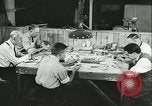
WPA workers build a massive scale model of New York City; also WPA art, library, and theater programs
Works Progress Administration (WPA) projects in New York City during the Great Depression. Skilled architects, draftsmen, and artists work for the WPA on a massive scale model of New York City, built in cooperation with New York University (this model predates the famous Panorama of New York City model built for the 1964 World's Fair). An artist is seen leaning over part of the model painting one of its features, which include detailed roads, bridges, buildings, and waterways. A hand lifts a building and measures its base with a ruler. Cartographic Survey WPA workers are seen creating a relief map of Staten Island for educational use. Men and women artists, including sculptors, are seen creating new sculptures funded by WPA. A man carves a bust in an art studio or class. Another man carves a relief stone commemorating Dewitt Clinton. A man stands in a Free Library and looks at books. Two women on a park bench look at books from the WPA Free Library holdings. A skilled artist is seen laying out and buildings stained glass windows for the United States Military Academy at Westpoint in New York. Stained glass panels depicting George Washington and soldiers are seen. A series of the George Washington stained glass windows is seen in place, with the artist applying final touches. Men work on the Federal Theater Project. Billboard signs advertising various WPA funded theatre productions in 1936 are shown, including Jefferson Davis, The World's Greatest Circus, Taking the Air, The Mikado, Macbeth, All American Minstrels, Battle Hymn, and Horse Eats Hat.

Funeral of Cardinal Patrick Joseph Hayes at St. Patrick’s Cathedral, New York City
Funeral of Archbishop of New York Cardinal Patrick Joseph Hayes at St. Patrick's Cathedral (5th Ave, New York, NY 10022, United States) in New York, United States. Priests and dignitaries enter the Cathedral. New York residents walk in line to pay their last respects to the late cardinal. Catholic nuns praying inside the cathedral. Engraved writing inside the cathedral reads 'The Archbishops of New York'. An empty crypt inside the cathedral. Cardinal Hayes’ body lies in the state before burial in a special crypt.

United States President Lyndon Johnson attends funeral of First Lady of New York, wife of Mayor Robert Wagner.
United States President Lyndon B. Johnson attends funeral of Susan (Edwards) Wagner, wife of Mayor of New York City Robert F. Wagner. Scene is outside the Madison Avenue Presbyterian Church (921 Madison Ave, New York, NY 10021, United States) in New York City. Roman Catholic Francis Joseph Cardinal Spellman attends the Presbyterian funeral service. President Johnson arrives by car at the church. The sidewalk is lined with New Yorkers paying their respects. The casket, completely covered in flowers, is carried into the church followed by Mrs. Susan Edwards, mother of the deceased, and Mayor Wagner and his two sons. After the funeral service, the casket is carried from the church as an honor guard of New York City policemen stand at attention. Mayor Wagner thanks President Johnson for attending and shakes his hand at the funeral. The funeral procession moves on.
CRITICALPAST.COM: About Us | Contact Us | FAQs - How to Order | License Agreement | My Account | My Lightboxes | Shopping Cart | Advanced Search | Featured Collections | Website Terms & Conditions | Privacy Policy ©2026 CriticalPast LLC.
License Agreement |
Terms & Conditions |
Privacy Policy
©2026 CriticalPast LLC.