


 Francais
 Deutsch
 Italiano

Refine Your Search
Hoboken New Jersey 1918 stock footage and images
- Showing 3769 to 3774 of 9492 results more
 Hide
Color Sound

Indonesia is promised independence from Japan, at ceremony in Istana Gambir (Gambir Palace). Indonesian crowds celebrate news.
The promise of independence for Indonesia is broadcast throughout the city of Jakarta, following a ceremony at Istana Gambir, or the Gambir Palace (Merdeka Palace, Jawa Timur Jawa, Jawa Timur 65455, Indonesia). Exterior of Gambir Palace in Jakarta Indonesia. Indonesian leader Sukarno, head of the Japanese-created Poesat Tenaga Rakjat (POETERA - Concentration of People's Power) emerges from a car, climbs steps, and enters the Gambir Palace, presently known as Merdeka Palace. He stands together with other Indonesian officials. Imperial Japanese Army Lieutenant General Kumakichi Harada addresses the gathering and delivers news of Japanese Prime Minister Koiso's September 7, 1944 promise of future independence for Indonesia (the so-called Koiso Declaration). Large Japanese flag seen on the wall behind speakers. Sukarno approaches General Harada, bows and then speaks into a microphone. Scenes of jubilation in the streets of Jakarta as citizens hear the news that Japan has promised future independence for Indonesia (date undeclared). A man standing atop a truck announces the news over a megaphone. People stand near the truck, listen and cheer. A caravan of loaded trucks rolls slowly through a Jakarta neighborhood spreading the news about the promised independence. Citizens cheering and smiling. People standing at a railway station and at stopped trains hear the news and cheer. Citizens including men, women, and many children wave to the passing caravan. Sign on side of truck includes words "Bangsa Indonesia diperkenankan merdeka" meaning "Indonesia allowed Independence". Clip is from a Japanese newsreel during World War 2, with Japanese narration.

Highlights of the Allied New Guinea campaign and other Pacific battles against the Japanese in World War II
The Allied campaign across New Guinea and onward to the Philippines during World War 2. U.S. warships firing their guns at night. Flashes illuminate the blackness. Bombs dropping from an aircraft bomb bay. Bombs exploding on stretch of jungle near water. A U.S. Army Air Forces B-26 bomber in flight View rearward from very low flying USAAF bomber as it bombs it drops explode behind. U.S. troops making amphibious assault on New Guinea. Map showing path of Allied attacks from Australia, across New Guinea from Port Moresby to Buna and on to the Admiralty Islands, cutting off Japanese-held Rabaul, New Britain. Map shows Allied forces moving towards Japanese strongholds at Wewak and along the North shore of New Guinea and bypassing Wewak to strike at Hollandia. General Douglas MacArthur is seen aboard a U.S. warship conferring with American and Philippine officers. Annimated map shows Allied assaults on Japanese positions along the coast from Hollandia, to Warde, Biak, and beyond, stepping along towards the Philippines. Views of numerous fallen Japanese soldiers numbering more than 150 thousand dead. Crosses in battlefield cemetery at graves of some of the more than 13 thousand Allied military who lost their lives during the campaign. A soldier paying respects at one of the gravesites. Admiral Chester Nimitz with members of his staff at his headquarters in Hawaii. U.S. Navy F4F aircraft launching from an American aircraft carrier. American aircraft bombing Japanese positions on an atoll. U.S. warships bombarding Japanese positions with their heavy guns. Admiral Nimitz standing with Admiral William Halsey. More Navy gunfire and amphibious assault scenes. Map showing places where Allied forces had to battle the Japanese, including, Tarawa in the Gilbert Islands, Kwajalein, in the Marshals, Saipan, and Guam in the Marianas, and Palau to complete the "bridging" of the Pacific to the doorstep of the Philippines.

Four British working men and four American counterparts visit officials concerned with war production, in New York City and Washington DC (WW2)
A British film entitled, "People to People." Four British working men, visiting America, are seen in overcoats on the deck of a ship passing the Statue of Liberty in New York Harbor during World War II. They are accompanied by four American workers who were returning on the same ship, from a similar visit to England. Closeup of the eight men, named by the narrator, who calls them trade unionists on an exchange visit. Brief view of Chiang Kai-Shek, Franklin D. Roosevelt, and Winston Churchill at the Cairo Conference in 1943.Camera pans closeup over Roosevelt and Chiang Kai-Shek. Brief views of Roosevelt, Churchill, and Joseph Stalin at the Tehran Conference in 1943. Closeup of Roosevelt and Churchill, with Anthony Eden standing immediately behind them. Closeup of Stalin and Roosevelt, with U.S. Army Air Force Chief, General Henry H.(Hap) Arnold and British General Alan Brooke, Chief of the Imperial General Staff, conversing behind them. Scene shifts back to the men aboard the ship in New York harbor, with the New York City Manhattan skyline of buildings in the background. Next, the eight men are seen climbing steps to New York City Hall. Inside they are welcomed by New York City Mayor Fiorello LaGuardia. The group is then seen entering a building in Washington, DC, where they sit down at a table with Donald Nelson, Head of the U.S. War Production Board. In the Department of Labor building they meet William Hammatt Davis, Head of the War Labor Board, and also the Secretary of Labor, Frances Perkins. After that they are seen heading into the White House, where they are met by Mrs. Eleanor Roosevelt, who comes out of the White House to greet them on the porch. (Narrator says she later invited them inside for tea.) The men are next seen climbing the Capitol steps. Vice President Henry A. Wallace comes out to greet them and comments about industrial production not only during the war, but in the time of peace to follow.
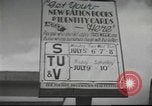
Post-war economy of Britain; start of Marshall Plan to rebuild Europe; New York City auto show scenes
"Get your new ration books and identity cards here" seen written on a sign. British civilians line up to obtain new post-war ration books, after the end of World War 2. Women shopping for rationed food. British ships idle in ports as exports wane. View of New York harbor with tugs and barges and Manhattan skyline and skyscrapers in background. Woman holding poster advertising First International Auto Show (held from February 5-10, 1949, at the Sixty-ninth Regiment Armory, Twenty-fifth Street and Lexington Avenue, in New York City), including European cars to be shown in New York City. British cars in their first car show. One of the cars shown is the 1948 Ghost Minx with two women seated inside it. A 1948 Jaguar convertible is also shown. Communist parades in Europe and Asia. Start of Marshall Plan to help Europe rebuild after the war. Newspaper shows President Truman signing Foreign Aid Bill (led to Marshall Plan).
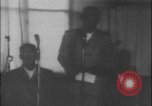
USS Pueblo Lt. Commander Lloyd Bucher reads speech during news conference for Western and Asian reporters in Pyongyang, North Korea
USS Pueblo Lieutenant Commander Lloyd Bucher (USS Pueblo Skipper) reads a speech during a news conference hosted by North Korea, saying that "those that sit before you, and the remainder of the Pueblo crew, are criminals who committed espionage and hostile acts after having intruded deep into" the territorial waters of North Korea. Western and Asian reporters with cameras listen to Lieutenant Commander Lloyd Bucher’s speech. Man standing during news conference. Reporters during news conference. Lieutenant Commander Lloyd Bucher ends his speech with a birthday greeting for his son Mark in the United States. News anchor Chet Huntley reports on the USS Pueblo crewmen news conference in North Korea.
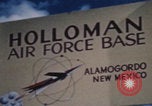
Animated map shows phototheodolites, tracking radars Stations near Holloman Air Force Base, New Mexico
Sign reads "Holloman Air Force Base Alamogordo New Mexico”. An animated map of New Mexico showing the location of cities such as Alamogordo New Mexico and El Paso, Texas. Map of New Mexico showing Holloman Air Force Base, Alamogordo and Mockingbird Gap. Then the animated map shows the various positions of phototheodolites and tracking radars between Holloman Air Force Base and Mockingbird Gap. Positions of the Beacon Triangulation Stations in New Mexico are also shown on the map.
CRITICALPAST.COM: About Us | Contact Us | FAQs - How to Order | License Agreement | My Account | My Lightboxes | Shopping Cart | Advanced Search | Featured Collections | Website Terms & Conditions | Privacy Policy ©2026 CriticalPast LLC.
License Agreement |
Terms & Conditions |
Privacy Policy
©2026 CriticalPast LLC.