


 Francais
 Deutsch
 Italiano

Refine Your Search
Hoboken New Jersey 1918 stock footage and images
- Showing 397 to 402 of 9492 results more
 Hide
Color Sound
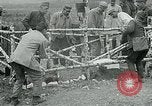
U.S. and French soldiers repair the grave of Lieutenant Quentin Roosevelt in World War I
French and American soldiers remove a makeshift fence from around the grave of Lieutenant Quentin Roosevelt (son of former President Theodore Roosevelt) who was killed during aerial combat in skies over Chamery, France, on June 14, 1918. He was buried with honors, in a battlefield grave, marked with a simple wooden cross, by German fliers. Now American and French soldiers are seen placing a new fence around the grave, along with a new cross and headstone, engraved in French. They also place floral pieces on the grave.

Scenes of American forces in France at conclusion of World War I, Christmas gifts, and immediate postwar period
Several u.S. Army soldiers of the American Expeditionary Forces (AEF) stand near three French children, outside a church building in France, during World War 1. A large relief of Christ on crucifix is displayed on the wall behind them. One soldier kneels down next to the children and gives them some chocolates. He talks with them. Closeup of the children eating their candy. A boy wipes his hands on his sweater. The children make circles on their tummies, indicating that the food tasted good. New sequence shows American Army of occupation troops celebrating Christmas, 1918, at Montabaur, Germany. They are assembled at a hillside, around a platform holding a monument and statue. A large decorated Christmas tree is set up on one side of the monument, and an Army brass band stands on the other side. Captain William A. Turner, of the Salvation Army, dressed as Santa Claus, hands out gifts to some of the soldiers, assembled in the foreground. There also appear to be some local German people gathered to the far right, of the brass band. Next, "Santa Claus" is seen throwing gifts out to the gathered soldiers. Scene shifts, again, this time to several U.S. Navy dreadnought battleships that might be returning troops from Europe back to the United States. The first seen is a two-stacker, Florida-class; the second is the USS Pennsylvania (BB-38) and the third is the two-stacker USS New York (BB-34). Final sequence shows U.S. Secretary of the Navy, Josephus Daniels, and Secretary of War, Newton D. Baker, in top hats, stand on deck of a ship with with its Captain (a U.S. Navy Commander) to review U.S. Battleships returning from service with the British fleet in World War 1. The dim image of a battleship is seen in the background. (World War I; World War 1; WWI; WW1)

New York Yankees and New York Giants baseball teams train in the north during World War II
The New York Yankees train at Atlantic City New Jersey for the 1944 baseball season, during World War 2. Yankees players, wearing long sleeves, jog around the infield. Manager Joe McCarthy addresses the club. Players warm up with throwing and batting drills. Outfielder Ed Levy (#9) swings in batting cage. Second baseman Stuffy Sternweiss (#2) takes a swing. Manager McCarthy clowns around with movie camera. Action shifts to New York Giants spring training camp in Lakewood, New Jersey. Catcher Gus Mancuso takes part in camera tricks. Manager and Hall of Fame slugger Mel Ott looks over his squad. Shortshop Billy Jurges hits a ground ball. (Note: Spring training for all Major League Baseball clubs was in the north that year because of travel restrictions during World War II.)

Artisans risk their lives installing giant clock on the City Hall building in Camden, New Jersey.
Five women holding the minute hand of the huge clock standing in a queue. Two of the artisans seen carrying the minute hand of the clock. The minute hand is cast in a solid bar of aluminum, weighing 87 pounds, and is 120 inches long. Artisans seen installing the minute hand on the clock face at the top of the 22-story city hall. Camden City Hall with a new clock. Powerful lights behind the dial would make the numerals visible at three miles. A person setting the timings of the clock at 3:14 which further shows time till 3:45.

Timber catches fire at zinc mine in Franklin,New Jersey.
Zinc mine worker carelessly hangs an acetylene lamp against timber at zinc mine in Franklin,New Jesrey. Timber catches fire. The miner sees smoke and runs for help. Shift boss arrives and puts out the fire using a fire extinguisher.

Montage of scenes depicting America in World War I, from 1917 to 1919.
U.S. President Thomas Woodrow Wilson signs the declaration of war during World War I. U.S. ships sink after torpedo attacks. United States troops aboard a troop carrier ship bound tor France. Assistant Secretary of the Navy, Franklin D. Roosevelt. U.S. troops disembarking on docks in France. Navy ships being built in U.S. shipyard. Allied troops attack across no man's land. Allied rail gun firing. U.S.Soldiers fire howitzers. Smoke pours out of Allied biplane aircraft after being shot down. German troops fighting in trenches. A horse falls into a trench after being shot. Tanks in action. Tanks advance and fire. German machine gunners. German prisoners walk in a line. American troops in France celebrate the end of hostilities with the Armistice on the 11th hour of 11th day of 11th month, 1918. The American flag flies on a pole as a symbol of victory. Huge crowds of Americans celebrate in Manhattan, New York city, waving newspapers with headlines announcing German surrender. In 1919, President Wilson and General John (Black Jack) Pershing review victorious American troops marching in Chaumont, France (Pershing's headquarters). Franklin D. Roosevelt, Assistant Secretary of the Navy with Secretary of the Navy, Daniels, in France. U.S. troops board transport ships to return home after war. Returning U.S. Armies hold a victory parade in Manhattan, New York City, where they parade through a temporary Victory Arch constructed expressly for the purpose in Madison Square. Hydrogen balloons decorate the Arch. New York City mounted police monitor the crowds.
CRITICALPAST.COM: About Us | Contact Us | FAQs - How to Order | License Agreement | My Account | My Lightboxes | Shopping Cart | Advanced Search | Featured Collections | Website Terms & Conditions | Privacy Policy ©2026 CriticalPast LLC.
License Agreement |
Terms & Conditions |
Privacy Policy
©2026 CriticalPast LLC.