


 Francais
 Deutsch
 Italiano
Refine Your Search
Hoboken New Jersey 1918 stock footage and images
- Showing 37 to 42 of 9472 results more
more Hide
Hide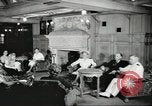
The Swedish ship, M.S. Gripsholm awaiting departure from pier at Jersey City, New Jersey, in World War II
At start, the film shows the Captain of the M.S. Gripsholm relaxing, with an American civilian official, along with several crew members and some American women, in the First Class smoking lounge aboard the ship. Scene shifts to view of the Gripsolm's two smoke stacks and then to a stack of baggage belonging to Japanese Nationals and Issei passengers aboard the ship for repatriation to Japan in World War 2. Customs officials are seen screening the luggage. Stern view of the Gripsholm docked at pier in Jersey City, New Jersey. Swedish flag displayed on the deck. More stern views of the ship.

Anti-Red supporters of Mayor Frank Hague cause jam at Journal Square during a demonstration in Jersey City, New Jersey.
Scenes from a night time parade and anti-communist demonstration held by supporters of Mayor Frank Hague in Jersey City, New Jersey. The crowd of people march on a street and jam Journal Square. They carry American flags and banners in the nighttime parade. The supporters set off fireworks during the demonstration. A large lit banner reads, "Reds Stay Out of USA" as spinning fireworks and aerial fireworks are launched behind it.
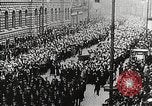
Independence Day celebrations in Prague, Czechoslovakia, 1918
Population celebrates independence of Czechoslovakia, October 28, 1918, with the fall of the Hapsburg Empire, near the end of World War 1. Streets of Prague are seen filled with marching throngs and cheering spectators. View of new national flag flying from tall building overlooking Wenceslas Square.Statue of St. Wenceslas visible below. Animated map outlines general area to encompass the new Czecho-Slovak Republic. (World War I; World War 1; WWI; WW1)
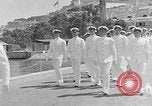
Dedication of memorial to lives lost on U.S. Coast Guard Cutters Tampa and Seneca, in 1918
U.S. Coast Guardsmen parade in dress whites, at pier in Gibralter harbor, and assemble in formation for ceremony to dedicate a memorial. The Coast Guard Ensign hangs over, and hides a memorial plaque on wall of building. Participants include British and American officers and British and American civilian officials, several dressed formally, with top hats. A number of ladies are seated for the event. After brief invocation by clergyman, A British military brass band plays, Coast guardsmen, with rifles, present arms, and the Coast Guard ensign is removed, unveiling the memorial plaque. The plaque honors those lost when the Cutter Tampa was torpedoed by an enemy submarine, in Bristol Channel, on September 26, 1918, with loss of all 115 souls on board. It also honors 11 officers and men of the Cutter Seneca, who volunteered, and were lost attempting to salvage the torpedoed British Steamer, Wellington, in the Bay of Biscay, September 17, 1918. The American flag is displayed above the new plaque, and Coast Guard officers place four wreaths at the base of the memorial. .

Brazilian Foreign Minister Dr Osvaldo Aranha and other officials aboard a ship at harbor in Jersey city, New Jersey.
Brazilian Foreign Minister Dr Osvaldo Aranha arrives in Jersey city in New Jersey, United States. Dr Aranha and other officials aboard a ship. Officials discussing. Dr Aranha leaving for Washington.
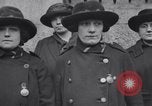
Women join ranks of police reserves in New York City, during World War I.
Closeup of women in the New York City Police reserve, during World War 1. They stand outside the 23rd Police Precinct ("Tenderloin") Station House on West 30th Street, Manhattan, New York City. Their uniforms include round-brimmed hats and overcoats, and they have round badges topped with eagles, pinned to their coats. Next, about 15 are seen, walking two abreast. All wear white gloves and badges, but otherwise, their uniforms are not identical. One supervisor woman walks beside the group, wearing a slightly different badge. Walking casually, a short distance behind the group is a woman (probably Mary Noonan) in the uniform of a captain (with "railroad tracks" insignia on her collar). Scene shifts to a street filled with a traffic mix of horse-drawn and motor vehicles, all staying fairly clear of trolley tracks visible in the center of the road. A police reserve woman stands in the center of the street, directing traffic. Next, a large group of school children is seen standing on a street corner, accompanied by a woman police officer. They begin to cross the street under the watchful eye of another woman reserve police officer, directing traffic in the street. Some adults cross behind the children. (Note: On May 9, 1918, the New York City Police Department announced formation of a new Police Reserve, that would include a women's contingent. This was the idea of Special Deputy Commissioner Rodman Wanamaker, who reasoned, since New York women had received the vote, on November 6th 1917, they should have a role in enforcing the laws. Over 3,000 women were recruited. Their Captain was Mary Noonan. Their duties did not involve direct dealings with criminals. According to the New York Times of May 10, 1918, "If need arose for use of the nightstick or other instrument for curbing crime,the work would be referred to the men members of the force.")
CRITICALPAST.COM: About Us | Contact Us | FAQs - How to Order | License Agreement | My Account | My Lightboxes | Shopping Cart | Advanced Search | Featured Collections | Website Terms & Conditions | Privacy Policy ©2026 CriticalPast LLC.
License Agreement |
Terms & Conditions |
Privacy Policy
©2026 CriticalPast LLC.