


 Francais
 Deutsch
 Italiano
Refine Your Search
Hoboken New Jersey 1918 stock footage and images
- Showing 4597 to 4602 of 9472 results more
more Hide
Hide
Second draft of World War I draft numbers is drawn by United States Secretary of War, Newton D Baker; Draftees report for duty
The United States Secretary of War, Newton D Baker during the second draft ceremony for World War I. His eyes are covered with a blindfold and he draws draft numbers from a bowl. The drawn draft number is read. General Enoch H. Crowder oversees the ceremony. A large number of draftees -- men dressed in suits and hats -- passes along a roadside. Men disembark a railroad train at a military training facility. Men march along tracks carrying the U.S. flags in hands. New recruits, including men and a few women practice marching in formation, still wearing civilian clothes.
Soldiers march on streets holding rifles during World War I and veterans return to farming and dairying in United States.
A United States troop transport ship at sea during the first World War. U.S. Army troops (aka dough boys) aboard the ship. U.S. Army soldiers march in formation in a large city square area in Europe (likely France) holding rifles during World War 1. United States troop ships being loaded with American soldiers for World War I, and scenes of U.S. troops in WWI marching in the streets of a European city. Scenes from earlier during combat in the war. World War I allied soldiers on battle front in France. Soldiers run to a bomb crater area for shelter when crossing no man's land. Soldiers fire artillery. Artillery shells explode. Allied soldiers running across a battlefield as tanks run beside them toward the German enemy. People wave U.S. flags as First World War war ends with Armistice. Large crowd gathers in New York celebrating WWI armistice. Newspaper held high by a man with headline "Germany Surrenders". Views in the United States of hard times in American towns after World War I ended and war industries were no longer providing money. View of forests. Girl draws water from a well. Man and a boy operate a grindstone sharpening a saw. Farmers plowing fields with horse drawn plows during great depression era. People do agricultural works at fields. White farmer tilling a field. African American farmers working in fields and harvesting hay with help of a horse. African American farmers at cotton office. Cattle in field. Man and a woman milk cows with hands. Man pours milk in vessels. Milk processing before bottling including pouring milk through a cooling device. Men on tractor at fields. A board reads 'For the common defense'. Views of a factory. A man operates a switch on a switchboard for generating electricity. Views of a power generation plant. Narrator describes how America will prevent a slide into hard financial times again after World War 2 ends. From a 1942 production with footage from 1917 through 1942.
Cattle drawn carriages and artillery pass on Pontoon Bridge in World War I.
Civilian official addresses large formation of American troops from a podium at a reviewing stand. U.S. troops on parade across the field, in front of spectators, at an Army base. Included are troops on horse back and horse-drawn caissons. French troops use cattle teams to pull heavy artillery pieces across a pontoon bridge, in France during World War I. Boats tied at Pontoon Bridge. The French artillery battery fires in field. French troops move casually along a road. New recruits, without uniforms, drill in a field. under guidance of U.S. Army soldiers. French soldiers hoist 320mm shell, with block and tackle, to load rail gun, that sits under camouflage netting. Rail gun fires and recoils. French gun crew works on another 320mm rail gun, elevating the barrel to firing position during World War 1.
American soldiers in France hauling cut trees and building a military encampment during World War 1
U.S. troops in France during World War I. They are building a camp. They haul cut trees from the edge of a forest using a truck and trailer, and are seen setting up a new camp using the logs.
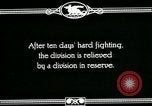
U.S. troops training film: Some soldiers suffer enemy gas attack while those not affected rest at Division Headquarters
A United States Army training film about defense against chemical warfare in World War I. Dramatization of a division chemical officer going over chemical warfare situation with the chemical officer from a new division. The officers seated inside a tent exchange notes. Gas casualties are taken out of ambulances. Disciplined soldiers return to rest areas at the Division Headquarters. A soldier removes his mask and goes to sleep.
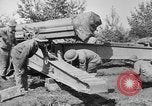
U.S. troops prepare and tow a 155 mm gun in World War I
Soldiers of American Expeditionary Forces (AEF) prepare to move a 155mm gun in World War 1. View of a dozen American Expeditionary Forces (AEF) soldiers working around a 155mm gun (Canon de 155 Grande Puissance Filloux (GPF) mle.1917). The breech has a cover over it. The soldiers jack up the gun to allow them to close the split trails. After closing them, they roll and secure the limber underneath the trails. Afterwards, they secure a steel housing over the rear of the gun. Next, they secure a tow bar from a Holt-caterpillar model 75 tractor to the gun carriage and tow the gun to its new location. (World War I; World War 1; WWI; WW1)
CRITICALPAST.COM: About Us | Contact Us | FAQs - How to Order | License Agreement | My Account | My Lightboxes | Shopping Cart | Advanced Search | Featured Collections | Website Terms & Conditions | Privacy Policy ©2026 CriticalPast LLC.
License Agreement |
Terms & Conditions |
Privacy Policy
©2026 CriticalPast LLC.