


 Francais
 Deutsch
 Italiano
Refine Your Search
Hoboken New Jersey 1918 stock footage and images
- Showing 469 to 474 of 9472 results more
more Hide
Hide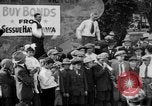
Hollywood movie stars Sessue Hayakawa and Mary Pickford promote Liberty bonds in Hollywood, California, on October 5 and September 29, 1918.
Clip includes scenes from two different events, one week apart. First scenes are from October 5, 1918. Large crowd gathered in Los Angeles California a stage with a mock tank in Central Park, during the Fourth Liberty Loan Drive in World War I. A banner reads "Buy bonds from Sessue Hayakawa" on a podium. Two little girls dressed in traditional Japanese attire kimono, seen on the podium. Japanese American movie star Sessue Hayakawa speaks through a megaphone to sell Liberty bonds during World War I. The next scene, from one week earlier on September 29, 1918, shows Hollywood actress Mary Pickford working the crowd and selling war bonds as she addresses the large gathering through a megaphone during the Fourth Liberty Loan campaign opening event in Los Angeles. Next Mary Pickford is seen seated on the stage. Shots of the crowd are seen. Next scene returns to the event on October 5, 1918. Sessue Hayakawa is speaking to the crowd, and the two Japanese girls on the stage are joined by another little girl, Hollywood child actor Mary Jane Irving. A man asks Mary Jane Irving to speak to the crowd, and she does. Sessue Hayakawa speaks again. Hollywood star Louise Fazenda stands in front a sales report board with a note pad writing down pledges. (Additional information from the Los Angeles Times, October 6, 1918: "Yesterday afternoon a big crowd turned out to greet Sessue Hayakawa and members of his company, including two bright little Japanese girls who shouted through megaphones, "Please buy a bond." Mary Jane Irving, an American sister in art, was on deck with the same message, which appealed mightily to the folks on the ground. Hayakawa made a stirring appeal for the sale of bonds. He said that although his color is different, and his features not the same as ours, he was 100 per cent American and then to prove it he bought $10,000 worth of bonds.")
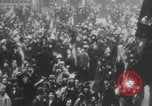
Crowds celebrating Armistice Day 11 November 1918, WW1
People worldwide celebrate Armistice Day on 11 November 1918, then end of WWI. Crowds cheerfully wave with their hats in the streets. Some British flags seen. A truck with soldiers and American flags slowly drives in the middle of a crowded road. People cheerfully wave USA flags and hats to celebrate the November 11, 1918 Armistice, which ended fighting on land, sea and air in World War I between the Allies and Germany, the last remaining Central Power opponent.
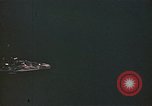
Warships of the U.S. Navy fleet in the Hudson River on Navy Day in 1945
View of the Hudson River from an aircraft flying North, over the New Jersey shoreline. United States Navy warships are seen in the Hudson River, on the occasion of President Truman's first official visit to New York City, on Navy Day, October 27, 1945. Approximately 50 ships were anchored in the Hudson. The first clearly identified is the Battleship, USS Missouri(BB-63) with the Destroyer USS Renshaw (DD-499) tied alongside (bringing President Truman aboard during his review of the fleet). Others seen include the USS Midway (CVB-41); the USS Enterprise (CV-6); The USS Augusta (CA-31); and the USS Boise (CL-47). Several more surface ships are seen followed by six submarines on the surface, as the aircraft approaches the George Washington Bridge. More warships seen North of the bridge. Scene shifts to the USS Missouri and USS Renshaw, again. Next, the aircraft flies past a Navy blimp hovering below, over the river. The Aircraft Carriers, Enterprise and Midway are seen again. Glimpses of the New York City shore and buildings are seen at times in the film, as well as the palisades on the New Jersey shore, near the George Washington Bridge.
Documentary about geography, fine harbors and long waterfront of New York, being the reason for its commercial supremacy.
Documentary about the geography of New York City. Slate indicates New York is the largest city in America. Its commercial supremacy is due to its fine harbor. A geographic map of New York, showing areas as Brooklyn, Manhattan, Lower Bay, Bronx and New Jersey. The bays and rivers in New York are shown. View of the Statue of Liberty. The waterfront of New York City as seen from a ship on the water. High rise buildings and early skyscrapers along the waterfront of Manhattan Island. Miles of docks at the New York City waterfront for ocean shipping.
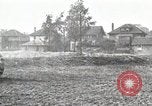
United States military officials test Ford 3-ton M1918 tanks built by Ford Motor on an open field in Michigan.
Testing of 3-ton M1918 tanks built by Ford run an obstacle course lay out on an open field behind residential area. Military and civilian officials observe as tanks cross gullies and climb earth banks. One of the tanks overturns in gully and another one fails to scale a mound of mud. Military officials gather to observe the overturned tank. (World War i; World War 1; WWI; WW1)
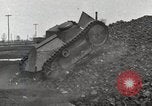
M1918 tanks built by Ford Motor Company are tested to cross gullies and climb earth banks.
World War 1 U.S. Army tanks built by Ford run an obstacle course lay out on an open field behind residential area. Military and civilian officials observe as 3-ton M1918 tanks cross gullies and climb earth banks. Tank knocks down posts embedded on ground, crosses railroad tracks and fails to scale sharply graded bank on mud. Military officials gather to take a look at the tank. View of residential houses in the background. Tanks along with their drivers lined up for inspection during World War I.
CRITICALPAST.COM: About Us | Contact Us | FAQs - How to Order | License Agreement | My Account | My Lightboxes | Shopping Cart | Advanced Search | Featured Collections | Website Terms & Conditions | Privacy Policy ©2026 CriticalPast LLC.
License Agreement |
Terms & Conditions |
Privacy Policy
©2026 CriticalPast LLC.