


 Francais
 Deutsch
 Italiano
Refine Your Search
Hoboken New Jersey 1918 stock footage and images
- Showing 4999 to 5004 of 9472 results more
more Hide
Hide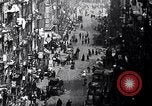
Lives of typical immigrants to the U.S., early in the 20th century
Tenements and open-air markets, part of life for many new immigrants, in Manhattan, New York City, early in the 20th century. Brief footage of elevated view of street likely in lower east side of Manhattan. Series of still images: Children pose on a fire escape platform. Merchants with pushcarts line the street. Men open a fire hydrant that spews water into the street. Men place cups in the stream. Children wade in the water. Many small children seen on the sidewalk. A boy tries to drink the last few drops from the hydrant, after it is turned off. Boys stand in an alleyway, near garbage cans. A boy at home preparing to wash in a basin. A boy holding a puppy in an unsanitary tenement apartment. View of Italian immigrant family members crowded into a Mulberry Street tenement. In contrast, a group of well-to-do young women are seen outdoors dressed in white, carrying parasols, as they learn social etiquette. A young woman, in a carriage, with a chaperone. Two well-dressed, mature women, conversing. A family, including several children, all engaged in needle work at home, for a pittance in wages. Men and women at sewing machines manufacturing clothes in a crowded "sweat shop.".

Scenes from the Merchant Seamans Club during World War 2, providing social and R&R for Merchant Seamen of many countries
A film titled 'Merchant marine, There is something about a sailor'. Views of a Merchant Seamans club in New York City providing rest and relaxation opportunities for allied Merchant Marines and Seaman from all over the world during World War II. View of the club building exterior at 109 West 43rd Street, New York City. Sign over doorway reads, "American Theatre Wing - Merchant Seamans Club". Men enter the club and their identification is checked at the door. Inside, they enjoy drinks, a game of darts, food, card games, and socializing with women present at the club and sometimes celebrities. Famous cartoonist Otto Soglow is present to do caricature drawings of some of the men, for fun, in the Food Bar area of the club. Soglow is seen creating a cartoon drawing. A Russian woman Merchant Seaman steps forward and Soglow notes that it is a nice change for him to get to draw a woman. American actress Shirley Booth comes forward and welcomes the Russian woman to the Club. Booth reads a welcome message that is partly in Russian. The Russian woman says that she knows Ms. Booth from her role on the radio as Miss Duffy in the show Duffys Tavern. The Russian woman describes her duties in the Russian Merchant Marines. She answers questions from Shirley Booth and describes her training and motivation in fighting the war.

Italian influence on American music. Villa Pauline, Riverdale, home of Arturo Toscanini. Gian Carlo Menotti. U.S. Senator Pastore
Examples of notable Italian-Americans. Several cars on Parkway, in Riverdale, New York. A signboard directs 'Downtown, Riverdale Avenue Northbound and Yonkers Ferry.' Views of Villa Pauline, home of the late famed Italian-American conductor, Arturo Toscanini. Another noted Italian musician,carrying on the Italian-American traditions, is Gian Carlo Menotti, who is seen looking over programs of musical events in which he has been involved. Views of the United Nations Building in New York City. The Flags of different nations on flagpoles. Cars parked on sides of road. Leonardo Vitetti, Italian Representative to the UN, talking to U.S. Senator John O. Pastore, of Rhode Island.
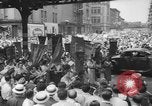
Communists, Pacifists and Liberals demonstrate against Mussolini's aggression against Ethiopia.
People demonstrate in New York City, United States. Communists, Pacifists and other liberal anti-war demonstrators protest against war in general and Italy's aggression against Ethiopia (Italo-Ethiopian war). People carrying banners move on streets of New York. Banners read ' stop war' ' Unite against war'. From a 25 year retrospective in a newsreel dated July 14, 1960.
High rise steel building under construction. Crane swings wrecking ball. Fuel oil tank lowered by crane.
Urban renewal in New York City. A steel frame building under construction with cranes on its top. Steel girders of a new building. A large crane swings a wrecking ball against the wall of a building, as worker directs crane operator. A man stands precariously on the top edge of a brick building and swings sledge hammer, to dislodge bricks. A huge oil tank being lowered,by a crane,into excavation next to building under construction.
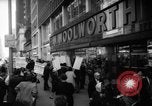
International Ladies' Garment Workers Union pickets Woolworths store protesting Company's discrimination policy in the South.
Members of the International Ladies' Garment Workers Union, AFL-CIO, picket a Woolworths store in New York City. Members of Union Locals, 23, 40, 62 and 66 are seen carrying signs as they march in front of the F.W. Woolworth store. Some of the signs read: "Woolworth practices discrimination in the South, and We Support Dr. Martin Luther King" (civil rights leader). A New York City uniformed police officer stands on the sidewalk observing the peaceful picketing. Civil Rights leader A. Philip Randolph is seen among the protestors, carrying a picket sign and marching. Passersby seem to ignore the activity.
CRITICALPAST.COM: About Us | Contact Us | FAQs - How to Order | License Agreement | My Account | My Lightboxes | Shopping Cart | Advanced Search | Featured Collections | Website Terms & Conditions | Privacy Policy ©2026 CriticalPast LLC.
License Agreement |
Terms & Conditions |
Privacy Policy
©2026 CriticalPast LLC.