


 Francais
 Deutsch
 Italiano

Refine Your Search
Hoboken New Jersey 1918 stock footage and images
- Showing 5029 to 5034 of 9493 results more
 Hide
Color Sound
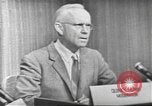
U.S. Senator John Kennedy talks about the foreign policy of America prior to presidential elections in the United States.
The fourth presidential election debate held between Democratic nominee Senator John F. Kennedy and Republican nominee U.S. Vice President Richard Nixon in New York, United States on 21st October 1960. ABC news correspondent Quincy Howe speaks prior to the fourth Kennedy-Nixon presidential debate. Senator Kennedy says he agrees with the policy of Eisenhower's administration regarding the Formosa Strait (Taiwan). He speaks about Communist influence of Cuban Prime Minister Fidel Castro on Latin Americans which is becoming a threat for the United States. Kennedy also mentions Communist Russians broadcasting ten times as many programs in Spanish to Latin America as the United States does. He talks about technical assistance given to Africa by the United States. He speaks about future of increasing communist influence in world. Kennedy mentions Liberia and the Union of South Africa who voted with America on the question of admission of Red China in the United Nations. Senator Kennedy speaks about Communist influence increasing in the world and relates to it by saying that there are six counties in Africa that are members of the United Nations and there is not a single American diplomatic representative in any of these six. He further speaks about military progress of Communist nations.
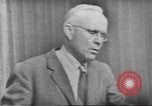
Vice President Nixon and Senator Kennedy debate over a fight against communism prior to presidential elections in the U.S.
The fourth presidential election debate held between Democratic nominee Senator John F. Kennedy and Republican nominee U.S. Vice President Richard Nixon in New York, United States on 21st October 1960. ABC News correspondent Quincy Howe speaks during the debate and allows correspondent Walter Cronkite to ask Senator Kennedy a question. Mr. Cronkite asks Senator Kennedy that in what areas the United States might take offensive against communism rather than being defensive to the Soviet Union. Senator Kennedy replies to the question and says that the eastern Europe is very vulnerable area according to him. He says there should be policies which make it possible to establish closer relation with a country like Poland and he also mentions the Hungarian Revolution. Senator Kennedy speaks about the relations between the Soviet Union and China. He says that India represents a great area for affirmative action by the free world. India started from about the same place that China did. India under a free society has been making some progress. But if India does not succeed, Communism can take over. He says that in Africa, Asia, Latin America, eastern Europe, the great force on their side is the desire of people to be free. Correspondent Howe asks Vice President Nixon to comment on the topic. Nixon speaks about Poland and says that Poland in not in a position to take any independent position under Soviet control. He talks about aids being sent to Poland from the U.S. and says that the U.S. can have more exchange with Poland or with any other Iron Curtain countries.
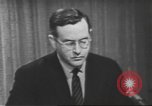
Vice President Nixon and Senator Kennedy debate over Quemoy and Matsu issue prior to presidential elections in the U.S.
The fourth presidential election debate held between Democratic nominee Senator John F. Kennedy and Republican nominee U.S. Vice President Richard Nixon in New York, United States on 21st October 1960. ABC News correspondent Quincy Howe speaks during the debate and allows NBC correspondent John Chancellor to pose a question to Richard Nixon a . Correspondent Chancellor asks a question about Quemoy and Matsu issue. Vice President Nixon points out inconsistency of Senator Kennedy. He further explains it by saying that Senator Kennedy signed a resolution in 1955 which gave the president the power to use United States forces to defend Formosa (Taiwan) and offshore islands. But he also voted for an amendment which was lost, an amendment which would have drawn a line and left out those islands. Vice President Nixon supports President Eisenhower's position. Correspondent Howe asks Senator Kennedy to comment on the topic. He speaks about President Eisenhower sending a mission to persuade Chiang Kai-shek in the spring of 1955 to withdraw from Quemoy and Matsu because they were exposed. The President was unsuccessful. He refers to the fact that in 1958, as a member of the Senate Foreign Relations Committee, he was very familiar with the position that the United States took in negotiating with Communist China (PRC) on these two islands. He further that the U.S. was unable to persuade China's Chiang Kai-Shek to withdraw and thus it was decided by the U.S. to defend the islands.

An antenna fastened by metal cables and equipment laid out at the Air Force Flight Dynamics Laboratory Mobile Test Station.
Laser induced lightning experiments conducted by Electromagnetic Hazards Group at the Air Force Flight Dynamics Laboratory Mobile Test Station on Mt. Baldy, Colfax County, New Mexico. Mobile Test Station, Air Force Flight Dynamics Laboratory in New Mexico. An antenna fastened by metal cables. Parts attached to the antenna. Equipment laid out near one of the trailers.
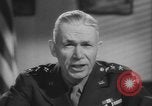
Wartime film describing the problem of substitution and conversion of needed supplies for U.S. military forces during World War 2
Production of supplies for American soldiers during World War II. Commanding General of U.S. Army Service Forces( ASF ) Brehon B. Somervell seated at a desk in his office in the United States. He explains the serious problem of substitution and conversion and what is being done by American science to meet these needs. Somervell states that he is issuing an order: A command to think along new lines regarding every product essential to the war. He asks: 1) Can it be made as well of some less critical material; 2) Can it be made better, faster, or in greater quantity by some other method of production? He calls on viewers to draw on the brains and ingenuity. View of ordnance insignia. Interior of an office. An officer and a draftsman examine a machine gun. Exhibit of mannequins wearing uniforms with supplies for soldiers and nurses. Miniature tents and kitchen equipment. An officer and executives from two rubber production companies check synthetic rubber and test its tear resistance and they collaborate on improvements. Radio engineers from the Signal Corps in a lab work in front of equipment checking new types of aircraft radio equipment designed to decrease weight. Workers weighing equipment and finding ways to make needed supplies lighter in weight. Chemical warfare officers at work. A soldier with a new plastic gas mask comes out of a room. Medical and other industry leaders around a conference table evaluating medical equipment made of steel and considering use of plastic replacements in order to conserve and ration use of steel. Business men in suits gathered around tables planning improvements for wartime efficiency, rationing, and use of new materials. Military and civilian leaders gathered around a large supply map depicting symbols for different kinds and quantities of armament and war weapons with narrator seeming to indicate they are analyzing shipping space. Elevated wide view of an aircraft engine manufacturing plant with many engine turbines seen on the factory floor, and a large group of workers streaming onto the factory floor at start of a work shift. A man places a paper in a suggestion box labeled "ideas for increasing production."
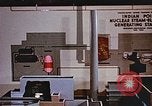
Various power plants and different uses of isotopes in United States,1957.
Men discussing design of Model of 275000KW Indian Point Nuclear power plant to be built in New York. Nuclear power plants in Detroit,Chicago and New England planned in next 10 years. Animation of a map of U.S. shows new nuclear power plants to be built. Narrator indicates that by 1975 atomic plants (nuclear power) may provide a substantial portion of the U.S. electricity. Views of electric power supply lines and towers. Cans of isotopes in a factory. A reaction studied by scientist. Exterior of White Plains Hospital building; inside doctors at a radio lab. Iodine isotopes are mixed in water and a patient drinks it. Doctor analyzes the isotopes by a tracer placed near the Thyroid gland of the patient. The doctor looks at the scale. Doctor examines another patient. The patient is given radiation therapy to control malignant tumors of cancer, via a cobalt therapy machine, at New York Memorial Center.
CRITICALPAST.COM: About Us | Contact Us | FAQs - How to Order | License Agreement | My Account | My Lightboxes | Shopping Cart | Advanced Search | Featured Collections | Website Terms & Conditions | Privacy Policy ©2026 CriticalPast LLC.
License Agreement |
Terms & Conditions |
Privacy Policy
©2026 CriticalPast LLC.