


 Francais
 Deutsch
 Italiano
Refine Your Search
Hoboken New Jersey 1918 stock footage and images
- Showing 5461 to 5466 of 9472 results more
more Hide
Hide
French Naval hydroplanes in World War I
A French ground crewman hands small bombs to another man who stores them in the cockpit of a French bi-wing hydroplane (seaplane) during World War 1. The aircraft is equipped with a large open raeial engine. The propeller appears to be split with one segment in front of the lower wing and the other behind it. Change of scene shows a foldable seaplane suspended from cranes on the deck of a French warship. Crewmen fold the wings aft. Closeup of the aircraft and men rotating the propeller. Next the plane is seen in the water on its pontoons as a pilot standing in the open cockpit fastens an overhead cable to the plane. Aerial view of a convoy of several ships seen from an overflying airplane. A naval port facility seen from the air. Back to the Naval hydroplane, again, as it its being raised from the water by a crane. The pilot stands on one of the large flat main pontoons. Closeup of the plane and pilot as they are lifted high above the water level and deck hands pull the plane over the ship's deck.
French Naval seaplanes (hydroplanes) in World War I
A sleek hulled French bi-wing seaplane equipped with a single radial pusher engine, taxis from shore during World War 1. It is then seen in flight and making a smooth landing in the water. Next, a French single-engine pontoon-equipped float plane is photographed from a larger seaplane as they both fly with sight of one another.
Cartoon of Charlie Chaplin as "The Little Tramp" is painted on nose of a French Farman bomber in World War I
Opening scene shows nose gunner compartment of a parked Fremch Farman biplane bomber as viewed upward from the ground below. It is embellished with a painting of Charlie Chaplain as the iconic "Little tramp." Above, the nose art, a French gunner displays the maneuverability of his machine gun mounted in the open nose position of the aircraft.
Elements of Portuguese Expeditionary Corps (Corpo Expedicionário Português or CEP) on Western Front in France during World War I
Members of the Portuguese Expeditionary Corps (Corpo Expedicionário Português or CEP) are seen having a civilized lunch at a second line trench, where they served under British and/or French control, on the Western Front in France during World War 1. Portuguese soldiers emerge from a well-established dugout deep in a wood lattice-reinforced trench. Lengthwise view of Portuguese troops lined up in the deep trench. Several make their way single-file toward the camera. Slate identifies a telephone station in the secondary trench. A soldier in a French Adrian steel helmet stands at the entrance of a heavily fortified dugout. Numerous phone wires extend outward and upwards from the dugout entrance. (They are difficult to see against the rocks reinforcing the entrance.)
Portuguese soldiers observe from deep trench on Western front in France during World War I
Opening scene shows Portuguese soldiers in a deep lattice-reinforced frontline trench in France, during World War 1. One is standing on a platform looking over the edge of the trench, as an officer stands nearby. Glimpse of the soldier wearing an Adrian French steel helmet as he peeks above the trench. View of cameraman using a periscopic viewer to look over a heavily sandbagged section of trench.
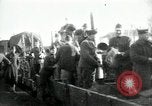
U.S. 102nd infantry cooks prepare meals for troops during World War 1 at Vailly in France.
Shows U.S. 102nd infantry cooks preparing meals for troops at a field kitchen during World War I at Vailly in France. Food is prepared in a large cooker. The cooks put the food in containers and load it on horse carriages. The food is delivered to 102nd Infantry troops in trenches.
CRITICALPAST.COM: About Us | Contact Us | FAQs - How to Order | License Agreement | My Account | My Lightboxes | Shopping Cart | Advanced Search | Featured Collections | Website Terms & Conditions | Privacy Policy ©2026 CriticalPast LLC.
License Agreement |
Terms & Conditions |
Privacy Policy
©2026 CriticalPast LLC.