


 Francais
 Deutsch
 Italiano
Refine Your Search
Hoboken New Jersey 1918 stock footage and images
- Showing 5971 to 5976 of 9472 results more
more Hide
Hide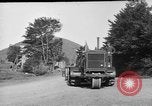
Step-by-step views of American gun crew towing, setting up, and firing a 155mm gun in World War I
Soldiers of American Expeditionary Forces (AEF) operating a Caterpillar-Holt model 75 tractor in World War 1. They display a large American flag, as they tow a French 155mm gun ( Canon de 155 Grande Puissance Filloux (GPF) mle.1917). They move along a dirt road and stop near some trees, where they are joined by other U.S. soldiers who begin preparing the gun for operation. Two soldiers pry a steel cover from the rear of the gun. It falls to the ground, where they pick it up by suspending it on a steel bar. One jacks up the carrier as several soldiers remove the limber from under the gun trails. Two teams of soldiers spread the trails of the gun. Next, two gunners are seen cranking controls to adjust azimuth and elevation of the gun. A gunner wipes clean a shell for the gun. One soldier holds the shell upright as another screws a fuse into the nose. Gun crew rams charge into breech of the gun with a ramrod and another secures the breech, as gunners make final adjustments to elevation. All step away, as one fires the gun with a lanyard. Then the crewmen rush back to ready the gun again. (World War I; World War 1; WWI; WW1)
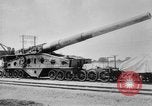
Various WWI railroad guns. 305 mm; 520 mm; and 14-inch, used by Allies in World War I
Allied railroad guns of World War 1. Crews working on 520 mm railroad gun. Brief shot of a 305 mm railroad gun. Crew elevates barrel of 14-inch U.S. naval gun configured as a railroad gun for the AEF. This is at an industrial site and many spectators watch as the gun's movement is demonstrated. (World War I; World War 1; WWI; WW1)
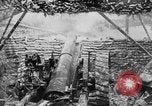
Various artillery pieces being fired during World War I
French gunner, in camouflaged position, firing Canon de 155 Grande Puissance Filloux (GPF) mle.1917 (155mm gun) during World War 1. German gunners firing Krupp 7.5 cm Model 1903 field piece. Closeups of the Krupp gun barrel during firing. American soldiers run to front of their French 75 artillery piece and use ramrod to clean the barrel. Final images show U.S. gunners operating French 75 field pieces in routine as well as rapid fire mode.
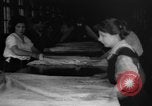
Women work at a curtain manufacturing factory in United States
Curtain manufacturing factory in United States. Women inspect the length of curtains by spreading them on a table. Women sew curtains using Singer machines. Curtains processed on a machine by men.
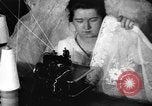
Selvage of curtain woven by women at a curtain manufacturing factory in United States
Curtain manufacturing factory in United States. Selvage of curtains woven by women as they work on a machine to prevent damage to the lace. Selvage is trimmed off. Piles of curtains lying at the factory as women work. Curtains scalloped and over locked in a single operation.
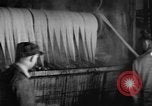
Washing and bleaching of curtains at a curtain manufacturing factory in United States
Curtain manufacturing factory in United States. Curtains washed and bleached. Five miles of curtain sewed together travels through porcelain rings into boiling vats. Piles of curtains on floor as curtains pass through porcelain rings and roll along the machines as they undergo washing. Curtains poured into a whizzer to be rinsed and dried. Men on work on various machines in the washing process.
CRITICALPAST.COM: About Us | Contact Us | FAQs - How to Order | License Agreement | My Account | My Lightboxes | Shopping Cart | Advanced Search | Featured Collections | Website Terms & Conditions | Privacy Policy ©2026 CriticalPast LLC.
License Agreement |
Terms & Conditions |
Privacy Policy
©2026 CriticalPast LLC.