


 Francais
 Deutsch
 Italiano
Refine Your Search
Hurtgen-Forest stock footage and images
- Showing 673 to 678 of 753 results more
more Hide
Hide
Dramatization: Rogers' Rangers fight during the French Indian War and soldiers advance during the American Revolution
Actor Vic Morrow, who plays role of Sergeant Saunders on TV series, "Combat" speaks about his experience during his visit as a guest of the Commanding General at the U.S. Army Infantry School at Fort Benning in Georgia. He speaks about famous Infantry units, beginning with the Rogers' Rangers during the French Indian War in 1756. Dramatized scenes with reenactors show the rangers running through a forest during the French And Indian War. They advance and snare a sleeping Native American Indian and then battle with a North American Indian tribe. Scenes of cobblers, blacksmiths, farmers and bookkeepers joining the army to fight against Britain during the American Revolution. They advance on the battlefield during the American Revolution. Sketches depict infantrymen advancing during a war.
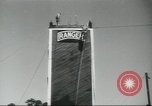
U.S. Army Rangers learn river crossing and mountaineering techniques during their training in the United States.
Training of U.S. Army Rangers in the United States. U.S. Army Rangers climb down a wall, run through a forest and perform exercises during their physical training. They climb up ropes and do wrestling. They perform a tug of war. They learn to use explosions for demolition work. They walk through a jungle during a patrolling mission. They cross a river by walking on a tight rope and they climb up a rope ladder during a confidence building course. They learn river crossing and mountaineering techniques. They study about reptiles.
Town in French Alps with glacier and surrounding mountains; group of mountaineers starting hike
A town in the French Alps, possibly Chamonix, France. A man stands next to a car parked on a platform at edge of a river. River and mountain in the background. Two women tourists walk with a glacier behind them. A columned building is in foreground. Next scene shows a group of mountaineers or boy scouts and possibly guides with packs heading out on a hike or mountaineering trip in the Alps. Views of mountains and valleys. Women walk through forest. Farmer using horses to harvest grain in a field. (Amateur home movie.)
Yugoslav partisans battle against German troops in Nazi occupied areas of Yugoslavia during World War II.
Anti-German Partisan resistance in Nazi occupied areas of Yugoslavia during World War II. Partisans martial their forces in the wooded hills. Partisans fire guns at Italians in a ravine. Dead Italian soldiers. An Axis convoy of trucks under attack by partisans in hills above. Axis troops patrol in a Yugoslav village backyard. A poster offering an award for capture of Partisan leader. Pictures show hanging of Yugoslav Partisans and their execution by Nazi German firing squads. Yugoslav Partisans receive arms on a mountainside. Contingent of uniformed Partisans (including several women) march with arms. Partisans setting up explosives. Detonated explosives. Partisans charge from hilltops. Dead German soldiers. Partisans returning to their villages from the hills. More war dead. Uniformed partisans march into a village. Partisans firing field artillery at German positions. Adolf Hitler shakes hands with Ante Pavelic, head of Croatia. Germans launch an offensive against partisans, whose families flee further into the mountainous and forested regions of the country.
U.S. CCC (Civilian Conservation Corps) clean trees in jungle.
Occupations of U.S. CCC (Civilian Conservation Corps) workers during the Great Depression in the United States. CCC workers use saw and cut trees in the forest. Workers felling large trees. A worker pushes the handle of the explosive detonator. Explosion occurs. A worker sets off explosives to cut down a tree.
United States CCC (Civilian Conservation Corps) workers spray trees and construct a culvert in the United States.
Occupations of U.S. CCC (Civilian Conservation Corps) workers in the United States plains or prairie areas during the Great Depression. CCC boys clear unwanted plants from field. Workers bundle short tree or bush boughs into tight packages that are then loaded onto trucks. Young men workers cut tree logs and clear forests and stumps from an area. They dig a drainage trench and culvert, and build footbridges over the culverts. Workers spray brush and vegetation with a pesticide or herbicide. A worker drops a poison of some kind into a ground hog burrow or hole. A worker shows carcasses of dead groundhogs.