


 Francais
 Deutsch
 Italiano
Refine Your Search
Hurtgen-Forest stock footage and images
- Showing 271 to 276 of 753 results more
more Hide
Hide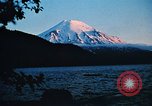
Volcanic eruptions of Mount St. Helens in Washington State, United States, in 1980
Film begins showing pristine snow-covered Mount St. Helens in Washington State, U.S.A. View on March 20, 1980, the mountain appears to have less snow on it. Camera pans over the Cascade mountains. Still picture (illustration) of Mount St. Helens erupting in the past. Several hikers are seen sitting on the peak of the mountain. Camera pans over the view, showing Spirit Lake below and, in the distance, Mount Rainier. Slate reads: "Camp Mehan 1959."View of Mount St. Helens overlooking the Y.M.C.A. Boys try rowing a boat with one oar lock unfastened to the gunnel. one boy sailing alone in a small sail boat. Boys playing volleyball. Boys diving from a dock. A camper speaking with a Forest Ranger in the Gifford Pinchot National Forest. Campers in the park at places such as Bear Cove, Cedar Brook, and Donnie Brook. Hikers with full back packs exploring the forest. Campers cooking over a charcoal grill. A man with a fishing rod casting into a lake. Interior of a lodge at the end of a trail. View of Mt. St. Helens in 1979. View of a seismograph recording a moderate earthquake of 4.1 on the Richter Scale, beneath the mountain on March 20, 1980. View of smoke and ash rising from the mountain on March 27, 1980. Forest service vehicles closing roads and access to the Gifford Pinchot National Forest. View from the air, of a newly opened crater on Mount St. Helens. Forest Service workers and cooperating scientists setting up their gear to study the phenomenon. Nearby Ranger stations, such as Pine Creek are seen after being evacuated by the Forest Service. On March 29th, a second crater is seen on the Mountain. Explosive eruptions seen on March 31st. Camera captures these. A bulge in the mountain at Goat Rocks, is show. Narrator states that it is moving at 5 ft. per day. Another view of smoke and ash rising from the mountain. Scientist David Johnson is seen as he describes how the symmetry of the mountain means that volcanic outflows would come down on all sides of Mount St. Helens. A helicopter lowers a large refuse bin to help Spirit Lake youth camp operators hauling out. Outdoor shops are seen hawking Mt. St. Helen souvenirs. On May 18, 1980, a Forest Service tree planting crew is seen at work in a field. Rumbling sounds. A mountain lion is seen running. Tree planters look up as Mt. St. Helens has a violent eruption, which is seen on film, as the field workers run to escape. Narrator states the cloud reached nearly 14 miles into the sky. The cloud and internal bolts of lightning are seen. View of daylight obscured in Eastern Washington. Policeman wearing a face mask, stops a car from proceeding eastward. A helicopter of the 304th Aerospace Rescue and Recovery Squadron depart their Portland Air Base, to search for Geologist David Johnson, who was manning a scientific lookout above Cold Water Creek. View from inside the helicopter in flight. Narrator notes they failed to find him.
Volunteers undergo training for Emergency Conservation Work and President Roosevelt visits these camps.
From the film, "Forests and Men. The President's Conservation Corps at Work." President Franklin Roosevelt signs a document regarding the establishment of the Civilian Conservation Corps during the Great Depression. F. A. Silcox, Chief of United States Forest Service talks about the need for forest conservation. American flag on a pole. President Franklin Roosevelt visits an ECM (Emergency Conservation Work) camp. He has lunch with other officials. ECW workers and officals pose for a photograph with the President. View of the Shenandoah National Park CCC camp #3 from a hilltop, with letters "CAMP NIRA" (National Industrial Recovery Act) visible painted on the roof of one of the buildings. Woman hands over a sheet of paper to the Director of ECW, Robert Fechner. People stand outside United States Army recruitment camp and an Agriculture Department building. ECW volunteers being trained by the U.S. Army at Fort Washington in Virginia. Volunteers undergo training at camps and are sent to various forest conservation areas. Cooks cut meat. Men stand in line to receive food and are seated at outdoor tables eating food.
Wildlife, nature and its destruction due to lumber cutting activities in United States
'The home of wild things' is a production that studies wildlife along with nature and the destruction caused due to lumber cutting activities. Two bears playing near a tree. A bear climbing in a tree. A herd of elk and some deer seen in woods in a forest. View of the house of a fur trapper. The man with his furs and pelts hanging outside the simple cabin home, sits nearby at work. View of forest and river. A car parked in a ditch below a massive tree (shot is dark.) Group of uniformed Boy Scouts in a troop setup camp in a forest. People swimming in a swimming pool in a wooded setting, with trees all around the outdoor pool area. One young man walks on his hands in the foreground, beside the pool. Men in logging industry cut down trees in forest with a two man saw. A freshly cut tree falls to the ground. View of land with cut tree trunks.
American Boy Scouts stage a fire safety skit in Washington DC during a gathering of Boy Scouts
American Boy Scouts stage a skit to educate fellow Boy Scouts of America about prevention of forest fires. Irresponsible activity leading to forest fire is shown in the dramatized skit, staged on a field with a large group of Boy Scouts seated and watching (possibly some kind of Jamboree). The scouts demonstrate the hazard of a carelessly tossed cigarette. They also show an unattended fire spreading and consuming a tree completely. Sign boards read 'The Trial', and 'Guilty', as the offenders are "Sentenced to Be Educated' (sentencing done by Walter Irving McCoy, the Chief Justice of the Supreme Court of the District of Columbia). Scouts take part in a Tug of War game. Sign reads 'Forest Demon Burned' and the "demon" figure in fabric is set on fire and hoisted into the air. Boy Scouts are seen on the Washington Monument grounds as they take an oath together. Boy Scout plays a trumpet. Sign board on the trumpet reads 'Fight Forest Fire'.

Making a brief history of Totem Poles of Alaska.
Landscape of Alaska is shown. Trees, glaciers, show covered mountains, dense forests and woods of Alaska, including areas of Tongass National Forest. View of paper mills and pulp mill factories (in other areas) that use tree harvest resources from the area. Forest rangers can be seen in boat reaching Alaska through water ways. Forest rangers walk up to Indian totem poles of native indigenous cultures, now overgrown with vegetation. A simple fishing village with small wooden homes can be seen near the water. A man walks next to a pile of old totem poles on the ground. An Alaskan Native American Indian artist teaching a young man how to carve a totem pole out of tree. Men cutting and carving trees and drawing outlines of figures on wood blocks. A carver sharpens his axe and works on long block of wood. Figures are carved on wood. Then the totem poles are painted with colors. Views of completed totems raised up. Tourists looking at the totem poles.
101st Airborne troops setting up field telephone in foxholes in Bastogne, Belgium (WW2)
United States Army 101st Airborne troops standing under snow-covered trees in forest near Foy, Bastogne, Belgium during World War II. A soldier with a field telephone in foxhole under the trees. Other soldiers surround him. Snow falling in the forest. Troops setting up telephone in the forest. Brig. Gerald J. Higgins, Deputy Division Commander of 101st Airborne talks to officers in the forest. One of the officers hold a map. Brigadier Higgins and officers study map together. Soldier puts down the phone and stands up in front of the officers.