


 Francais
 Deutsch
 Italiano
Refine Your Search
Hurtgen-Forest stock footage and images
- Showing 319 to 324 of 753 results more
more Hide
Hide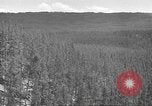
Pine trees are cut, transported and dried for lumbering in Idaho, Unites States.
Lumbering in Idaho in the Northwestern United States. A forest covered mountain. Animation of a map depicts national forest area. Men cut pine trees. Logs are carried in trucks. White Pine logs are made wet for lumbering. Wooden boards are sorted. A man piles them for drying.
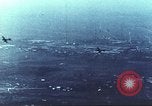
"Operation Firestop" experiments in aerial firefighting. Various aircraft used in firefighting.
World War II scenes of German Stuka dive bombers in operation. U.S. B-25 bomber in flight, and views of firestorms from Allied incendiary bombing of Axis targets. Scenes of the "Operation Firestop" project in 1954-55, in California. U.S. Forest Service and other agencies cooperate in a one-year project headquartered at Camp Pendleton, California. Aerial views of Camp Pendleton area, in Southern California. A modified Grumman TBM Avenger torpedo bomber in flight discharges water from its torpedo bays. Men installing fabric water container into the bomb bay of the TBM. The aircraft seen in low level pass, dropping water contents onto field. Cropduster pilot Floyd Nolta, seen flying his Stearman biplane over California landscape, and then taxiing in to park, after landing. On the ground, we see how he modified his airplane to release water from a hopper in its bottom. On August 13, Vance Nolta flies the Stearman on multiple sorties, dropping water on a fire in the Mendecino Forest. Nolta filling his water tank from a hose at Willow Airport, and dropping water from the air, above the fire. View at Willow Airport, of 7 Stearman and N3N airplanes modified for aerial firefighting. Views of these aircraft dropping chemically treated water from the air. TBM aircraft equipped with 400 gallon tanks drop water from the air. PBY flying boat seen in flight. A B-26 bomber passing low and dropping chemically treated water. A U.S. Navy Martin Mars flying boat passing overhead. The aircraft drops water from a 7000 gallon tank.
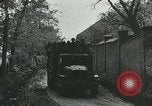
Allied Winter campaign prior to entering German heartland, during World War II
U.S. Army soldiers arriving in Army trucks, one company at a time, for 24 hours rest on the West band of the Moselle River, after combat on the East bank, during World War 2. The soldiers receive a hot meal, a hot shower and shave,issue of clean clothing, and get to attend a movie.(Poster advertises the film Bathing Beauty, starring Esther Williams and Red Skelton.) The next morning, troops board trucks to return to the front line again. Scene changes to U.S. troops in snow, as winter arrives. Squadron of British Spitfire aircraft seen on snow-covered field as airmen refuel them from hand-carried gas cans. An American Army woman nurse clears snow from military vehicle in Paris. General Jean de Lattre de Tassigny, Commander of French Army B, consulting with Major General Wade Haislip, Commander of the U.S. XV Corps, during Winter campaign in Vosges Mountains. French forces firing a mortar. British forces entrenched and machine gunner trying to keep warm. Uniformed British women volunteers trying to keep warm in their office bunker. Allied infantry entrenched and moving across a field. American soldiers in the Ardennes forest suddenly find themselves under attack by German artillery and tanks (Battle of the Bulge). Shells exploding near camera position. Camera shakes. Soldiers taking cover and a jeep driving by as an explosion rocks the area immediately behind it in the trees of the forest.
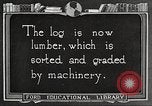
U.S. workers sort, grade, dry and stack them in the open at a lumber industry in the United States.
Forests being converted to lumber industry in Northern forests of the United States. Workers sort and grade lumber with the help of machinery. The green lumber is dried and sea-soned in a steam heated kiln. Theses boards are seasoned in the open for air to circulate freely about them. Workers stack lumber sheets in piles.

American Civilian Conservation Corps work in fields and destroy pests as part of conservation work in the United States.
Forest Conservation Work in the United States. Man looks through binoculars. CCC (Civilian Conservation Corps providing work during great depression) men work in field. Tractor on the field. Two workers atop a tower. Dead trees being cleared from the forest. Workers fell dead trees and cut wood. Civilian Conservation Corps destroy tent caterpillars by burning their tent nests, and fight grasshoppers and pests that destroy meadows by spreading poison bran by the handful.
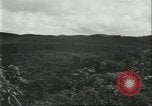
Wide views of Fordlandia rubber plantation area, houses and gardens in Brazil.
Views of rubber tree forests and plantation of Fordlandia, built and operated by Ford Motor Company, in Brazil, to supply rubber for the company's needs. A forest area, fields and small thatched huts on the plantation. Houses with gardens and a swimming pool. Wide view from up high of buildings on the plantation, and the Ford water tower and power plant of Fordlandia in the distance, with the Tapajos river behind. (Data accompanying this reel of film gives a date of 1940, but this may be from circa 1934 near the time that Fordlandia operations stopped and Belterra operations began).