


 Francais
 Deutsch
 Italiano
Refine Your Search
Hurtgen-Forest stock footage and images
- Showing 583 to 588 of 753 results more
more Hide
Hide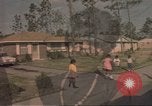
Residents in new houses under Housing and Urban Development (HUD)Turn Key 3 Program in the United States.
The pilot Forest Heights project of Housing and Urban Development Turn Key III Program in the United States. Group of mostly African American children playing outside a house. African American woman putting clothes on a line to dry. Children playing football. African American boys and girls playing on playground equipment in parks or school playground.
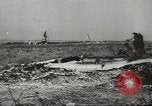
German citizens evacuate from cities and towns being bombed by Allied forces during World War II
Film begins, showing remains of a Boeing B-17F from the U.S. 100th Bombardment Group (BG) with home base at RAF Station Thorpe Abbotts, England, during World War 2. Camera pans over a field of debris containing two of the aircraft's engines and the wreckage of the fuselage and tail. The tail displays the Square D symbol of the 100th BG, plus the letter "T" and some of its tail number: "2303." Camera pans interior wreckage including crew seats and oxygen tanks. It then shows broken wings along with bodies of several crew members wearing parachute harnesses. A different side of the fuselage and tail shows the tail number "230311." This fully identifies it as B-17, number 42-23011. A field grade German officer and another officer examine the wreckage. Views of aircraft wreckage, in a forest, including a Browning M2 .50 caliber machine gun and another aircraft engine. Scene shifts to nearby town, where German women in white are serving meals at an outdoor food kitchen, for local people who are preparing to evacuate. A camper van loaded with family belongings is seen moving in the background. Several women, carrying plates of their food, walk toward tables. Some sit and eat at a table with a German soldier. Women make themselves sandwiches with foods laid out on a butcher block table. Closeup of a large drum of drinking water. local people fill containers from it. German children are seen aboard a bus waving goodbye to their mothers during evacuation for their safety. German children are placed aboard open boats at a port, for transport to safety out of war zone. German women and children board a train during evacuation to safety. Huge piles of their luggage is stacked on the train platform. View of a substantial private home in a residential area. Inside view shows it has been converted into nursery for infants, who are seen in many small cribs. Women sit on the lawn behind a substantial country home, as some small children run toward them from the house.
Scenes of Hitler and German General Staff at the Wolf's Lair Headquarters in Gierloz, Prussia
Nazi German Fuhrer Hitler and his top Military Commanders at the Wolf's Lair Headquarters in midst of forest, in Gierloz, East Prussia, during World War 2. Adolf Hitler throws item for trained German Shepherd dog to retrieve over an obstacle. He strolls the grounds with Heinrich Himmler. Hitler meets with the German General Staff, including, Marshal Hermann Goering, Admiral Doenitz, General Keitel, and General Jodl. They review documents or maps laid out on a table, and discuss.

U.S. troops train in jungle warfare in Panama during World War II.
American soldiers train in jungle warfare in Panama during World War II. Soldiers walk across a dense forest. They cross a pond. The soldiers seated on the ground as they eat.
A U.S. soldier rinses his eyes with sodium bicarbonate solution after encountering a tear gas attack (WW2)
A chemical warfare training film based on U.S. soldiers being treated for exposure to various gases during World War II. Soldiers marching in a forest in the United States encounter a tear gas attack (dramatized for training). The soldiers put on their gas masks. They continue to march. A soldier without a gas mask faces problems as his eyes burn. He uses a solution of sodium bicarbonate to rinse his eyes at the nearest battalion aid station.
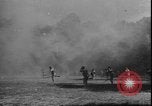
U.S. soldiers are treated for exposure to DM (Adamsite) candle gas during dramatized training (WW2)
A chemical warfare training film based on U.S. soldiers being treated for exposure to various gases during World War II. Smoke rising from a DM (Adamsite) candle on a training batllefield in the United States. Soldiers walk through the smoke-covered battlefield. A soldier falls down (dramatization) after coming in contact with DM candle smoke. The casualty is evacuated from the field by a medic. At an encampment next to a forest, the soldier gargles with a solution of sodium bicarbonate at an aid station to prevent throat infection. The same soldier breathes through a bottle containing chlorine. He lies down on the ground after receiving treatment. Three solutions chlorine, phosgene and chloropicrin in test tubes. A soldier shows how these three gases can be released in a field.