


 Francais
 Deutsch
 Italiano

Refine Your Search
Iran 1951 stock footage and images
- Showing 229 to 234 of 1204 results more
 Hide
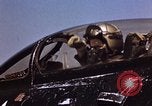
U.S. Navy locates a missing pilot using photographs and rescues him from behind enemy lines during Korean War.
Glimpse of a U.S. Navy pilot in the cockpit of an airplane, during the Korean War. He is pointing down at something. Next, a parachute is seen drifting rapidly in the wind as it descends. Pilot in aircraft hears about a pilot bailing out behind enemy lines. He is instructed to photograph the area. Next, a Navy 9F9 Panther aircraft is seen in the air. It has tail code "PP" indicating it is from the aircraft Carrier USS Essex (CV 9) with Carrier Air Wing Five (CVW-5) and Composite Squadron 61 (VC-61) from June 1951 to March 1952. . Glimpse of Navy ships in formation. View of Landing Signal Officer bringing in several 9F9 Panther aircraft to land on deck of the USS Essex. These aircraft carry tail code "M" of Squadron VF-23 with Air Task Group 2, aboard the Essex from June 1952 to February 1953. Next, several Navy A-4 Skyraider aircraft come in to land. They display "S" tail codes of Squadron VF-54. They are followed by another 9F9. Scene shifts to photo interpreters and pilots studying the photographs for clues to where their parachuting pilot might be located. They discover a parachute in the photos, and circle it. Ship loudspeaker is seen as helicopter crews are alerted for rescue mission. A Sikorsky HO3S-1 helicopter takes off from the flight deck. Other pilots wait anxiously as the Helicopter returns to land on the Essex flight deck. The missing pilot is aboard and they help him from the helicopter, place him on a litter and cover him with blankets. His friend takes his picture.
Vickers Wellington No. 149 Squadron RAF takes off during WW2
Period dramatization: British Royal Air Force (RAF) station groundcrew assist Vickers Wellington No. 149 Squadron RAF during taxiing and take off from RAF Mildenhall airfield during World War 2. A ground control crew member salutes to an officer, the air controller, entering the control room of a portable ground controlled approach radar equipment (GCA) room. Air controller stands on a wooden stool to look through a bubble window in the control room’s ceiling. Air controller tests his radio, saying, "ground control, are you receiving?" View of air direction indicator on air field. Engines running on Vickers Wellington bomber at sunset along with "OC" on fuselage. “You may taxi out and take off!” the air controller says after a pilot asks for clearance on the radio. A Vickers Wellington bomber taxiing. Evening view of lighted bubble window of air control trailer as air controller inside watches the Vickers Wellington bomber taking off. Vickers Wellington bomber flying over RAF Mildenhall airfield. “C for Charlie airborne sir! Nineteen hours thirty-five minutes!” a RAF officer says as he enters air control trailer. Air controller standing in control room dome relays information, saying, "C Charlie took off 19:35." Inside air control headquarters at RAF Mildenhall as RAF officer smokes a pipe while another RAF officer writes flight information on the blackboard. More Vickers Wellington bombers taxi and take off from the airfield one by one. Vickers Wellington OJ-F 'F for Freddie' kicking up dust as groundcrew watches. Vickers Wellington OJ-F 'F for Freddie' taking off as the last Vickers Wellington bombers in No. 149 Squadron departs for Germany at night. View of pilot in Vickers Wellington as he radios to crew, "OK chaps, here we go!" RAF officer writes down the last aircraft’s departure time as “19:51”.

President Harry S. Truman welcomes Mohammad Reza Shah Pahlavi, Shah of Iran and both deliver brief remarks in Washington DC.
Mohammad Reza Shah Pahlavi, Shah of Iran visits the United States and is welcomed by the President of the United States, Harry S. Truman, at the Washington National Airport. President Truman delivers a short speech of welcome from some notes. Mohammad Pahlavi responds impromptu, that he brings with him a message of warm regard and goodwill from Iran and says that it was a privilege to be a part of the Allied campaign and to contribute towards freedom in World War II. He thanks President Truman for the welcome given to him. He talks about the friendship of the United States. Among microphones capturing the comments is one labeled VOA (Voice of America). The President's VC-118 aircraft, "Independence" is parked behind the speaker's stand.

Mohammad Reza Shah Pahlavi, Shah of Iran hosted by President Harry S Truman during visit to U.S.
Mohammad Reza Shah Pahlavi, Shah of Iran, and his entourage, arrives at the Washington National Airport, aboard the President's VC-118 (DC-6) aircraft. The Shah's military and diplomatic companions precede him down the steps of the aircraft and are greeted by the President and U.S. officials. An honor guard stands in formation on the airport ramp. A color guard carries flags of the United States and Iran. President Truman escorts the Shah in a walking review of the assembled Honor guard. U.S. President Harry S. Truman and Mohammad Pahlavi seated in an open car. The car is driven away.
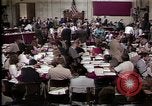
U.S. Marine Corps Lieutenant Colonel Oliver North arrives to testify before a Joint Congressional hearing on Iran-Contra affair
U.S. Marine Corps Lieutenant Colonel Oliver North arrives to testify before a Joint Congressional Committee formed to investigate the Iran-Contra affair. People in the hearing room. Lieutenant Colonel North arrives and is surrounded by media and press photographers taking pictures. Committee members slowly arrive in the room and take their seats. The hearing is called to order by Senator Daniel K. Inouye, Chairman ot the Senate Select Committee On Secret Military Assistance to Iran And the Nicaraguan Opposition.

Mr. John Nields questions Lieutenant Colonel North during the Iran-Contra affair hearing in Washington DC
U.S. Lieutenant Colonel Oliver North testifies before a Joint Congressional Committee formed to investigate the Iran-Contra affair in the United States. Mr. John Nields, Chief Counsel for the House Select Committee of the Joint Committe, asks Lt. Col. North about the sales of arms in Iran. Senator Inouye, Joint Committee Chairman, addresses Lt. Col. North. Mr. Nields asks him several more questions to which Lt. Col North responds.