


 Francais
 Deutsch
 Italiano
Refine Your Search
Iran 1951 stock footage and images
- Showing 307 to 312 of 1204 results more
more Hide
Hide
Shah and party talks to a pilot on flight deck of USS Valley Forge (CVS-45) in Caribbean.
Shah of Iran Mohammad Reza Pahlavi aboard USS Valley Forge (CVS-45) in Caribbean. Shah and party come up on the elevator. Shah talks to a jet pilot in flight suit. He receives still picture album as a gift. Sailors stand. USS Valley Forge written on gangway.

Princess Fatima and her husband on their honeymoon in Paris, France
Princess Fatima of Iran and her husband Vincent Hillyer of California on their honeymoon in Paris, France. They roam around the city.

Lend Lease materials transported across the world by convoys of American and British ships in World War II
Opening scene shows Lend Lease military equipment covered with canvas, at a port in the United States, during World War 2. A B-26 bomber with wings removed outboard of its engines, is being maneuvered for shipment at a port in the United States. A Lockheed P-38 airplane is moved on a crane and then rolled along a pier toward the stern of the U.S. Light Cruiser, USS Phoenix (CL-46) which is docked there. Wings of a Curtiss SOC-1 Seagull scout plane can be seen on the Phoenix. Two more P-38 aircraft are rolled along the pier, past another Brooklyn class Light Cruiser at the end of the pier. (Her triple 6-inch gun turrets are noticeable.) Crated supplies are seen being lowered into ship cargo holds. An American M2 light tank being lowered from a crane. An American M3 Lee tank being secured in a ship. Numerous tanks in a ship’s cargo hold. Next, a convoy of ships carrying war materiel overseas is seen at sea. A U.S. Cruiser plunging through heavy seas. View from her bridge overlooking her triple gun turrets, as her bow is awash in waves. A formation of U.S. battleships, led by a Nevada class Battle Ship armed with twin over triple forward gun turrets. She is followed by what appears to be a modernized Pennsylvania class Battleship and other battleships. A British Battle Cruiser followed by another British warship. Various Allied battleships firing their heavy guns. Animated map tracing the “Lend-Lease” routes across the North Atlantic to Iceland, the British Isles, and Murmansk. Map also shows routes by sea and air to the West Indies, Brazil, and South Africa and West Africa, and then by air across Africa, to egypt and the Middle East. Other routes are shown to Suez, Iran, India, and China, as well as trans-Pacific routes to various places. American soldiers crowd the upper deck of a troop transport ship. A military chaplain conducts religious services aboard ship at sea. More views of ships in convoys. A U.S. Navy Kingfisher float plane in flight over the water. A barrage balloon aloft. A U.S. Navy Catalina PBY flying boat in the air above a fleet of supply ships in a vast convoy.
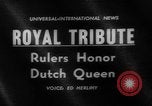
Celebration of the 25th Wedding Anniversary of the Queen Juliana and Prince Bernhard and Queen's 53th birthday in Amsterdam.
Royal guests attend the reception for a double celebration in Amsterdam, Netherlands. A large crowd gathered outside the Royal Palace of Amsterdam (Koninklijk Paleis Amsterdam Postbus 3708 1001 AM Amsterdam) to pay tribute to the beloved Queen of Netherlands, Queen Juliana, and her husband Prince Bernhard during their 25th wedding ceremony and the Queen's 53rd birthday. Amsterdam police form a human barricade to control crowd. Views of the Royal Palace Amsterdam. Crown Princess Beatrix and her sisters, Princess Irene, Princess Margriet, and Princess Marijke (also known as Princess Maria Christina), move past the crowd in a royal carriage. The crowd greets the princesses. View of the Amstel Hotel in Amsterdam (Professor Tulpplein 1 1018 GX Amsterdam Nederland). Guests include Queen Elizabeth II with Mohammad Reza Shah of Iran, Iranian Queen Consort Farah Pahlavi with Prince John of Luxembourg, arriving at the state dinner in Amstel Hotel. King of Norway Olav V, Grand Duchess Charlotte of Luxembourg, Prince Philip of Britain, and King Gustav VI Adolf of Sweden, and other royal dignitaries also attend the reception. Fireworks organized for the occasion are seen, framing large sign numbers "1962".
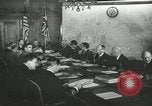
Landing craft, tanks, munitions, and gasoline supplies assembled in England for D-day invasion in World War II
Preparations in year 1943 for the June 1944 invasion of Western Europe by Allied Force during World War 2. Conference at Supreme Headquarters Allied Expeditionary Force in London. U.S. Generals George Marshall, Henry H. Arnold and British Field Marshal Bernard L. Montgomery meet at SHAEF (Supreme Headquarters Allied Expeditionary Force). Montage of war scenes: British Lancaster bombers taking off. British men and women monitors working in a British Command and Intelligence Center, tracking aircraft positions on maps. U.S. B-17 bombers in daylight missions over Germany. Allied pilots and crew members in aircraft. U.S. Army Air Force B-17 aircraft at high altitudes leaving contrails behind. Bombs bursting on German industrial targets. Allied agents being airdropped over France. Allied one-man submarines or solo submarines, torpedo boats and Commandos sampling French beaches and soil conditions in the Normandy region for ability to support 30-ton tanks for the invasion of France. British airman loading reconnaissance camera into a British Spitfire reconnaissance aircraft for photographing the planned invasion region. Woman operating microscope analyzing film. Aerial reconnaissance film images being laid out and attached together to create a large overhead viewing map. Arms and equipment being air dropped to indigenous resistance forces in Nazi-occupied Europe. Mulberry floating harbor segments being designed and built to create invasion ports. Allied landing craft training in Devon, England. Allied aircraft strafing a German ship. Meteorological equipment assessing weather along the invasion coast. Wire netting to pave the beaches. Underwater pipelines to carry gasoline or petrol to France. Allied armored vehicles bearing the White Star. Troops being inoculated or vaccinated. Newly built ship going down the ways at an Allied ship yard that builds Navy warships. View of British intelligence officers with headsets at radio equipment, and personnel monitoring German radio broadcasts. Soviet Embassy in Tehran, Iran, where the Big Three are seen meeting at Tehran Conference to finalize invasion plans. Stalin, Roosevelt, and Churchill sitting on the porch of the Embassy building, in 1943. General Eisenhower and Allied Military leaders planning the D-Day invasion. General Omar Bradley, sitting with a British admiral. General Bernard Law Montgomery Aerial view of formation of U.S. Army Air Force B-17 aircraft, flying through Flak bursts. Pilots in B-17 cockpit .Bombs striking German targets. Polish, Scenes including gun camera footage of Czech, and British in Spitfire aircraft striking German railroads and marshaling yards. B-26 bombers and gunner attacking German Luftwaffe Me-109 aircraft.

United States capture various islands in the Pacific Theater after defeating the Japanese during World War II.
Allied campaign against the Axis in 1944 during World War II. Exteriors of a building in Tehran, Iran where the Tehran Conference took place in 1943. Soviet Premier Joseph Stalin, U.S. President Franklin Roosevelt and British Prime Minister Winston Churchill seated outside the building after the conference. A map depicts United States campaign against the Japanese in the Pacific Theater. U.S. troops land at the Marshal Islands. Troops fire and advance in Palau islands. Soldiers wade through water. Flakes burst and explosions occur at sea near Saipan. U.S. troops advance inland in Guam. A blind soldier walks.