


 Francais
 Deutsch
 Italiano
Refine Your Search
Iserlohn Germany 1945 stock footage and images
- Showing 163 to 168 of 10471 results more
more Hide
Hide
Remains of the USS Gamble (DM-15) being towed out to sea for scuttling, near end of World War II
The USS Gamble, destroyer/mine layer, DD-123, DM-15 being prepared for scuttling off of Guam, in final days of World War 2. Her severely damaged hulk is seen tied up to a pier. An inspection party examines her. View from camera on the Gamble as she is towed out of Apra Harbor, Guam. View of tugboat ahead, pulling her. View from another boat, of the Gamble with a tug at her port side. Six men are seen riding on her superstructure. Camouflage paint and numerals "15" are still visible on her hull. The tug at her side pulls away. Continued views from nearby boat as the Gamble is towed seaward for scuttling. (Note:The USS Gamble was struck by two Japanese bombs off Iwo Jima on 18 February, 1945. After finally being assessed as damaged beyond repair, she was decommissioned, on June 1, 1945, and scuttled on July 16, 1945.)
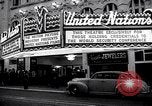
Delegates of United Nations Conference watch motion picture on surrender of Germany and work toward defining UN Charter.
Exterior of a United Nations theater in San Francisco, with movie theater marquee indicating its use exclusively for pass holders attending the United Nations Conference on International Organization. Inside the Delegates of United Nations conference gather during the 2nd week of the conference to watch footage of the German surrender at Reims, signed by General Alfred Jodl. Projectionist and movie projector in booth of theater are shown. View of men and women in movie theater watching movie, including an elevated side view of people watching the movie, and views of the theater screen and movie playing, with backs of heads of people in foreground. Delegates talking and attend meeting in San Francisco, California as they continue work leading toward defining the UN Charter and founding the United Nations organization. Footage from the San Francisco Conference vote, chaired by Anthony Eden of Great Britain, approving the Charter of the United Nations on June 26, 1945
Adolf Hitler and the fall of Nazi rule in Germany, the Nuremberg trials and signing of UN charter after World War II.
Documentary about significant events of the year 1945. German dictator Adolf Hitler visits German hospitals. He talks to and asks well being of Nazi soldiers. The famous Nuremberg trials of the Nazi leaders. Prominent Nazi leaders Hermann Goering, Speer and others facing the trial in a Court of justice. The United Nations Conference with delegates from various nations. Delegates sign the UN Charter.
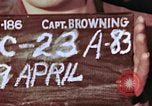
USAAF airmen load bombs on B-26 of 323rd Bomb Group preparing for mission to bomb targets in Germany during World War II
Slate identifies location as A-83 (Denain-Prouvy Airdrome, France) and date as 29 April (1945). Ground crew armorers are connecting wires to bombs and loading them into the bomb bay of a a U.S. Army Air Forces Martin B-26 Marauder aircraft of the 323rd Bombardment Group. View from under the aircraft as a crewman gives signal to close bomb bay doors and they slowly close and lock. Ground crewman removes a metal chock from the aircraft wheel. Flight crew members climb aboard the aircraft. A crew member writes in chalk on a bomb sitting on the ground. The message is: "Happy Boithday Hoimann from Duffy's Tavern," (conveying the New York accent associated with characters in "Duffys Tavern" radio show). World War 2; WWII; WW2.
Trials of war criminals in Germany after World War Two. Belsen local trial.
"The Guilty." Animation depicts person being hanged. View of an angry crowd on a road. People beat captured German soldiers and collaborationists. Mob of Italian partisans in Italy raising dead bodies of Mussolini and others up to hang from their heels in public after their execution. Foreign Minister Vyacheslav Molotov and British Foreign Secretary Sir Anthony Eden signing the Moscow Declaration in November, 1943. The declaration is signed to preserve the authority of law in Europe and to ensure fair and orderly trials for war criminals. Next scene shows Allied soldiers at a liberated Concentration Camp near the end of World War 2 in Europe. Military jeeps in the background. Military photographer takes pictures as officials arrive to tour the concentration camp. Man opens a crematorium oven, revealing bones of a corpse inside. Pile of dead victims of a concentration camp. Elevated view of a room full of documents that are in review for war trials. Officials search documents to identify war criminal suspects. Nazi officers and officials who committed suicide are shown, including a German admiral, the body of Heinrich Himmler, and the bodies of the Mayor of Leipzig and his wife. War criminals being summoned for the various war crime trials. Scenes from the Belsen Trial in September 1945, held in a Lüneburg gymnasium, to decide the fate of German guards and SS officials from the Auschwitz and Bergen-Belsen concentration camps. A defendant being brought to trial on a stretcher. Soldiers guard the court room. View of defendants including many women SS-Gefolge members. German Commandant Josef Kramer during his trial, and German doctor Fritz Klein beside him. The court trial underway for the war criminals. Guilty war criminal brought to the gallows to be hanged, black cover placed over his head and he is hanged. View of dead bodies of concentration camp victims. View of a crowd amassed at a hanging execution of several German officers, possibly in the Soviet Union.
Eisenhower as the Supreme Commander of the North Atlantic Treaty Organization (NATO) and as the President of the Columbia University
Highlights the military career of U.S. General Dwight D Eisenhower from 1945 to 1952. Depicts notable World War II scenes and events starting on D-Day as Allied Forces invade France. Allied planes drop bombs on the enemy positions. Allied troops in Higgins boats land on the beaches of Normandy France. U.S. tanks move forward. Allied soldiers advance towards Saint Lo. Battle in St Lo area. General Patton Forces move forward. French troops and the soldiers of the U.S. 5th Corps march through Paris. The civilians cheer. Allied soldiers move towards the German border fighting on their way. Battle of the Bulge - when the Germans turned counter offensive. The bridge at Remagen on the river Rhine. Allied troops cross the bridge. Allied troops on the offensive, west of the Rhine. The enemy surrenders. Rubble on the streets. General Eisenhower with the troops. Military officers sign documents of German surrender on May 7 1945 in Reims at SHAEF headquarters. Eisenhower makes a speech at the end of the war. Eisenhower, in Paris, waves at the people from an open carriage. People welcome him in his homeland with a ticker tape parade in New York City. Eisenhower waves at the people gathered at the side of the streets from an open car of a motorcade. Eisenhower swears in as the 1st post war Chief of Staff of the U.S. Army. He visited troops in various parts of the world. He salutes and moves towards a car with his wife as he leaves active military life. Pictures of Eisenhower as he becomes the president of the Columbia University. He reviews the troops as he becomes the Supreme Commander of the North Atlantic Treaty Organization (NATO). Eisenhower on European soil. He enters a car. He assumes supreme command of the land, the sea and the air force. Against the threat from the USSR he prepares the European Armies. Soldiers enter into a train. He reviews troops. General Eisenhower and General Matthew Ridgway salute. He enters into a plane with his wife. Painting of Eisenhower being sworn in as President of the United States. Eisenhower Library in Abilene, Kansas, two boys leaving the Library.
CRITICALPAST.COM: About Us | Contact Us | FAQs - How to Order | License Agreement | My Account | My Lightboxes | Shopping Cart | Advanced Search | Featured Collections | Website Terms & Conditions | Privacy Policy ©2026 CriticalPast LLC.
License Agreement |
Terms & Conditions |
Privacy Policy
©2026 CriticalPast LLC.