


 Francais
 Deutsch
 Italiano
Refine Your Search
Iserlohn Germany 1945 stock footage and images
- Showing 199 to 204 of 10471 results more
more Hide
Hide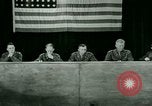
German civilian Pusch testifies in trial of Franz Strasser for shooting of American aviator prisoners; scenes from tribunal in Dachau (WW2)
Excerpts from 24 August, 1945 (World War II) military commission tribunal in Dachau. Swearing in of translator and charges read against Franz Strasser for: "Violation of the Laws and Usages of War. In that on or about 9 December 1944, FRANZ STRASSER, Kreisleiter of Kreis Kaplitz, an Austrian National, did at or near Kaplitz, Czechoslovakia, wrongfully and unlawfully kill an American airman, whose name, rank and serial number are unknown, [by shooting him with a machine pistol]. Strasser replies with a plea of not guilty. Next scene shows entry of German civilian truck driver, Josef Pusch, who is sworn in and provides testimony about the incident. Pusch describes the events of the shooting of the American prisoners by Strasser. United States flag and judges on raised platform. U.S. officials, defendants and civilians in the court room. Shows hearing as it begins. The Nazi commandant seated with other officials. The German civilian is questioned by an interpreter. German civilian Pusch identifies Strasser. Pusch gives his account to the tribunal about the shooting of the American flyers.
Soviet Katyusha rockets fired in Battle of Berlin; German civilians looting stores
Opening scene shows Katyusha rockets fired by Soviet forces in streets of Berlin at night during World War 2, during Battle of Berlin. They create fires in Berlin buildings leading to fire storm with whole buildings engulfed in flames. Soviet troops are silhouetted against the fire backdrop as they rush through the city streets. Insert of German film showing Adolf Hitler standing on a podium at a torchlight ceremony with Sturmabteilung (Storm Troopers) prior to World War 2. They march carrying torches as Hitler gives Nazi salute from the podium. Views of the torches in formation and glimpse of the Storm troopers marching. Film reverts back to 1945 and German prisoners of war being marched under guard as Soviet troops fire Katusha rockets in the background,during daylight, in Berlin. The Kaiser Wilhelm Memorial Church, on Kurfürstendamm is seen dimly. Soviet troops scamper among ruins of buildings and self propelled gun fires in a street. Desperate German civilians enter a damaged store and loot fabric and clothing as well as small boxes of goods. One man carries a huge pile of clothing and towels on his back.
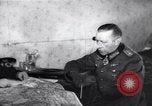
Soviet Field Marshal Georgy Zhukov and other Soviet officers inspect ruins of city after capture of Berlin during World War II.
Film begins showing German General Helmuth Weidling, commander of the Berlin Defense Area, who surrendered his forces to the soviets on May 2, 1945, during World War 2. He is describing to a Soviet officer, interogator, using a pointer and map, the defense tactics of his Berlin defense. He also describes the condition in which he found Adolf Hitler when he last visited him at his Berlin Chancery. He demonstrates the palsy-like shaking of Hitler's hand. German officer being questioned as he sits on a curb. Soviet officers examine charred bodies including a possible Hitler body double or doppelgänger, lying on the ground in courtyard of the German Chancery. The area filled with trash. View of a very tall steel tower. Closeup of the Soviet Red flag flying atop that tower. View of the damaged Quadriga statue atop the Brandenburg Gate. Soviet Field Marshal Georgy Zhukov and other Soviet officer pass under Brandenburg Gate. View of Kaiser Wilhelm monument. Marshal Zhukov and his party walking through central Berlin past various monuments and Government buildings. Several Nazi Eagle symbols are seen displayed on buildings. Crystal chandeliers inside one building. Destroyed interior of building. A cast head of Adolf Hitler in trash outside a building. Other statuary and Swastika symbols in trash. Marshal Zhukov and party stop to examine two damaged German armored cars in courtyard of a building. View of the Victory Column in Tiergarten Park adorned with a Soviet Red flag. Marshal Zhukov looking upward at it and then walking up steps toward the monument base.
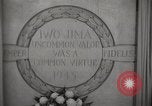
Dedication of Marine Corps War Memorial at Quantico Virginia, and sculptor Felix de Weldon working on sculpture for Arlington location.
The U.S. Marine Corps War Memorial original statue during its unveiling ceremony at the Marine Corps base in Quantico, Virginia on November 10, 1951 (This is after the statue had been moved from its original Constitution Avenue location in Washington DC in 1947, and subsequently renovated under sculptor de Weldon's supervision while it was in Quantico.). A sign on the memorial reads "Uncommon valor was a common virtue, 1945." Next scenes show sculptor Felix de Weldon as he works to build the larger Marine Corps War Memorial in Arlington, Virginia, which was dedicated in November 1954. Felix de Weldon measuring a model of the flag raising on Iwo Jima made by him. de Weldon and others on his team work to carve the large war memorial in plaster before it is cast in bronze. Views of the sculpted faces of the six Marines who raised the flag on Iwo Jima: Faces of John Bradley, Rene Gagnon, Ira Hayes, Franklin Sousley, Harlon Block and Michael Strank. Brief glimpse of the original flag raising scene on Mount Suribachi in February 1945. Next scene, circa 1954 or 1955, shows the completed Marine Corps War Memorial in bronze, in Arlington Virginia, with Washington Monument and Lincoln Memorial landmarks of Washington DC in the background. Close-up views of faces of a young boy, an elderly woman, and a middle aged man who removes his hat. American flag fluttering in the breeze atop the war memorial.
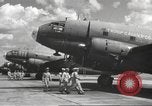
Chinese airmen board a U.S. troop carrier aircraft at Austin, Texas
United States and Chinese airmen at Bergstrom Field, Austin, Texas July 1946. The Neo-Classical building is the Texas State Capital at Austin, Texas and Austin Texas is noted on the graduate’s diploma “Bergstrom Field, Austin, Texas”. At this time the 349th Troop Carrier Group was based at Bergstrom and assigned to the Third Air Force, Tactical Air Command as noted on the diploma. Also “Air Force Combat Units of World War II” Edited by Maurer Maurer states this unit trained Chinese crews to operate C-46 aircraft. Film is very interesting in that it visually shows the transition from “Army brown to Air Force Blue” for the C-46s still carry the I TROOP CARRIER COMMAND insigne on the nose, with was disbanded on 4 Nov 1945 but they have the new AAF wide "Buzz Numbers" for all aircraft operating solely within the continental USA, by T.O. 07-1-1 of November 1945 and the graduate’s diploma is notating the new post-war air force type command reorganization of March 1946.
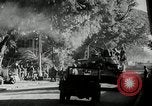
Brutalities against prisoners, officials gathered in 1949 in Palace of Nations for Third Geneva Convention; discussion of Geneva Conventions.
Film from 1965 shows scenes that span from early 1940s through mid 1960s. Film opens showing armed conflict in Laos and South America. Soldiers firing rifles in jungle areas. Armed men running across a field and in a town in Cyprus. Heavy armor engaged in conflict and buildings burning in undisclosed location. Riots in Congo with a crowd of men beating another man. Armed Republic of South Vietnam soldiers (ARVN) moving through jungle in Vietnam War. A Viet Cong fighter shot as ARVN troops attack a hut. People fleeing in streets of Cuba as government soldiers engage armed revolutionaries under Castro. A civilian woman suffering a seizure as Red Cross workers attempt to carry her. Burned body of dead tank crew soldier atop a tank. Medical corps persons moving wounded on a stretcher. Various views of ARVN with captured Viet Cong in Vietnam. Narrator discussion about Geneva Conventions and Counterinsurgency. View of the Palace of Nations building in Geneva Switzerland. Scene shifts to inside, in 1949, where delegates of 59 nations are gathered to develop new rules expanding the original 1929 Geneva Conventions, in order to better protect prisoners of war, wounded prisoners, noncombatants and others caught up such internal conflicts. View from ground of German paratroopers during World War 2, jumping from Junkers Ju-52 trimotor transport planes. Closeup of German soldiers leaping from a plane and descending in parachutes. Japanese soldiers surrendering to Americans on a Pacific Island in World War 2. Several scenes of massacre victims lying on the ground, victims of Nazi German brutality in Europe during World War II. Survivors of a Nazi concentration camp near the time of its liberation in 1945. A U.S. Army medical corpsmen help one to a stretcher. Executed prisoners of war. Courtroom of the Nuremberg trials. Seen in the front row of Nazi leaders are: Hermann Göring, Rudolf Hess, Joachim von Ribbentrop, Wilhelm Keitel, Ernst Kaltenbrunner, Alfred Rosenberg, Hans Frank, Wilhelm Frick, and Julius Streicher. Seated behind them are: Karl Dönitz, Erich Raeder, Baldur von Schirach, Fritz Sauckel, Alfred Jodl, Franz von Papen, Arthur Seyss-Inquart, Albert Speer, and Konstantin von Neurath. Scene shifts to the postwar trial of Japanese Lieutenant General Masaharu Homma, in the Philippines. Prisoners with hands bound, in an unidentified Asian conflict, being herded into an open truck. Views of the document constituting the 3rd Geneva Convention of 1949, addressing treatment of prisoners and of parts directed to "conflicts not of an international character." Views of a traumatized civilian driver wounded and a female passenger killed in in his car (appears to be in Cuba or Latin America). Armed gunmen have the man leave the car. A man lays the body of the woman beside the car. Scene shifts to a group of surrendered Vietcong fighters with their weapons stacked. Wounded combatants being carried on stretchers. American survivors of a Japanese prison camp receiving a good meal after being rescued - this is possibly in the Philippines in 1945. Many of the American prisoners are gaunt and emaciated and malnourished. Narrator recites list of activities prohibited by Geneva conventions, as images show these activities: A ditch filled with victims of massacre. Hostages being taken in an internal conflict in an African country. Prisoners being beaten by non-uniformed civilians in and humiliated in public. A recently liberated prison with a former prisoner in striped uniform beating a man as a group is marched away (likely a World War 2 concentration camp with a liberated prisoner beating a former Nazi guard). Death sentences being rendered without due process. A court in Cuba. A boy pointing at a lineup of prisoners. A prisoner shot.
CRITICALPAST.COM: About Us | Contact Us | FAQs - How to Order | License Agreement | My Account | My Lightboxes | Shopping Cart | Advanced Search | Featured Collections | Website Terms & Conditions | Privacy Policy ©2026 CriticalPast LLC.
License Agreement |
Terms & Conditions |
Privacy Policy
©2026 CriticalPast LLC.