


 Francais
 Deutsch
 Italiano
Refine Your Search
Iserlohn Germany 1945 stock footage and images
- Showing 277 to 282 of 10471 results more
more Hide
Hide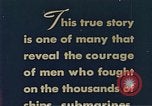
Log book entries depict events that took place on USS Franklin as it was underway in the Pacific Ocean during World War II.
The film 'The Saga of the Franklin' to honor and remember the men who served in the U.S. Navy during during World War II. A board reads USS Franklin (CV-13). The log book of the ship. An entry from the log book. The ship leaves San Francisco, California in February 1945. A U.S. flag flutters on the ship. The ship in the western Pacific Ocean. A fleet of ships underway at sea. Aircraft take off from the deck for a mission on July 4th, 1944. The target is Iwo Jima, Japan. Other ships nearby. Guns are fired. A Japanese Kamikaze aircraft crashes on a ship. An aircraft in flight. Explosions on the ground below. A Kamikaze aircraft is hit by guns fired from USS Franklin by Air Group 13. Rocket equipped aircraft struck Japanese ships. Aerial view of burning ships in water. Kamikaze aircraft in flight. A Kamikaze aircraft which has been hit, falls downwards in a mass of fire. It crashes into water. A Kamikaze aircraft crashes into water near a ship. A ball of fire rises up. A Kamikaze aircraft crashes into USS Franklin on October 30, 1944. After being repaired, USS Franklin reaches Ford Island in Pearl Harbor, Hawaii. A band plays to welcome the ship. U.S. Navy WAVES ( Women Accepted for Volunteer Emergency Service) on the ship. A U.S. Navy Vice Admiral decorates sailors. Air Group 75 and 35 aboard the ship. Aircraft on the deck. An aircraft takes off from the deck of the carrier. An aircraft prepares for a take off. A white diamond painted on the tail of an aircraft in flight. An aircraft comes in for a landing. An LSO ( Landing Signal Officer ) signals using flags. He makes a signal for an aircraft to cut off its engine while landing. The aircraft makes an arrested landing. An aircraft lands on its nose. Men sunbathe in Hawaii. A party abroad USS Franklin. A cake to celebrate the 9000th landing on the carrier. Ensign A. W. Graf who had made the landing cuts the cake.
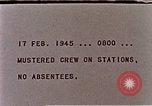
Crew members are inspected aboard USS Franklin in the Pacific Ocean during World War II.
A film to honor and remember the men who served in the U.S. Navy during World War II. A log book entry of USS Franklin (CV-13). Crew on the flight deck of USS Franklin in the Pacific Ocean. Fueling crew in red shirts, aircraft directors in yellow shirts. Men who load armor and aircraft in blue shirts. Men are reviewed by the executive officer. After the inspection men leave for their work. Aircraft taxi on the flight deck on 20th February, 1945. Aircraft of Air Group 35 and 75 take off. Aircraft in a formation flight. Aerial view of the Naval Air Station at Kanoehe, Hawaii. A ship loaded with supplies. Supplies loaded on trolleys. 'Outrigger Canoe Club' at a beach. Fliers on the beach. They sunbathe and enjoy rowing. Sailors board USS Franklin. The ship underway at sea to rejoin task force 58. Escort vessels sail alongside. Aircraft in flight overhead. The ship heads towards Ulithi island. A log book entry. A fleet of ships near Ulithi island. Carrier Hancock in the fleet. The fleet sails towards the island of Honshu, Japan.
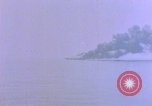
Thick smoke rises from USS Bunker Hill after it suffered a Japanese air attack in the Pacific Ocean during World War II.
Japanese air attack on U.S. ships underway in the Pacific Ocean during World War II. USS Bunker Hill (CV-17) underway burning after an air attack on 11th May, 1945. Thick smoke rises from the burning ship. U.S. Navy sailors aboard a destroyer which is counter sailing.
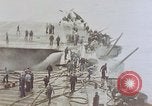
Crew of USS Enterprise suppressing fire after being struck by a Japanese kamikaze in World War II
U.S. Navy warships under attack by Japanese aircraft during World War 2. Fire fighting detail working on the deck of USS Enterprise (CV-6). They play hoses into elevator shaft where forward elevator was blown out of its well by Japanese kamikaze on 14 May 1945. Another ship in the far background, as battle with Japanese aircraft continues. Bomb splash in water near distant ship.
Damage on USS Enterprise after it was attacked by a Japanese suicide aircraft while underway in the Pacific Ocean
Japanese air attack on U.S. ships underway in the Pacific Ocean during World War 2. Men running on the deck of USS Enterprise (CV-6) after it suffered a Japanese air attack on 14th May, 1945. It was hit by a kamikaze Zero, piloted by Lt. J.G. Shunsuke Tomiyasu, destroying her forward elevator, killing 14 and wounding 34. View of damage to number one elevator from the suicide airplane attack Fire fighters try to douse the fire. Burned aircraft on the deck. On hangar deck, fire fighters plays hoses on bulkheads. Ammunition and damaged airplanes are jettisoned over the side. An aircraft on its nose on the deck. Debris strewn all around.
Destroyer, USS Sigsbee, being taken in tow by the Cruiser, USS Miami, after being hit by a Japanese Kamikase in World War II
Aftermath of Japanese Kamikaze attack that struck aft of number 5 gun on the destroyer, USS Sigsbee (DD-502), April 14th, 1945, while she was on radar picket duty off Okinawa, during World War 2. The USS Sigsbee is seen with its stern partly under water. The USS Dashiell (DD-659) is in the background. View of the Sigsbee, from the U.S. Cruiser, USS Miami(CL-89) as she prepares to take the destroyer under tow. Some Sigsbee crew members seen on her upper deck and several occupy her gun position forward of the damaged area. Camera pans over Sigsbee's main deck, where many of her crew are seen, and then focuses on her bow, as crews from both ships secure tow lines.
CRITICALPAST.COM: About Us | Contact Us | FAQs - How to Order | License Agreement | My Account | My Lightboxes | Shopping Cart | Advanced Search | Featured Collections | Website Terms & Conditions | Privacy Policy ©2026 CriticalPast LLC.
License Agreement |
Terms & Conditions |
Privacy Policy
©2026 CriticalPast LLC.