


 Francais
 Deutsch
 Italiano
Refine Your Search
Iserlohn Germany 1945 stock footage and images
- Showing 355 to 360 of 10471 results more
more Hide
Hide
Profile of job and work of Commissioner of Consumer Affairs as she checks various goods and retail practices in New York City
Views of the crowning ceremony at the Miss America beauty pageant in 1945, and winner Bess Meyerson on stage. Next scene shows Bess Myerson years later as Commissioner of Consumer Affairs for New York City enters a car, car on road on streets of Manhattan, New York City. View of New York City buildings from a moving car. Views of various consumer goods, with price tags on them, people buying. Views of manual cash registers ringing up totals. Views of consumers in markets, stores, and supermarkets. Views of Consumer rights protection office, men and women at work. Women and men on phone. Consumer protection officer at a store, checking different food items. Views of items in butcher or meat department. Interior of a laboratory, food items are tested. Officials working in an office. Commissioner of Consumer Affairs in her office, various items on her desk. View of many different grocery items moving on a checkout belt toward a store cash register. Store worker lifts paper grocery bag and hands it to shopper. Consumer Affairs Commissioner walking on streets of New York City and greeting a woman passing by.
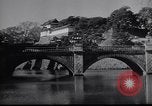
Film tracing activities of General Douglas MacArthur from defeat of Japan in World War II through Korean War (1950)
Highlights covering General Douglas MacArthur, from 1945 through 1950. The Imperial Palace in Tokyo, Japan. Several Japanese bowing towards the Palace. General Douglas MacArthur exits a car in Tokyo and walks up steps to enter his headquarters in Japan. Emperor Hirohito walks between two U.S. sentries, as he leaves a building and enters his limousine. Japanese citizens form lines on streets to cast ballots in election.Several Japanese women voting. Exterior of the Japanese National Diet building. Interior with representatives seated. A farmer behind a cultivator, pulled by an ox, in a rice paddy. Japanese school children waving American and Japanese flags together, as MacArthur leaves his Tokyo headquarters, walks down steps, and enters car. MacArthur saluting at a military ceremony, where his wife, Jean MacArthur, and son Arthur are spectators. Explosions in hills, from American Patton tank shelling North Korean positions in Korean War. American soldiers firing a mortar; infantry advancing along sides of road; and American tank commander rendering first aid to wounded comrade. United States Air Force (USAF) C-47 transport aircraft ferrying American troops into Korea, from Japan. American infantry marching across a bridge; firing mortars and rifles; and advancing on foot across fields. American troops on trucks followed by a Patton medium tank. MacArthur meeting troops on river boat; riding in a jeep; being briefed by U.S. officer in the field; examining a knocked out tank; and decorating U.S. troops in winter. Closeup of MacArthur in winter gear with his circle of five stars pined into a fur cap. Views of U.S. amphibious landing at Inchon (or Incheon) in Korean War. MacArthur watching from a ship offshore. Syngman Rhee, President of South Korea, reading message of appreciation to General MacArthur and shaking hands with him at the podium. U.S. President Harry S. Truman, pinning a medal on General MacArthur,on Wake Island in October, 1950.
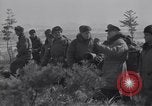
General Douglas MacArthur delivers a farewell address at a Joint meeting of Congress in Washington DC.
The life of U.S. General Douglas MacArthur from 1945 to 1951. General Douglas with other officers in Korea during the Korean War. Soldiers battle with the Chinese on the Korean Front. MacArthur in a jeep studies a map. A motorcade in San Francisco. Large crowds welcome MacArthur. MacArthur in an open car waves at the people. Mrs MacArthur in an open car with other women. MacArthur makes a speech expressing his gratitude towards his wife. The MacArthur family in an open car. Gen. MacArthur delivers a speech at the Joint session of Congress in Washington DC as he completes his 52 years of service, including famous line, "Old soldiers never die, they just fade away." The audience applauds. Sergeant Stuart Quinn of the U.S. Army talks about General MacArthur.

Early pictures of General Eisenhower showing his childhood home and his welcome ceremony when he returned home.
'The Big Picture' depicts the life of U.S. General Dwight D Eisenhower. Sergeant Stuart Queen of the U.S. Army stands in front of a map. He gives an introduction of Eisenhower. In 1945 Eisenhower returns to his homeland in Denison, Texas. A banner reads 'Welcome IKE'. People gather on the sides of the streets to welcome him. He waves from an open car at the cheering crowds. People at parade carry the U.S. flags during a ceremony. Eisenhower salutes. D Day, June 6, 1944- Barges carrying American troops land on the shore of Normandy. Eisenhower with another military officer. Eisenhower salutes. Streets of the city Abilene. Exterior of the Eisenhower Museum. Two boys enter the museum. Pictures of Eisenhower in his childhood - during infancy, house in which he was born, Eisenhower with a group of children, Eisenhower with his family, with his baseball and football team. View of Eisenhower's bedroom- scripture readings on the walls and books in the shelves. A truck passes the creamery where Eisenhower worked in his spare time. Pictures of Eisenhower leaving home to join the Military Academy at West Point. Cadets marching at the grounds of the military academy. Graduation Certificate of Eisenhower. Eisenhower with his wife Mamie Geneva Doud. Fight in Western Europe during the World War I. Picture of Eisenhower with other cadets. The certificate of the Distinguished Service Medal presented to Eisenhower for his services for training tank crews in Pennsylvania.
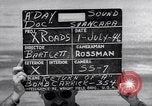
B-29 "Dave's Dream" returns to airfield in Marshall Islands after Test Able atomic bomb drop on Bikini Atoll
The B-29 "Dave's Dream" returns to airfield in Marshall Islands, after dropping atomic bomb on Bikini Atoll, in Test Able of Operation Crossroads, on July 1st, 1946, during U.S. nuclear testing. The B-29 lands and taxis to a parking place on the ramp. The area around the aircraft is cordoned off and the crew is confined therein as they deplane. Navy photographers take photos. An interviewer talks to crew members. The crew walks away from the aircraft along a cordoned pathway between numerous military personnel on hand to greet them on this historic occasion. The aircraft, number 44-27354, was actually participating in its second atomic mission. It also served as a photographic platform for the mission to Nagasaki on August 9, 1945, when it was named "Big Stink.". Pilot for the Bikini mission was Major Woodrow Swancutt of Wisconsin Rapids, WI. The aircraft was renamed "Dave's Dream" in honor of Captain David Semple, a bombardier killed during the crash of another B-29 on March 7, 1946, near Albuquerque, New Mexico. (World War II period).
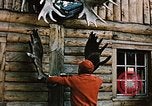
Man placing moose antlers on log cabin in Alaska.
Man securing Moose antlers for display on a former homsteader's log cabin, maintained for airmen's recreational use at Elmendorf Air Force Base (now Joint Base Elmendorf-Richardson, Alaska). He fastens the antlers below another set fastened near the cabin roof. Another take of the same event. Snow visible on roof of the cabin. (Note:The land for Fort Richardson and Elmendorf was purchased by the U.S. Federal Government, from private landowners and homesteaders during 1939 through 1945.)
CRITICALPAST.COM: About Us | Contact Us | FAQs - How to Order | License Agreement | My Account | My Lightboxes | Shopping Cart | Advanced Search | Featured Collections | Website Terms & Conditions | Privacy Policy ©2026 CriticalPast LLC.
License Agreement |
Terms & Conditions |
Privacy Policy
©2026 CriticalPast LLC.