


 Francais
 Deutsch
 Italiano

Refine Your Search
Iserlohn Germany 1945 stock footage and images
- Showing 4567 to 4572 of 10470 results more
 Hide
Color Sound

Views of ruined Europe following WW2 and a list of Nazi criminals being charged at Nuremberg.
'Nuremberg it's a lesson for today ', Destroyed buildings and houses all over Europe in aftermath of World War II. Children running and groups of boys playing on rubble of destroyed buildings in a European city. Hungry people in despair. A hungry boy asleep leaning against a building. People make a fire to stay warm, atop rubble of wrecked buildings. Face of a young boy in despair. A young girl walking amid ruin. An old woman looking upset. People walking through rubble on street in Germany with Brandenburg Gate in the distance. Children seek relief at in a breadline or food relief area asking for food, with some taking cups offered and others reading hands forward. An hungry and upset young boy beside a military truck shows the motion of holding an item and eating it in order to ask a person (unseen) for food. A distraught looking woman with disheveled hair cradling a young girl in her arms and walking away from a group. Crucifix standing alone amid rubble. Scene changes to the Palace of Justice in Nuremberg, Germany as Military Police guards the palace. A document shows the names of Nazi leaders who will be tried at the Palace of Justice for war crimes during the Nuremberg Trials.

U.S. President speaks about the consequences if the Nazis win World War II during a speech in Washington DC, United States.
U.S. President Franklin D. Roosevelt delivers a speech in Washington DC, United States, before the entry of the United States into World War II. During the speech he warns the Americans of the consequences if Germany wins the war. He says that if Britain loses the war Nazis will take over the whole of Europe, Asia and Africa, and gain control of the seas. Such a situation would endanger the freedom in American continent as well. He clarifies that the U.S. does not intend to send its military forces to Europe to fight against Germany. He also assures the citizens that the Nazis are not going to win the war.

United States soldier training and preparedness during Cold War
A sign board reads: 'Border Operations'. Sign board along the side of a road in Germany for an inner-Germany border at Ronshausen in the Rotenburg district. A U.S. Army jeep drives past on the street. Soldiers advance along supply lines to protect them. Soldiers in training during Cold War receive training in firing a Browning M1919A4 .30 caliber machine gun. Aerial view of snow covered arctic mountain region. A sign board reads: "Army Arctic Training Center, Big Delta, Alaska." U.S Army soldiers training in Alaska are seen on skis, firing rifles in prone position on the snow. Scene changes to a sign board that reads, "Organized Reserve Corps U.S. Army." An officer briefs U.S. Army Reserve soldiers (wearing civilian clothing) about ammunition and equipment in a briefing room. U.S. Army soldiers exercise for their physical fitness. They are seen doing synchronized callisthenic drills including pushups on a large field. Men in a radio room receiving a transmission. One of the men presses a button to ring an alarm bell. View of an alarm ringing. U.S. Army soldiers in a dining hall or mess hall hear the alarm and scramble and run to battle stations during a Cold War aerial attack drill. Soldiers running toward outdoor gun positions, past a rotating radar position. U.S. Army soldiers taking positions, with some entering communication vans and some that man an anti-aircraft gun. Soldier plotting positions on a clear, erasable wall board. Wide view of soldiers manning a 90-mm Anti-aircraft gun M1 on mount M1A1.
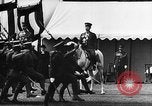
Actions of Axis and Allied powers on brink of World War II in period 1937-1939.
Japanese troops parade for Emperor Hirohito, mounted upon a white horse. Italian troops goosestep and German troops goosestep on parade. View of an Austrian town with snow-covered Alps mountains in background as German troops enter Austria on March 13, 1938 during the Anschluss. Local citizens welcome them, displaying swastika flags and giving Nazi straight arm salutes. Troops, military vehicles, tanks, motorcycles, and horse-drawn artillery comprise the German invading force. Shifts to Spain, where war torn buildings reflect effects of German and Italian intervention during the Spanish Civil War. A donkey standing near field artillery piece. Artillery being fired from an urban park in Spain. Artilleryman using a range finder. German gun crew with heavy artillery piece. Soldiers wearing Adrian steel helmets, firing a two-wheeled water-cooled machine gun. Spanish carrying wounded on stretcher. Spanish civilians inadvertently slain during civil war conflict. Starving dog walking in street. Huge poster of Francisco Franco and view of him on reviewing stand saluting marching Nationalist troops. Repeat of Hirohito reviewing troops and Italian and German troops goosestep. Adolf Hitler and Benito Mussolini stand together in open car heading to Fuhrerbau in Munich, Germany, for signing of Agreement between Germany, Italy, Britain, and France in 1938. Neville Chamberlain, and Edouard Daladier riding in car to Fuhrerbau. Views of the principals signing the accords. First is Adolf Hitler, followed by Prime Minister Neville Chamberlain, Benito Mussolini, and Edouard Daladier. After the signing, the principals, plus Hermann Goering, mingle and converse. Change of scene to nighttime in Rome, Italy, where Benito Mussolini addresses a huge throng gathered near the Victor Emmanuel Memorial to cheer him after his return from Munich. Next, German troops are seen entering Sudetenland (Czechoslovakia) greeted by joyous ethnic German inhabitants. Banners are stretched across a street. One gives thanks to the Fuhrer. Several scenes of cheering population. A woman strews flowers in a roadway. Hitler arrives, standing in an open car, and is met with cheers of adulation. A military brass band plays from the open beds of two moving army trucks. Signpost points to Prag (Prague), Eger (Cheb), Joachimstal (Jáchymov), and Komotau (Chomutov) after German annexation. Scene shifts to Prague, where German troops are seen occupying the city. High ranking German officers in a car are seen coming through the gateway from the Court d´honneur of the Prague Castle into the Hradčany Square. The next sequence shows an Italian Freccia-Class destroyer in the Albanian Port of Durrës. An Italian L3/35 Tankette is driven off a large cargo ship. Italian troops on bicycles ride in a city street. A German 88mm antiaircraft (flak) gun is shown, mounted at a fort overlooking a river and city. Final scene shows Adolf Hitler addressing a meeting of the Bundestag in the Kroll Opera House (alternate meeting place after burning of the Reichstag). He reads, contemptuously from an April 14, 1939 letter sent to him by U.S. President Roosevelt, asking him to give "assurance that your armed forces will not attack or invade the territory or possessions of the following independent nations: Finland, Estonia, Latvia, Lithuania, Sweden, Norway, Denmark, The Netherlands, Belgium, Great Britain and Ireland, France, Portugal, Spain, Switzerland, Liechtenstein, Luxembourg, Poland, Hungary, Rumania, Yugoslavia, Russia, Bulgaria, Greece, Turkey, Iraq, the Arabias, Syria, Palestine, Egypt and Iran." As Hitler reads through the litany of nations, the Bundestag erupts in laughter.

German troops supported by heavy artillery and rockets and a German antiaircraft downs an enemy bomber in Monte Cassino, Italy.
Battle of Monte Casino between Germany and Allied troops in Monte Cassino, Italy. German troops are supported by heavy artillery and rockets. The troops fire artillery and rockets. Explosions and smoke rises over targets. A battle with mortars and small arms. Allied prisoners (both British and American) are taken by German forces. Allied POWs marched on road under German guard. Cannons are fired. A soldier watches a plane through binoculars. Rockets are fired. Planes in flight. Ruins of Cassino. A German antiaircraft downs an enemy bomber. Explosions and smoke rises. A flag of Nazi Germany in the ruins. (World War II period).
French and 3rd army troops enter Strasbourg and advance in the Metz area, France (WW2)
French and United States Army 3rd Army troops liberate Strasbourg, France during World War II. Tanks of the French 1st Army moves from the Swiss border. Sign reads “Mülhausen Elsaß” (“Mulhouse, Alsace”). Troops find the body of a dead German soldier along the road. They advance in the Metz area. The 9th army advances through villages in bordering Germany. Soldiers walk on the battlefield. German prisoners of war (POWs) walk along with the soldiers. Civilians holding the French flag return to their homes after the battle. Strasbourg sign in German reads “Straßburg Schiltigheim”. Bell tower of the Cathedral of Notre Dame in Strasbourg, France. Damaged buildings near the Cathedral. The street is littered with pile of handheld, small Nazi flags with swastika emblem. Men gather outside buildings discussing amongst themselves. U.S. Third Army soldiers walk in the mud. Winter weather overshoes are distributed to troops. Soldiers put on the all-weather boots. More German soldiers and officers are captured in Metz. United States Ninth Army troops enter the town of Weisweiler, Germany. Soldiers moving through backyards, chicken houses and engage in house-to-house fighting. A mortar crew fire mortars behind trench made of sandbags. A wounded U.S. Army soldier crawls to reach the outstretched arm of a fellow soldier. Injured U.S. soldier receiving treatment in aid station. Medical aid stations at various places on the battlefield. Medics treat a wounded soldier. A dying soldier lies down on the street. Soldiers carry a patient to top of a tank. They march forward on the battlefield as officers in Jeep watch.
CRITICALPAST.COM: About Us | Contact Us | FAQs - How to Order | License Agreement | My Account | My Lightboxes | Shopping Cart | Advanced Search | Featured Collections | Website Terms & Conditions | Privacy Policy ©2026 CriticalPast LLC.
License Agreement |
Terms & Conditions |
Privacy Policy
©2026 CriticalPast LLC.