


 Francais
 Deutsch
 Italiano
Refine Your Search
Iserlohn Germany 1945 stock footage and images
- Showing 43 to 48 of 10471 results more
more Hide
Hide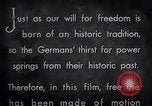
U.S. Army orientation film "Here is Germany" showing the contrast in life in Germany pre-war and during World War 2
U.S. Army training film titled 'Here is Germany'. Circa 1930 - 1938 views of pre-war German countryside, and German cities including Berlin and others before destruction in World War 2. Shots include famous German landmarks and buildings in major cities including Brandenburg Gate and Victory Column sculpture close-ups and other monuments all before bombing of World War II. Lifestyle of German people with families and children in their routine lives in the decade of 1930 before the war. Farmers working fields, mined coal transported by rail, potatoes poured from a full sack, a boy shepherd with geese; a farmer counting pigs descending a ramp at a farm. City port or harbor scene with ships and a modern looking railroad train arriving at a station, sign on side reads Deutsche Reichsbahn (German Reich Railway). High speed highway roads like the Autobahn. German cruise ship at sea. Aerial view of airport with "Berlin" sign on ground. German schools, offices, factories and markets. German woman braiding a girl's hair. German woman taking in washed clothing from a clothesline. German men, women, and children cleaning and polishing work areas and possessions. A German library with people studying and others at book shelves. German classroom with a teacher instructing children and writing on a blackboard. Scenes of German musicians and symphony orchestra and musical instruments, artisans, masons, cooks. Busy roads with cars. Narrator then presents a darker other side, showing an arms factory during rearmament of Germany, German soldiers escorting away a religious priest. German military officials. Scenes circa 1945 of victims of German armies and of the concentration camps. Lumps of dead bodies from massive public shootings, a man being tortured, burning chambers, prisoners of war, concentration camps, human ovens, gas chambers. Survivors of the German custody in relief camps of Red Cross. Evidence of atrocities committed by Nazi Germany. Articles made of human skin and bones. Daily utility items like toys and brushes made from human body parts. Scenes of survivors of concentration camps. Polish people dead from Nazi atrocities at Lublin Castle. Italians and Belgians murdered by Germans, American POWs murdered by Germans. Scenes return again to 1930s views of peaceful German citizens and German lifestyle juxtaposed with views of German soldiers and military actions in World War 2. Some famous Americans of German roots: Wendell Willkie, Admiral Chester Nimitz, Henry J. Kaiser. Narrator talking about American customs and values. View of two teenage American boy students viewing a housing area and taking notes. One of the teenage boys is African American. Some men gathered at a bar in an American town. A man holding a long fly fishing pole preparing to depart on a fishing trip. Woman neighbors in discussion. Young American women walking down a sidewalk in an American town as a group of American boys watch and admire them.
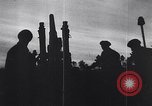
British and Canadian Infantry of 1st Canadian Army capture Kleve (Cleve) Germany during World War 2
Artillery batteries of British and Canadian forces, under command of Field Marshal Montgomery, bombard German positions on the German-Dutch border.British artillery firing BL 4.5 inch Medium Guns and 155mm heavy guns, in an 11 hour bombardment of German positions east of Nijmegen, Netherlands. Snow covers the ground. A British Land Mattress rocket launcher firing a salvo of 3-inch rockets. I Infantry of 1st Canadian Army, under command of General H.T.G Crerar, march toward an area between the Mars and Rhine rivers. They move through forest of the Reichswald, where they encounter Siegfried Line obstacles. British and Canadian tanks using heavy chain mine flails are seen beating their way through mine fields. Infantry in single file silhouetted against a light sky. Canadian Sherman tanks advancing with infantry. One is labeled "Spitfire II." Churchill tanks and heavy vehicles advance, including Churchill AVRE fascine mat-laying vehicles and Churchill ARKs (Armoured Ramp Carriers). Sherman tanks pass, including one named "Diana." British Armor pushing through rain-soaked and partly flooded towns towing BL 4.5 guns. They reach Kleve (formerly spelled Cleve) on February 11, 1945. Roadside sign reads: "Reichs-Grenze"(Border of Germany). Sherman tank of the 6th Guards Tank Brigade firing point blank on city street in Kleve. British troops taking cover behind tank destroyer moving slowly along street. Large number of German prisoners of war being marched to an assembly area. British infantry continuing their advance toward Goch, Germany.

U.S. Maj Gen Emil F Reinhardt shakes hands with Russian officer Maj Gen Rusakov in Germany during World War II.
Russians and Americans meet in Germany during World War II. American Major-General Emil F. Reinhardt, Commanding General of the 69th Division shakes hands with his Russian counterpart Major-General Vladimir V. Rusakov Commanding Officer of the 58th Guards Division at a meeting of American and Russian troops near the Elbe River and the town of Torgau, Germany in late April, 1945. American and Russian troops stand in formation. US, Russian, and British flags on display.
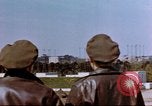
United States Airmen visit the Zeppelinfeld and Zeppelintribüne in Nuremberg, Germany
Activities of United States Airmen in Germany very soon after end of World War II in Europe. United States Army Air Forces Lieutenants visiting the war-damaged Zeppelintribüne, at the zeppelinfeld, in Nuremberg, Germany, 1945. They climb the stairs of the Zeppelintribüne grandstand. Later, the American soldiers look at the remains of the Swastika and Eagle that formerly adorned the Zeppelintribüne, and was blown up by the U.S. Army. One tries to pick up a piece of it. Airmen stand and chat. One Lieutenant helps another to lit up a cigarette. They smoke cigarettes, and pose for a photograph on the field.
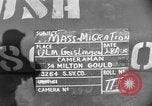
Trucks loaded with refugees and their luggage drive past through the streets in Ulm Germany.
Mass movement of German refugees in Germany during World War II. Trucks loaded with the refugees and their luggage drive past on streets in region of Ulm, Germany. A group of refugees rests alongside a highway with their luggage. They load their luggage on a truck. A directional board on a street. Second part of clip is from September 13, 1945, again at Ulm: At a railroad train station: German refugees gathered at the station with their luggage. A blond German girl child sits on a suitcase. A German family stands at the door of a boxcar.
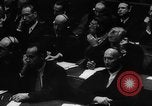
Nazi criminals are questioned during the Nuremberg Trials in Nuremberg, Germany.
Events related to the Nuremberg Trials held at the Palace of Justice (Fürther Str. 110, 90429 Nürnberg, Germany) in Nuremberg, Germany. German attorneys defend the accused. One by one the accused are cross examined. Rosenberg is examined on the count of high mortality rate among Russian prisoners of war. Joachim von Ribbentrop is questioned about the military pressure on Russian from Germany. Goering is questioned about his knowledge of the policy to exterminate Jews. Speer testifies about negative things Hitler said about Goering in response to Goering's telegram suggesting that Goering took power in April 1945.
CRITICALPAST.COM: About Us | Contact Us | FAQs - How to Order | License Agreement | My Account | My Lightboxes | Shopping Cart | Advanced Search | Featured Collections | Website Terms & Conditions | Privacy Policy ©2026 CriticalPast LLC.
License Agreement |
Terms & Conditions |
Privacy Policy
©2026 CriticalPast LLC.