


 Francais
 Deutsch
 Italiano
Refine Your Search
Iserlohn Germany 1945 stock footage and images
- Showing 5227 to 5232 of 10461 results more
more Hide
Hide
Assorted scenes of World War I, as America enters in 1917
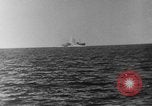
An Allied ship in final stage of sinking by German U-Boat during World War 1. The ship's boilers explode as she goes under. U.S. President Woodrow Wilson looking out a window in his office in the White House. Officers and crew crowd conning tower of German submarine U-35 as it approaches a steamer it has stopped in Mediterranean Sea. View of shells from the U-Boat's deck gun, striking at the ship's waterline. View from the U-Boat U-35 deck as the attacked ship is sinking. She disappears, bow-first, beneath the water. Black smoke issues from her stack. President Wilson signing papers at his desk. American flag flying in front of the nation's capitol. President Wilson addressing the Congress and obtaining a declaration of war against Germany, on April 6, 1917. A banner reading: "War is declared." New recruits marching into an Army Post, in civilian clothes, carrying personal baggage. Regular U.S. soldiers beginning the basic training of recruits. Recruits learning the manual of arms, with wooden substitute weapons. Recruits engaged in Calisthenics outdoors at an army base. Contingents of uniformed and trained American soldiers marching along a road. Soldiers practicing live fire with machine guns, and engaged in bayonet training. Troops in formation double-time marching. American troops marching to trains at a railroad station, as spectators cheer them from the train station platforms. They board railway train and wave as it pulls out of the station.
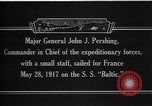
American Expeditionary Forces (AEF) arrive in France during World War I
The United States declares war against Germany during World War I. On May 28, 1917 Major General John J. Pershing, Chief of American Expeditionary Forces aboard the S.S. Baltic on its way to France during World War I. Nearly 2,000,000 American soldiers disembark at a port in France. The troops disembark from the ship. A ship at the harbor. Ships underway at sea. Sailors on the deck of a ship. A German U boat underway. Naval gun being fired at the U boat. Explosion occurs at sea. A man waves signal flags from a ship. The troops disembark from the ship. Soldiers at a rail road station and a train pulls up to carry them to the war front. (World War I; World War 1; WWI; WW1)
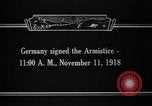
World War I armistice celebrations; Allied soldiers being decorated by General Pershing
People celebrate on the streets of New York after the Germans sign the armistice agreement ending World War 1 on November 11, 1918. People cheer and wave their caps. A French couple thanks Allied soldiers for rescuing them from Germany. Allied soldiers lined up in a field in France as U.S. General John J. Pershing decorates them. Troops of the United States 42nd Division march at a parade as General Pershing reviews them. Soldiers carry American flags at the parade.
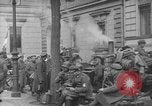
Central Powers troops at end of World War I
German soldiers relaxing on sidewalks of a city in Germany at end of World War 1. German Imperial flag with crest on display. Smoke rising from field kitchen stove. View of troops resting on sidewalk island. Arms are stacked and some troops are napping. Complete change of scene to Ottoman Empire Turkish troop bivouac in a valley during First World War. Numerous tents are erected. A soldier getting shaved in the foreground. Turkish troops eating at open air mess tables.
Scenes of World War 1 and the period between the wars, illuminating career of U.S. Air Force General Henry (Hap) Arnold.
Newspaper headline in Washington post reads 'United States and Germany at War'. Civilians recruited into the army. American pilots of the 103rd Aero Pursuit Squadron, in France, with their Spad aircraft. American airplane production factories in operation, with manny women war production workers seen assembling aircraft. People celebrate in the streets at end of World War I at time of armistice. Airplanes, under command of General Billy Mitchell bomb obsolete warships in demonstration of aircraft power in warfare. 1920s: Postwar flyers and stunt wing walkers perform in the roaring twenties. Developments and improvements in parachutes, and view as stunt men parachute from high buildings and airplanes. Aircraft flying forest fire patrols. Aerial view of burning forest fire below. Lieutenant Colonel Arnold commands emergency airlift and drop of food to snowbound Native American Indians in American Southwest, in 1932. World War I scene of American 103rd Aero Pursuit Squadron Spad airplanes taking off, in France. Lieutenant Colonel Hap Arnold with his family, including two young boys and a young girl (his sons and daughter) and his wife.
The story of AFN ( American Forces Network) Radio. Founding announced in 1942. First broadcast in 1943; growth in 1944.
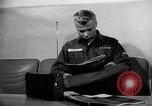
U.S. Army soldier reads newspaper while listening to radio. Soldiers doing their respective chores, listen to AFN (American Forces Network) Radio. General Marshall and General Eisenhower announce the creation of AFN, in 1942. July 4, 1943, the first broadcast of AFN. General Eisenhower mingling with paratroopers of the 101st Airborne Division, on the eve of D-day. U.S. B-26 aircraft in flight. United States soldiers aboard landing craft and wading ashore at Normandy, France, on D-day, June 6, 1944. Soldiers tuning radios in the field. United States Sherman tanks and infantry move along country road in France. Audio includes portions from AFN broadcasts, including an announcer saying "You are listening to AFN Paris. This is the American Forces Network, on the road to Berlin." Road sign points to St. Lo. Group of U.S. soldiers gathered around a jeep with a radio, listening to AFN, in Germany. (World War II period).
CRITICALPAST.COM: About Us | Contact Us | FAQs - How to Order | License Agreement | My Account | My Lightboxes | Shopping Cart | Advanced Search | Featured Collections | Website Terms & Conditions | Privacy Policy ©2026 CriticalPast LLC.
License Agreement |
Terms & Conditions |
Privacy Policy
©2026 CriticalPast LLC.