


 Francais
 Deutsch
 Italiano

Refine Your Search
Iserlohn Germany 1945 stock footage and images
- Showing 5311 to 5316 of 10470 results more
 Hide
Color Sound
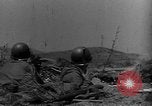
Preparations in England for the D-Day invasion of Normandy in World War II
World War 2 invasion of Normandy, France. President Franklin D. Roosevelt, Marshal Joseph Stalin, and Prime Minister Churchill, meeting at Tehran, Iran, in December 1943. U.S. Generals George Marshall and Hap Arnold, at conference table. Closeup of General Dwight D. Eisenhower. Map showing defense areas of the German 7th, 15th and 19th Armies in Europe. Map showing ports at Brest, Cherbourg, Le Havre, Dieppe, and Calais. Cherbourg is highlighted. U.S. Army trucks, tanks, and artillery, stockpiled in England. Railroad train carrying M3 Stuart tanks. U.S soldiers leaving troop ships and marching to their camps in Britain. Allied troops practicing amphibious assaults on Southern coast of England. Formation of B-26 bombers. View from Allied aircraft flying low over German-occupied area. B-17 aircraft dropping bombs over Germany. Bombs away view seen as bombs drop toward enemy targets. German fighter planes attacking B-17 bombers beginning in February 1944. Gunner in turret of B-17 firing at them. Dogfight views with German fighter aircraft. A B-17 exploding in the air. German fighter downed by B-17 gunner. Gun camera footage of German Bf 109 attacked from rear by gunfire. Just as it is hit it releases its drop tank. American soldiers in trucks, DUKWs, M4 tanks, and M8 armored Cars. Troops receive gas masks, waist life belts, field rations, and French money. May 30, 1944, American soldiers board tanks, trucks and other vehicles bound for embarkation points in England. Seen are Stuart M3 light tanks, jeeps, and M7 Priest tanks. M7 tanks are seen, equipped with intake and exhaust ducts. (At TC:11:39, U.S. M7 Priest tanks, equipped for deep wading, are seen passing the base of the Jubilee clock on the beachfront at Weymouth, on their way toward Castle Town in Portland for embarkation.) Transport ships are loaded at the embarkation ports. Trucks being backed onto LCT-453. U.S. Army infantry marching and boarding transport ships. Troops marching into LST 376 at Plymouth, England. Higgins Boats, from the USS Samuel Chase (APA-26) bringing troops to board her. Troops on deck of Attack transport, USS Joseph T. Dickman (APA-13). Barrage balloons overhead. Soldiers shooting craps on a troop ship deck. Coastguardsmen playing with a puppy dog. Gun crews on U.S. Navy warship being briefed. Soldiers field-strip and check their weapons.

Japanese girls wave Italian flags and dance with Axis emblem parasols at a theater in Japan.
Young Japanese women perform on a stage at a theater in Japan. Japanese dancing girls wave Italian flags on the stage. They dance with parasols (dance umbrellas) that are painted with Axis power country symbols of Japan, Germany, and Italy. The parasols have Nazi German, Italian, and Japanese emblems on them.
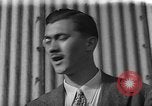
Author Leslie Charteris, a passenger on zeppelin Hindenburg's maiden voyage, tells of his experience.
Author Leslie Charteris (1907-1993), a passenger on zeppelin Hindenburg's maiden voyage, talks about his trip from Frankfurt, Germany aboard the airship. He says it is the most natural way to travel across the North Atlantic Ocean.

Father Paul Schulte describes the maiden North Atlantic voyage of the zeppelin Hindenburg at Lakehurst Naval Air Station.
Father Paul Schulte, a Roman Catholic priest from Germany, arriving at Lakehurst Naval Air Station aboard the German Zeppelin Hindenburg on the airship's maiden North Atlantic voyage, states that this is only his second trip to the United States. He would like to be able to have an airplane to explore "every nook and corner" of this country. He says "I don't like this country. I love it."

Rescue efforts and official persons being questioned after German Zeppelin Hindenburg disaster in Lakehurst, New Jersey.
Aerial views of the wreckage of German Zeppelin Hindenburg (D-LZ129) that crashed and burned while attempting to land at the U.S. Naval Air Station, Lakehurst, New Jersey, United States. Ambulances and other vehicles. Navy inspection board members walk around the zeppelin. Remains of the airship lying on ground. Ambassador of Germany Hans Luther walks down stairs and poses. Injured passenger being put into ambulances and transported From Lakehurst to major hospitals in New York City. Unharmed crew members at officer's mess of Naval station. Youngest crew member,13 year old Werner Franz, cabin boy on the Hindenburg, poses. U.S. Navy Commander Charles E. Rosendahl, head of the Naval Station being questioned by official from investigating committee of Bureau of Air Commerce Board. Inspection committee members seated.

Scenes of destruction from late 1939 in Finland during the Russo-Finish war
Film opens with a map of Europe showing black-shaded region of the Soviet Union, and pointing out Germany and Finland. Next, are shown moving images of rural buildings on fire in Finland, late in 1939, during the Russo-Finish war (or "Winter War"). (The Narrator comments that Finland's population was only 4 million while that of the soviets was 180 million.) Soviet bombers are seen high in the sky. A lone woman hurries along a street in Helsinki, Finland, past rubble of a bombed building. Smoke rises in the background. Finnish fire fighters man a hose to fight numerous huge fires in Helsinki.Various views of fires blazing in the capital.
CRITICALPAST.COM: About Us | Contact Us | FAQs - How to Order | License Agreement | My Account | My Lightboxes | Shopping Cart | Advanced Search | Featured Collections | Website Terms & Conditions | Privacy Policy ©2026 CriticalPast LLC.
License Agreement |
Terms & Conditions |
Privacy Policy
©2026 CriticalPast LLC.