


 Francais
 Deutsch
 Italiano
Refine Your Search
John-F.-Kennedy stock footage and images
- Showing 1321 to 1326 of 3759 results more
more Hide
Hide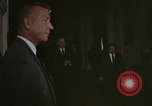
U.S. President Lyndon B. Johnson addresses the press and then signs the Civil Rights Act in Washington D.C.
U.S. President Lyndon B. Johnson at a Press Conference and signing ceremony in Washington D.C. , United States. Officials converse with each other. Press reporters preparing before the press conference. President Johnson speaks into a microphone. Reporters take notes. Photographers take pictures. People watch the President on television. President Johnson signs the Civil Rights Act. Nearby officials include Hubert Humphrey, Everett Dirksen, Martin Luther King Jr., Robert Kennedy. Officials shake hands with the President. Close views of smiling officials greeting the President after the signing, some holding pens that the President used in the signing. Martin Luther King Jr smiles and speaks to a woman present after the ceremony. Men and women buy and read newspapers at a city newsstand.
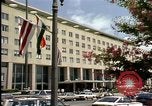
Indian PM, Gandhi visits House of Representatives and attend the formal state dinner hosted by President Reagan in the U.S.
Prime Minister (PM) of India, Indira Gandhi visits United States for better understanding and friendship between the two countries. Flag on a pole in front of the State Department building. PM Gandhi arrives and meets the U.S. Secretary of State George Pratt Shultz for discussing Nuclear Power matter. View of Capitol Hill. She signs the Foreign Affairs Committee book and receives a gift by representatives at Capitol Hill. PM Gandhi being introduced to guests at House of Representatives. One U.S. representative delivers a speech about the relationships with India. Prime Minister Gandhi delivers a speech. She visits the upper house with representatives. She attends the meeting of Senate Foreign Committee. Prime Minister Gandhi meets Senator Edward Kennedy. Photographers take photos. The formal state dinner hosted by President Reagan at the White House. President Reagan and Mrs Reagan greet Prime Minister Gandhi. President Reagan, Mrs Reagan and PM Gandhi pose for camera. They walk along with a band.
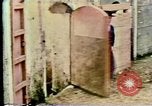
CIA and other U.S. sponsored experiments dealing with control of animals and people using various techniques during the 1960s and 70s.
In 1964, Professor Jose M.R. Delgado, of Yale University's School of Medicine, invented a device he called a stimoceiver. It was a chip that could alter the brain’s electrical impulses via radio signal. In tests sponsored by the U.S. Office of Naval Research, he implanted the device in the brain of a bull. This film opens shows that experiment and its results. A man in Cordova, Spain, opens a bull ring door to allow a fighting bull to enter. It charges a man holding a cape. Another man fires a dart to sedate the bull. Several men plant electrodes for a stimoceiver in the bull's brain. Next, the bull charges a man holding a cape, but pulls up short before hurting him. The bull chases the cape but never attacks the man as the man uses remote control to influence the animal's behavior. The bull charges around in a circle. Scene shifts to Dolley Madison Parkway (Route 123 in Mclean, Virginia, where sign points toward the CIA headquarters at Langley, Virginia. Narrator lists various techniques examined in the 60s and 70s, including brain surgery; psychosurgery; creation of amnesia; parapsychology; and manipulation of genes. Glimpse of some facilities at CIA headquarters. Change of scene to hearing of the Senate Subcommittee on Health and Scientific Research on September 20, 1977. Chaired by Senator Edward M. Kennedy, the Committee sought information about these activities by the CIA. Narrator says witnesses had agreed to limit information they would provide the Subcommittee. Former narcotics officer Charles Siragusa is seen on camera admitting that the man he reported to at the CIA wanted him not to say anything. Former CIA chemist Robert V. Lashbrook is seen testifying that he has no knowledge about the CIA running safe houses. (Narrator states he ran one of them and that a "surprise LSD experiment" was conducted there.) Scene shifts to a California tennis court, where Dr. Sidney Gottlieb is playing doubles tennis, Narrator says he oversaw those activities at the CIA but destroyed all his records when he retired in 1973. View of a letter he wrote at that time, in which he states he and his colleagues had been able to maintain contact with the leading edge of chemical and biological developments in the field of biological and chemical control of human behavior. View of Dr. Gottlieb entering an ante room where he testified before the Senate Subcommittee on Health and Scientific Research without being filmed because of what his lawyer claimed were health and cardiac problems. View of him on the tennis courts as Narrator states he declined ABC News requests for an interview. Change of scene to George White who retired from the CIA and lives in Stinson Beach, California. View of Stinson Beach from high overlooking vantage point. People jogging on the beach. Narrator states that White wrote to Dr. Gottlieb summing up his career saying, "it was fun fun fun, and where else could a red-blooded American boy lie, kill, and cheat, steal, deceive, rape, and pillage, with the sanction and blessing of the All Highest." Narrator strolls on lawn near the U.S. Capitol building and says it appears doubtful that mind control has been achieved. But work, that we don't know very much about, is continuing in this field. He asks how deeply are the Russians and other dictatorships into this. He notes that the CIA is reluctant to give information about it (such as Project MKUltra) and he questions where such a program fits in a democracy. He notes that one person working on these projects told him there are capable, conscientious, and very capable scientists working for our country, and "their work speaks for itself."
First Director of Peace Corps, Sargent Shriver interviewed in Washington DC, United States.
A Television series 'Your man in Washington'. Reporters Len O' Connor and Art Barriault interview the First Director of Peace Corps, Robert Sargent Shriver. During the interview Shriver explains how the idea for Peace Corps was put forward by President Kennedy during his election campaign. He says that Peace Corps consists of 1000 people and it serves in 13 countries across the globe. He also expresses hope that Congress will sanction a bigger chunk of money for the expansion of the Peace Corps.
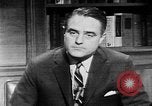
Robert Sargent Shriver interviewed in Washington DC, United States.
Len O' Connor of WNBQ interviews the First Director of Peace Corps, Robert Sargent Shriver. On being asked does he think there are too many Kennedy's in the public office, he disagrees. Shriver instead says that there is a dearth of qualified people capable of holding public offices and if people are qualified enough their surnames should not be an issue.

Sargent Shriver delivers a speech in New York, United States.
Robert Sargent Shriver, Director of Peace Corps, speaking in New York, United States.He talks about visiting Peace Corps sites all over the world and mentions that President Johnson asked him to convey his greetings to various world leaders during these visits, including one to the Pope who was visiting Israel. Of that he says:"When a Southern Prostestant President sends a Northern Roman Catholic (that was me) to deliver a message to an Italian Pope, in Jeruselem, that's the sign of an election year." He narrates several other illustrations of America's unique and improving tolerance regarding religion and race relations. And he narrates an amusing incident that took place with President Kennedy when he was campaigning for his election as a President, .
CRITICALPAST.COM: About Us | Contact Us | FAQs - How to Order | License Agreement | My Account | My Lightboxes | Shopping Cart | Advanced Search | Featured Collections | Website Terms & Conditions | Privacy Policy ©2026 CriticalPast LLC.
License Agreement |
Terms & Conditions |
Privacy Policy
©2026 CriticalPast LLC.