


 Francais
 Deutsch
 Italiano
Refine Your Search
John-F.-Kennedy stock footage and images
- Showing 1381 to 1386 of 3759 results more
more Hide
Hide
U.S. Navy F-4J Phantom II aircraft takeoff and crash in St. Louis, Missouri; Firemen fight fire engulfing crashed aircraft
U.S. Navy McDonnell Douglas F-4 Phantom II crashes at St. Louis, Missouri. It was test flight #155557 MAC 2833. The F-4J aircraft taxis for take off, lifts off and climbs steeply. Pilot and co-pilot eject. (Both survived: Pilot C. D. "Pete" Pilcher, Production Test Pilot, McDonnell Douglas Corporation; and Radar Observer Harvey A. Begay in backseat position.) Plane moves flatly through air in vertical position. It loses all speed. Aircraft falls flatly, impacts runway and explodes into a huge fireball. Black smoke billows up from impact area. Plane continues to burn. F-4J ablaze. Crash crew makes way to fire. Ambulance on ground. Pilot Pilcher and Radar Observer Begay meet-up together with other personnel on the airfield and observe the blazing aircraft from which they had ejected. They walk around a military station wagon. The two crew members examine ejection seat on runway. Ejection seat resting on runway. Two pilots get into a station wagon with other civilian personnel. Collapsed chute laying on grass. View of ejection seat. Blown canopy, other debris lying about runway in the background. F-4J still ablaze. Fire engine enters and moves down a runway. Firemen wade knee-deep through foam while fighting fire. Heavy smoke rises from wreckage. Crashed F-4J, heavy foam in the foreground. Fireman direct more foam into opening of F-4J while smoke is pouring out.

A U.S. Navy F8U-1 Crusader fighter plane takes off to show flight operations at different knots in the United States.
A training film based on flight operations of U.S. Navy F8U-1 Crusader fighter aircraft in the United States. An F8U-1 taxis and takes off from a runway. A pilot at the instrument panel of the F8U-1 in the cockpit. The F8U-1 taxis and takes off to show working of rudder, retracting of landing gear, lowering of wings at various levels of speed. The pilot moves the wing incidence handle to down position and brings lock handle to lock handle. Switches are turned on the instrument panel. The F8U-1 at high altitude. The exhaust temperature meter and the oil pressure meter of the F8U-1.

A missile being fired at a target from U.S. Navy F8U-1 Crusader fighter plane, United States.
Training film about APS-67 Radar operating system and an intercept mission by U.S. Navy F8U-1 Crusader fighter aircraft, United States. F8U-1E and F8U-2 in flight. APS-67 Radar installation shows intercept and attack procedures. F8U-1 in flight. Pilot turns radar function switch in stand by mode and radar gain all the way down. Brilliance control being adjusted before artificial horizon is achieved. FTC switch being turned to normal and tune knob is set to auto by pilot to achieve automatic radar tuning. Pilot presses test button. Radar scope in view. Master command switch is turned on. Radar is operated in search mode. Animation details intercept operation. F8U -1 in flight. Target appears on a radar scope. Artificial horizon seen on a radar scope. Pilot adjusts minimum range control. Radar scope shows exact position of target. Animation depicts the target. Missile being fired from F8U-1. Target explodes.
Formation of seven F-86s flying overhead and aerial action against MiG-15 in Korea.
United States F-86 aircraft in dogfight combat against a MIG-15 in Korea. Two F-86s take off from airfield in Korea. Formation of seven F-86s flying overhead, first flight four, second flight three. Gun camera views from F-86 engaging Mikoyan-Gurevich MiG-15, jet fighter aircraft. F-86 making fast climb. F-86 in flight executes a victory roll. (Korean War)
A U.S. pilot prepares to fly an O-1F Bird Dog liaison aircraft of U.S. 23rd Tactical Air Support Squadron in Vietnam.
A film based on U.S. Air Force O-1F Bird Dog liaison aircraft FAC (forward air control) operations against the Ho Chi Minh Trail by U.S. 23rd Tactical Air Support Squadron in Vietnam during the Vietnam War. Lieutenant Colonel William F. Bretzius and 1st Lieutenant Richard S. Kroll walk towards an O-1F aircraft and talk together beside the aircraft. Lieutenant Colonel Bretzius prepares for a flight in the cockpit of the O-1F aircraft. The O-1F engine starts and stops. Airmen push the O-1F aircraft into parking position.
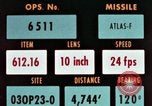
Atlas-F missile rocket launch, in-flight with thick white exhaust plume
An Atlas-F missile rocket launch in the United States. Missile launch site is stated as “03OP23-0” Smoke emits from the Atlas-F missile rocket as it prepares to launch in launch tower. Crane folds back upon launching of the Atlas-F missile. The Atlas-F missile rocket launches with smooth ascension. The Atlas-F’s exhaust plume is thick with white smoke. The Atlas-F ascents in-flight with white exhaust plume before it disappears into the blue sky.
CRITICALPAST.COM: About Us | Contact Us | FAQs - How to Order | License Agreement | My Account | My Lightboxes | Shopping Cart | Advanced Search | Featured Collections | Website Terms & Conditions | Privacy Policy ©2026 CriticalPast LLC.
License Agreement |
Terms & Conditions |
Privacy Policy
©2026 CriticalPast LLC.