


 Francais
 Deutsch
 Italiano
Refine Your Search
John-F.-Kennedy stock footage and images
- Showing 1963 to 1968 of 3759 results more
more Hide
Hide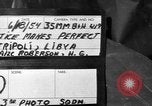
Dust rises due to fire passes from an F-86 Sabre in flight over Libya.
Aircraft in flight over Libya. A ground target area. Dust rises due to fire passes. A United States Air Force F-86 Sabre dives at the ground target.
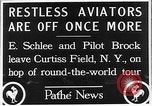
Aviators Edward F Schlee and William S. "Billy" Brock fly their 'Pride of Detroit' aircraft in North America.
The history of famous airplanes. Aviators Edward F Schlee and William S. "Billy" Brock at Curtiss Field in New York, United States. An aircraft parked on the airfield. Brock and Schlee stand beside the aircraft. Pilot Brock's head protrudes from the pilot's compartment of the airplane. 'Miss Wayco' painted on the nose section of the airplane. The pilot waves towards the spectators. Stinson monoplane model, 'Pride of Detroit' aircraft flown by the two men. The aircraft takes off. The two men stand beside their airplane at Harbor Grace in Newfoundland. Men work on their aircraft. A tarpaulin lying over the top of engine for protection. Men pour fuel in the wing tanks from five gallon containers. A man works on the engine. Spectators gather around the airplane. The aircraft takes off from Newfoundland. Spectators perched upon a hill nearby.
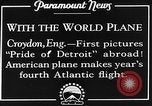
U.S. aviators Edward F Schlee and William S. "Billy" Brock stand near 'Pride of Detroit' airplane in Croydon, England.
The history of famous airplanes. U.S. aviators Edward F Schlee and William S. "Billy" Brock in Croydon, England. One of the men gets out of the 'Pride of Detroit' airplane. Men being interviewed by the spectators and press in England. Spectators grouped around the airplane. Brock and Schlee pose.
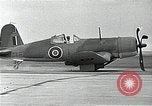
British Royal Navy F4U Corsair airplane makes emergency gear-up landing at NAS New York during World War II
Film opens with a Corsair F4U aircraft making a smooth gear- up emergency landing on a runway at the U.S. Naval Air Station New York (Floyd Bennett field) in World War 2. "Royal Navy, JT 229" is stenciled on the rear of its fuselage, identifying it as belonging to that Squadron. The canopy is open and other than for the landing gear malfunction, the pilot and aircraft appear OK. The Corsair's three-bladed propeller is bent and its engine is shut down. The runway appears to have been foamed, and bits of it are raised as the aircraft slides forward. After the aircraft stops, the cameraman moves, and takes up again as firefighters who were already standing by, respond with protective gear and a hose, ready to employ more foam, if necessary. However, the cockpit is empty and a sailor and the plane captain are already checking over the airplane, as firefighters get set up. It is clear they are not needed.
A pilot checks the physical condition and latest modification techniques of an F-105D in the United States.
A pilot and his crew inspect a F-105D aircraft for flight safety in the United States. A pilot stands beside the aircraft. The first task is to assess the condition of prime areas of the airplane. The pilot checks the physical condition of the aircraft. He checks tires of the aircraft and angle of free movement. Access doors are secured. Hydraulic lines and cables and many other things are checked. Crew checks landing light, safety pin, gears are in good condition. Wing tip is inspected. Engine access door are secured. The bomb bay doors are in a good condition. Interior and exterior of the tail pipe is checked and a compartment door is secured. The pilot and the crew check the left side of the aircraft. The left wing is inspected. Heat exchangers are inspected. Top service inspection is done and canopy is checked: seat arm vest, ejection seat, safety pin are installed and whole sitting is inspected. Interior: Bomb bay door handle and various dials of controls in the cockpit are checked. Seat belt and oxygen mask are checked. The pilot dons a helmet. After the engine starts, the crew checks the hydraulic system. Every phase is checked for safe return of the pilot and the aircraft.
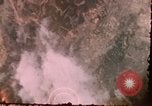
Ground installations are targeted by an F-105 Thunderchief in Vietnam during the Vietnam War.
View through gun camera target during the Vietnam War. USAF Republic F-105 Thunderchief in flight over a target area. Red target display center of frame as the aircraft targets the ground for firing. Smoke rises from explosions.
CRITICALPAST.COM: About Us | Contact Us | FAQs - How to Order | License Agreement | My Account | My Lightboxes | Shopping Cart | Advanced Search | Featured Collections | Website Terms & Conditions | Privacy Policy ©2026 CriticalPast LLC.
License Agreement |
Terms & Conditions |
Privacy Policy
©2026 CriticalPast LLC.