


 Francais
 Deutsch
 Italiano

Refine Your Search
John-F.-Kennedy stock footage and images
- Showing 2119 to 2124 of 3762 results more
 Hide
Color Sound

Construction materials made in factories and the construction of the Golden Gate Bridge in the United States.
A historical documentary about German born civil engineer John Augustus Roebling's early experimentation with wire rope suspension bridges in the United States. A suspension bridge. A railroad on tracks. The smoke stacks of John Augustus Roebling's factories. Hot molten metal in containers. Hot metal rods in a factory. Wires being made in the factory. A man operates a machine. A weaving machine in operation. A worker wearing protective gear welds using a welding torch. Insulated wires made on a machine. A rope on the roller of a machine. Flasks in a laboratory. Men work on a wire testing apparatus. A tank atop a factory. The Golden Gate Bridge. Animation depicts the principles of the construction of suspension bridges. The animation depicts the principle of the construction of the Golden Gate Bridge. Aerial view of the bridge under construction. Water gushing beneath the bridge. Machines at operation during the construction of the Golden Gate Bridge. A steel structure is erected. Barges in a river. Towers made for the bridge. Construction material hoisted a tower.
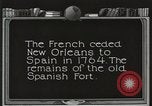
Ruins of the Old Spanish Fort and two men sit with legs in the stockade in New Orleans, Louisiana.
Scenes from the city of New Orleans in Louisiana, United States. Ruins of the old Spanish Fort at the Bayou St. John on Lake Ponchartrain, also sometimes called Fort St. Jean or Fort St. John, or Fort San Juan del Bayou. Tourists walking in the old fort area, and view of an old cannon in the fort grounds. Exterior view of the city arsenal at 615 St. Peter Street directly behind the Oabildo. The arsenal is on the site of a former Spanish prison. It was war designated in 1915 to be the relic department of the Louisiana State Museum, and dedicated as a "Battle Abbey." View inside the arsenal, where two African American men are seated on the ground with their legs in the stockades or stocks to demonstrate their operation.
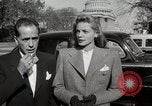
Hollywood stars visit Washington, DC, to voice their objections about proceedings of the House Unamerican Activities Committee (HUAC)
Hollywood stars (members of the newly formed, Committee for the First Amendment) visit Washington D.C. to express their objections to the actions of the House Unamerican Activities Committee (HUAC). Opening scene shows movie stars Humphrey Bogart and Lauren Bacall on a sidewalk at Indendence Avenue in Washington, DC, Southeast of the Capitol building which is seen behind them. A police car is parked at the curb and an officer is standing in the street. Next, they are seen posing with Hollywood personalities, including Danny Kaye and June Havoc, among others. Views of the group from different angles, and from behind a group of photographers taking pictures. Then they begin to walk towards the location of the HUAC hearings, with Bogart and Bacall in the lead. They proceed up the steps of the building. Scene shifts to the hearing room inside, where Screen writer, John Howard Lawson, is being sworn in. He begins to testify. During his testimony, the Chairman, Representative John Parnell Thomas, of New Jersey, finds it neccessary to gavel for order and appears to berate the witness. Lawson leaves the witness chair and departs. Another view of the hearing room.
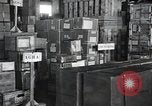
War supplies from different parts of the world, construction of shipyards, and building war ships in the United States.
War equipment and ships built in industries of the United States during World War II. Crates containing war supplies from all over the world stacked. Massive large columns of United States Army Soldiers and huge columns of United States Navy sailors in review, marching and standing in formation. Men work on the construction of shipyards and ships in shipyards. War production workers work on different machines to make and assemble ship parts. A crane lifts a part of a warship to be assembled. Men wearing protective masks do arc welding on parts of ships. A line of ships at dock. Scenes of many different cargo ships, Liberty Ships, battleships, cruisers, submarines, destroyers and aircraft carriers launched. Some of the ship names seen include: SS Zebulon Pike, SS Patrick Henry, SS John C Fremont, SS John Fitch, SS Ethan Allen, SS Mormacwren, SS Irving S Olds, a ship of the Lykes Lines, the U.S. Navy destroyer USS Bristol (DD 453), USS Hancock (CV-19), Men walk down the steps towards the ships. Men load supplies onto ship. Soldiers board transport ships. A Soviet cargo ship with a large flag "USSR" on it. A convoy of ships at sea.

Retired General Pershing supports destroyers for bases deal; Charles Lindbergh supports U.S.neutrality in World War 2.
Prominent Americans with opposing pro-war versus anti-war messages early in World War 2. Retired U.S. General of the Army, John J. Pershing and Colonel Charles A. Lindbergh, express opposing sentiments in public statements. The 79 years old U.S. Army officer General John J. Pershing seated at a desk and speaks into a microphone. He speaks in support of the so-called "Destroyers for Bases" initiative of the Roosevelt administration (without using that term). Among his opening remarks, he states,"With democracy and liberty overthrown on the Continent of Europe, only the British are left to defend democracy and liberty ...." In contrast, speaking at a rally at Soldier Field in Chicago, sponsored by the "Committee to Keep America Out of War," Colonel Charles A. Lindbergh argues against American involvement in World War II.

Celebrities attend a party celebrating the return of Constance Bennett to Hollywood
Celebrities welcome American actress Constance Bennett back to Hollywood. A party takes place on the set of ‘Madame X’. Cameraman filming the party. Constance Bennett smokes a cigarette. Hollywood actress Lana Turner is accompanied by her husband, Robert P. Eaton. An American actress Sandra Dee with her husband Bobby Darin. Mexican actor Ricardo Montalbán talks to an actress. Hollywood film producer Ross Hunter and his friend Mervyn LeRoy at the party. LeRoy greets Bennett with a kiss. Universal President Milton Rackmill meets Sandra Dee. A Japanese American actress Miiko Taka with actor James Shigeta. A Dutch actor John van Dreelen and an American actor John Forsythe stand together and talks to each other.
CRITICALPAST.COM: About Us | Contact Us | FAQs - How to Order | License Agreement | My Account | My Lightboxes | Shopping Cart | Advanced Search | Featured Collections | Website Terms & Conditions | Privacy Policy ©2026 CriticalPast LLC.
License Agreement |
Terms & Conditions |
Privacy Policy
©2026 CriticalPast LLC.