


 Francais
 Deutsch
 Italiano
Refine Your Search
John-F.-Kennedy stock footage and images
- Showing 2155 to 2160 of 3759 results more
more Hide
Hide
B-8 bomb being lifted up into the YF-105A Thunderchief fighter bomber bomb bay and in flight in the United States.
Development progress report of U.S. F-105 Thunderchief fighter bomber in the United States. U.S. Air Force YF-105A Thunderchief being towed. Republic maintenance men work on TF-105B on a ramp. The emergency hydraulic ram air turbine being extended from fuselage and then retracted. A bluff-shaped B-1 bomb being towed out and positioned under YF-105 on the ramp. Bluff-shaped B-8 bomb being lifted up into the YF-105A bomb bay. YF-105A taxis at the Edwards Air Force Base. Flyover of YF-105A. The wing tips and horizontal stabilizers being coated with high visibility paint. YF-105A in flight. A bomb bay and bluff shaped B-8 bomb drops towards the ground. Artwork depicts position change of the horizontal stabilizers. F-105B on dry lake bed after landing gear failure during the first flight. A truck mounted crane lifts the F-105B off the dry lake bed. F-105B with gear extended being towed by a tug on the dry lake bed. Two airmen work in the control room at the Edwards Air Force Base. A F-105B turns to the left and taxis towards the runway. Airmen work in the control tower. F-105 B taxis and takes off and retracting its landing gear. F-105 climbs after the take off.
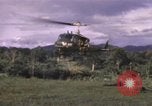
U.S. Special Forces and 20th Helicopter Squadron personnel catch a Vietcong suspect in a Vietnamese village.
U.S. 20th Helicopter Squadron, Special Forces personnel and Montagnard troops aboard U.S. Army UH-1F Iroquois helicopters en route to a remote village in Vietnam to pick up a suspected Vietcong prisoner during the Vietnam War. Troops leave a UH-1F helicopter as it lands. They run into a jungle. The UH-1F helicopter takes off. The UH-1F unloading troops. Special Forces personnel and Montagnard troops enter the village and bring the prisoner from a hut to the UH-1F. More troops leave the UH-1F. The UH-1F takes off. Aerial view of the village. UH-1Fs land on the field and troops leave a helicopter. Suspected Vietcong prisoner is marched by a Special Forces personnel. UH-1Fs take off.
U.S. Navy task force attacks Japanese-held Peleliu, Palau Islands, during World War II
Scenes from U.S. Office of War Information film called, "Fury in the Pacific." Clouds silhouetted at sunset or sunrise, over Peleliu Island, as seen from a ship during World War 2. View of Japanese airfield at Peleliu, from U.S. reconnaissance airplane flying overhead. U.S. Navy ordnance crewman wheels a 500 lb bomb, on a dolley, across the flight deck of an aircraft carrier. Other "red shirts" load a 500 pound bombs on an F6F aircraft. Marines loading machine gun belt ammunition into an airplane. Pilots scrambling across the flight deck to their aircraft. Engines starting on a large group of Navy F6F aircraft on the carrier deck. F6Fs taking off from carrier. SB2C Hellcat taking off. View back from tail of aircraft showing Essex-class carrier behind. Formations of SB2Cs and F6Fs in flight headed toward Peleliu. View from air of the Japanese airfield. Smoke rising from the ground. Formation of U.S. Army Air Force B-24 Liberator bombers of the Far Eastern Air Force, in flight overhead. Pilot and copilot in cockpit of a B-24. Navigator at his station. Aerial view of B-24 formation. Waist gunner manning gun in B-24. Bombardier in nose. Bombs falling away and striking all over the Japanese airfield. Anchors being weighed on warship. Sailors in control room of a U.S. warship. View of two New Mexico class battleships, one in camouflage. Three U.S. battleships in single file. the closest carries two Curtiss SOC Seagull scout planes. Sailors cleaning barrel of a war ship's gun. Glimpses of warships and transport ships of the invasion convoy.

U.S. Navy training film about escape from ditched modern jet fighters that sink faster than the old propeller airplanes
An F6F Hellcat ditches in the sea. It floats long enough to allow pilot to abandon it before sinking. Next an A-4 Skyhawk ditches. Narrator remarks about the short time for escape from such aircraft on the surface of the water. Views of tests conducted by the U.S. Navy to test the sink rates of jet aircraft from various heights and attitudes. A dummy is placed in the cockpit of a derelict F9F Panther, which is lifted by a crane and is dropped into water from a low height. It is seen floating. (Narrator states that even with no structural damage, it sinks in less than a minute.) Next an FJ-2 Fury is dropped from about 55 feet. Due to structural damage, narrator states such an aircraft may sink in a few seconds, and generally between zero to 55 seconds. View of crane operator and then of an airplane sinking rapidly. Scene shifts to James F. Roth of U.S. Navy Attack Squadron 42,(VA-42) the "Green Pawns," in the closed cockpit of a Navy jet airplane. Next, an F-4 phantom jet is seen being catapulted from an aircraft carrier. Animation shows that the airplane falling into the sea right after takeoff will sink ballistically and can descend as deep as 100 feet in 10 seconds.
USAF aircraft at an AFB on the Eniwetok Atoll in Marshall Island,Pacific Ocean.
Nuclear detonation on Bikini Atoll in the Pacific Ocean as part of the Operation Red Wing. A resultant mushroom cloud. Scenes of landing of several United States Air Force aircraft like B-52, B-47,B-66, B-57 on a United States AFB situated on the Eniwetok atoll (sometimes spelled Enewetak or Eniewetok) in Marshall Islands. Shows the aircraft carrier USS Badoeng Strait in Northwestern Pacific Ocean. Several US-airplanes like F-84F, F-101, B-52 and B-36 can be seen on the AFB. Maintenance crew can be seen working on a B-52's (Stratofortress) engines. Men working on the nose and wing section of a F-101 Voodoo. Technician working on the F-101's electronics equipment, opens its nose dome to reveal photo panel radiation gauges. Airman removes motion picture camera from the nose of F101. Technicians work at the instrumental panel of a B-57. Radiometer attached at tail section of B-66. Technician removes dust for radiation sample. Technicians work on the horizontal stabilizer of B-47 tail section.
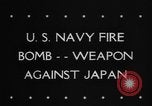
Public demonstration of "fire bomb" and its use supporting U.S. Marines in the Battle of Peleliu in World War II
A U.S. Navy F6F Hellcat airplane is seen parked on a ramp, with a bomb slung under its fuselage. The narrator identifies it as a "fire bomb," containing gel gasoline. Scene shifts to an F6F dropping one from several thousand feet, in a demonstration. The incendiary bomb creates a swath of fire along the ground, in the direction of flight. A flight of two F6Fs repeat the demonstration, dropping their bombs simultaneously, from a formation. Another drops a bomb on a pier at a waterfront. View to the rear from an airplane that just dropped a bomb in a wooded area. Views of actual U.S. 1st Marine Division operations on Peleliu, Palau Islands, during World War 2, showing F4U Corsair aircraft, flying low and slow, with gear down, dropping napalm incendiary bombs on Japanese troops dug in on a ridge. View of smoke rising from bomb strikes at targets near a river.
CRITICALPAST.COM: About Us | Contact Us | FAQs - How to Order | License Agreement | My Account | My Lightboxes | Shopping Cart | Advanced Search | Featured Collections | Website Terms & Conditions | Privacy Policy ©2026 CriticalPast LLC.
License Agreement |
Terms & Conditions |
Privacy Policy
©2026 CriticalPast LLC.